
Non-FictionSelf-HelpShort-Form Video
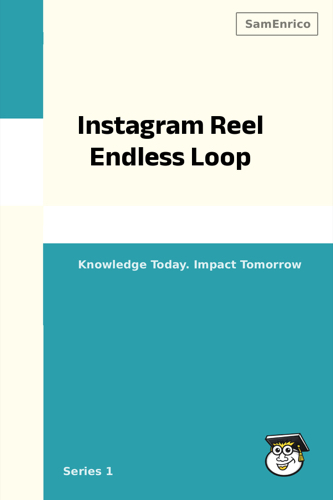
Instagram Reel Endless Loop eBook
Breaks short video scrolling with environment cues
Breaks short video scrolling with environment cues and time limits.
Formats
Free sample
Chapter 1: The Hidden Tax...--–- You are being robbed. Not by a stranger in a dark alley, not by a hacker on a distant continent, and not by the government taking its share from your paycheck. You are being robbed by a free application on a rectangular slab of glass and aluminum that you willingly carry in your pocket every single day. The robber does not wear a mask. It does not brandish a weapon.
It steals from you using the most effective technique ever devised: it makes you want to be stolen from.The currency of this robbery is not money, though money is certainly part of the equation. Tech companies convert your attention into advertising revenue at a rate of roughly twenty dollars per hour of your screen time. If you spend two hours per day on Instagram—the average for American users—you are generating nearly fifteen thousand dollars of value for Meta every single year. You see none of that money. You receive no dividend check.
You are not a customer of Instagram; you are the product being sold.But the true cost of the Endless Loop is not measured in dollars. It is measured in the slow erosion of something far more precious: your ability to direct your own attention, to choose what you think about, to decide how you spend the hours of your one and only life. Every minute you spend inside the Reels player is a minute stolen from something else—from a conversation with your child, from the first chapter of a novel, from a walk in the park, from the quiet emptiness that allows new ideas to germinate. The thief is efficient, relentless, and invisible. You do not see it coming.
You do not feel it taking. You only notice the absence afterward, when the evening is gone and you cannot remember what you watched.This chapter exists to make the invisible visible. It will name the mechanism that keeps you scrolling. It will show you the neurological trap that has been laid beneath your feet. And it will introduce the first environmental intervention of this book: a simple red card that interrupts the autopilot loop before it can begin.
By the time you finish reading, you will understand exactly what is being stolen from you and how to take the first step toward taking it back.The Most Expensive Free Lunch in History In 1895, a mechanic named Charles Fey built the first true slot machine in his San Francisco workshop. He called it the Liberty Bell, and it featured three spinning reels, five symbols, and a simple mechanism for dispensing coins. Within a decade, slot machines had spread across the United States, and within a century, they had evolved into the sophisticated digital gambling terminals that now generate more than thirty billion dollars in annual revenue for the casino industry.The slot machine is often called the most profitable invention in the history of gambling, and for good reason. It extracts money from players at a rate that would seem impossible if you didn't understand the psychology behind it. The secret is not complexity.
The secret is not deception. The secret is a simple pattern of reward that exploits a fundamental feature of the mammalian brain: the variable ratio schedule of reinforcement.Here is how it works. If a hungry rat presses a lever and receives a food pellet every single time, the rat will press the lever at a steady, predictable rate. When the food stops coming, the rat will quickly lose interest and go looking for food elsewhere. But if the rat presses the lever and receives a food pellet sometimes—randomly, unpredictably, with no fixed pattern—something remarkable happens.
The rat presses the lever faster. It presses with greater persistence. It ignores other sources of food. And when the pellets stop entirely, the rat keeps pressing for an astonishingly long time, unable to accept that the game has ended.This is the variable ratio schedule. It is the psychological engine that powers every slot machine, every lottery ticket, every scratch-off card, and every randomized reward system ever created.
And in 2018, when Instagram introduced the Reels feature, the company imported this same engine directly into the pocket of every user on the planet.A slot machine pays out in coins. Instagram Reels pay out in dopamine. But the mechanism is identical. You swipe up. You see a video.
Most of the videos are forgettable—a stranger's vacation, a recipe you will never cook, a dance you would never attempt. But occasionally, unpredictably, the machine pays out. A video makes you laugh. A video teaches you something useful. A video shows you a face that stirs an old emotion.
You feel a small rush of pleasure, a tiny spike of the neurotransmitter that your brain uses to encode reward and motivation. And you think: That was worth it.Except it wasn't. Because the cost of those rare moments of delight is measured in the hours of your life that disappear between swipes. And because your brain has now been trained to expect unpredictable rewards, you will keep swiping long after the pleasure has faded, chasing a high that becomes harder and harder to catch.The Pain-Pleasant Balance: Why Everything Else Feels Slow Dr. Anna Lembke, a psychiatrist at Stanford University School of Medicine and the author of the best-selling book Dopamine Nation, has spent her career studying the neuroscience of addiction.
Her central insight is simple but profound: the brain maintains a natural balance between pleasure and pain. When you experience something pleasurable, the pleasure side of the scale tips down, and the brain compensates by tipping the pain side up. You feel a comedown, a letdown, a small withdrawal. Then the scale returns to equilibrium.This is normal. This is healthy.
The problem begins when you pursue pleasure too relentlessly. If you flood your brain with dopamine over and over, hour after hour, your brain adapts by lowering the pleasure side of the scale permanently. It down-regulates your dopamine receptors. It becomes less sensitive to reward. What once felt like a seven out of ten now feels like a four.
What once felt like a four now feels like a two. Your baseline level of happiness drops, and you need more stimulation just to feel normal.This is tolerance. This is addiction. And it happens with Reels just as surely as it happens with cocaine, alcohol, or gambling.The average Instagram user spends more than two hours per day on the platform. For heavy users, that number climbs to four, five, or even six hours.
Every swipe delivers a small pulse of dopamine. Every new video offers the possibility of a reward. Over weeks and months, your brain's pleasure balance tilts dramatically toward pain. The baseline level of dopamine in your system drops. You start to feel vaguely unhappy when you are not scrolling.
Real life—with its slow rhythms, its long pauses, its unpredictable frustrations—begins to feel unbearable by comparison.This is why you reach for your phone during the ten seconds it takes for your coffee to finish brewing. This is why you check Instagram while…
This is the end of the free sample. Get the eBook to keep going. Buy now
About this book
Details
- Author
- Breaux Wilford
- Publisher
- SamEnrico
- Language
- English
- Genre
- Non-Fiction, Self-Help, Short-Form Video
- Released
- 2026-06-07
- Pages (approx.)
- 151
- Available as
- eBook, Audiobook

Read better in the ZLOADR app
Your eBooks on your phone or tablet. Sign in with your SamEnrico account and start reading.
More by Breaux Wilford
 The Mural Artist StoryBreaux Wilford$11.99
 Growth Mindset for HR ProsBreaux Wilford$11.99
 Depression Partner Support GuideBreaux Wilford$11.99
 Multiple App Simultaneous UseBreaux Wilford$11.99
 Graham Number GuideBreaux Wilford$11.99
 Forgiveness for In LawsBreaux Wilford$11.99
 Cult Adjacent Fringe GroupsBreaux Wilford$11.99
 Whispers of the Wild: The Raven King’s CodeBreaux Wilford$11.99
 The Siege of Robben Island: The Prison Gang War That Shocked South Africa (1960-1963)Breaux Wilford$11.99
 Service Providers Guide to Errand ServicesBreaux Wilford$11.99
 Venture Debt for FintechBreaux Wilford$12.99
 Cooperative Audit RequirementsBreaux Wilford$12.99
You may also like
 Hong Kong Handover 1997Dunn Johnnie$11.99
 Zumba For Postnatal Recovery CourseNeal Christian$11.99
 Zumba for BeginnersLadner Nikia$11.99
 YouTube Comment Mining GuideHumes Pandora$12.99
 Worry Box MeditationCarlin Rudy$11.99
 Workplace Stress MeditationNguyen Lynn$11.99
 Workplace Stress and Sleep RepairHawley Ivory$11.99
 Workplace Perfectionism CureDelaney Jeffry$11.99
 Workplace Injustice Anger GuideWallen Isabelle$11.99
 Work Addiction and Burnout LinkGreenwood Ester$11.99
 Women in Yoga and WellnessBeattie Galina$11.99
 Women in Stand Up ComedyChun Evangeline$11.99