
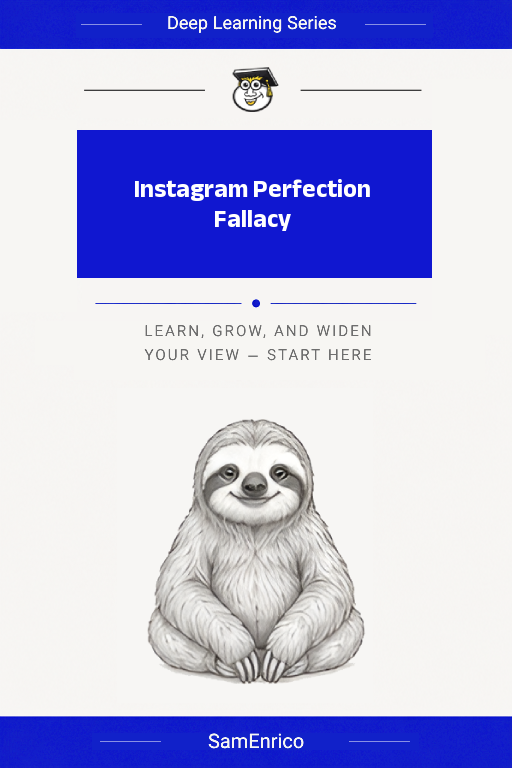
Non-FictionMental WealthSocial Media Psychology
Instagram Perfection Fallacy eBook
Uncover how Instagram curates highlight reels that
by Hanes Bunny
Uncover how Instagram curates highlight reels that fuel comparison culture. Learn to distinguish authentic content from manufactured lifestyles and build media literacy.
Formats
Free sample
Chapter 1: The Kodak Ghost--The summer I turned fourteen, my mother handed me a rectangular plastic object that weighed almost nothing and promised to change everything. It was a pink Kodak Fun Saver disposable camera, loaded with 27 exposures of ISO 800 film, and she gave it to me with a simple instruction: “Use it for things you want to remember.” I took that camera to the beach, to a friend’s birthday party, to my grandparents’ anniversary dinner. I hoarded each of those 27 shots like a miser counting gold, because once they were gone, they were gone. There was no delete button. No retake.
No filter. No audience beyond the future version of myself who might flip through a dusty photo album a decade later and think, Oh yes, that was the summer the dog ate my sandal.I remember exactly four of those twenty-seven images today. The rest are lost to a drawer somewhere, or perhaps thrown away during a move. And that is precisely the point.Twenty years later, I watched my fifteen-year-old niece take seventy-three photos of her breakfast in the span of twelve minutes. She deleted fifty-one of them immediately, edited twelve using three different applications, posted two to her Instagram feed, and then spent the next hour refreshing her screen to watch the likes accumulate.
When I asked her what she would remember about that breakfast in ten years, she looked at me with an expression of pure confusion. “Remember?” she said. “I don’t need to remember it. It’s on my grid.”That conversation was the first time I saw the ghost.The ghost is the old way of seeing, the way that treated photographs as scarce artifacts of genuine memory rather than infinite ammunition for social validation. The ghost is the part of us that still remembers when a camera was a tool for preserving the past, not constructing a presentable identity for strangers.
And the ghost is dying—choked out by an app that has fundamentally rewired not just how we take pictures, but why we take them, what we do with them, and who we believe we are because of them.This book is an exorcism. Or at least an attempt at one.The Great Migration: What We Lost When We Started Performing Before Instagram launched in October 2010, photography existed in a completely different psychological universe. It was a medium of scarcity. Film cost money. Development cost money.
Time cost money. Every click of the shutter carried a small but real economic penalty, which meant that people thought carefully before taking a photograph. You asked yourself: Is this moment worth preserving? Will I care about this image in five years? Is this the best possible use of this frame?These constraints produced a specific relationship with images.
Photographs were mnemonic devices—tools for triggering memory. A photo of a birthday party wasn't meant to capture the perfect version of the party; it was meant to capture *a* version of the party, warts and all, so that your future self could revisit the feeling. Blurry photos were acceptable. Poorly lit photos were acceptable. Photos where someone blinked at the wrong moment were not only acceptable but often preferred, because they were real.
They captured the chaos of actual life.The Kodak company understood this implicitly. Their famous slogan from the 1970s was “Kodak moments”—those spontaneous, unplanned instants of genuine emotion. A child’s first step. A couple laughing at a private joke. A grandmother crying tears of joy at a reunion.
These were not staged. They were not filtered. They were not edited. They were simply seen.Instagram flipped this entire philosophy on its head. Suddenly, photography became a medium of abundance.
You could take one thousand photos in a single afternoon and delete nine hundred ninety-nine of them without consequence. The economic penalty vanished. The time penalty vanished. The only penalty that remained was social: the fear that your photos weren't good enough, interesting enough, beautiful enough to earn the validation of strangers.This shift from scarcity to abundance produced a corresponding shift in purpose. When photographs are scarce, you use them to remember.
When photographs are abundant, you use them to perform.The Invention of the Highlight Reel Every sports fan knows what a highlight reel is. It is a carefully edited collection of the best moments from a game or season—the touchdowns, the buzzer-beaters, the impossible catches—edited together to make an athlete look superhuman. What the highlight reel deliberately excludes are the missed tackles, the air balls, the dropped passes, the exhaustion, the frustration, the mundanity of practice, the ordinary seconds that make up ninety-nine percent of the athlete’s actual experience.Instagram turned the entire human life into a highlight reel.Think about what actually appears on your feed. People post vacations, but not the flight delays. They post promotions, but not the months of anxiety before the interview.
They post engagement photos, but not the arguments about wedding budgets. They post perfectly plated meals, but not the sink full of dishes. They post smiling selfies, but not the hours of loneliness that preceded them.This is not necessarily deception. Most people are not trying to lie. They are simply following the unwritten rules of the platform: show the good, hide the bad, never break the spell.
The problem is that when you scroll through fifty highlight reels in a single sitting, your brain does not automatically add the disclaimer “These are only the best one percent of these people’s lives.” Instead, your brain does what brains have evolved to do: it compares.And you always lose that comparison.Documentary Anxiety: The Fear of the Unwitnessed Life One of the most insidious byproducts of the Instagram era is something I call Documentary Anxiety. It is the creeping fear that if an experience is not photographed, edited, and shared, it did not truly happen—or worse, that it is not real.Documentary Anxiety manifests in recognizable patterns. You arrive at a beautiful overlook during a hike, and your first instinct is not to breathe in the view but to pull out your phone. You attend a concert, and you watch the performance through your screen rather than with your eyes. You cook an elaborate meal, and you photograph it before anyone takes a single bite.
You hold your child, and you angle the camera for the best lighting rather than simply holding your child.The anxiety has a specific structure: If I don’t post this, how will anyone know I was here? If no one knows I was here, did I really experience this at all?This is not a trivial question. Human beings are social animals. We derive meaning from shared experience. But Instagram has hijacked this natural impulse by convincing us that “shared” means “broadcast to hundreds or thousands of semi-strangers” rather than “told to the three people sitting next to me at dinner.”The result is a population that is simultaneously over-documented and under-experienced.
We have more photographs of our lives than any generation in human history, yet we remember less of what we actually did—because we were too busy performing the…
This is the end of the free sample. Get the eBook to keep going. Buy now
About this book
Details
- Author
- Hanes Bunny
- Publisher
- SamEnrico
- Language
- English
- Genre
- Non-Fiction, Mental Wealth, Social Media Psychology
- Released
- 2026-05-30
- Pages (approx.)
- 141
- Available as
- eBook, Audiobook

Read better in the ZLOADR app
Your eBooks on your phone or tablet. Sign in with your SamEnrico account and start reading.
More by Hanes Bunny
 Los Angeles Noir Murder GuideHanes Bunny$11.99
 Child Loss Dream GuideHanes Bunny$11.99
 Sitting Meditation PrimerHanes Bunny$11.99
 Choreographing Large EnsemblesHanes Bunny$11.99
 The Beirut Syndicate: The Prohibition-Era Cartel That Outsmarted the LawHanes Bunny$11.99
 How to Start a Noil (wholesale) Business (Beginners Guide)Hanes Bunny$11.99
 How to Produce a Beater (Weaving Tool)Hanes Bunny$11.99
 Life Enrichment AssistantHanes Bunny$11.99
You may also like
 Hong Kong Handover 1997Dunn Johnnie$11.99
 Zumba For Postnatal Recovery CourseNeal Christian$11.99
 Zumba for BeginnersLadner Nikia$11.99
 YouTube Comment Mining GuideHumes Pandora$12.99
 Worry Box MeditationCarlin Rudy$11.99
 Workplace Stress MeditationNguyen Lynn$11.99
 Workplace Stress and Sleep RepairHawley Ivory$11.99
 Workplace Perfectionism CureDelaney Jeffry$11.99
 Workplace Injustice Anger GuideWallen Isabelle$11.99
 Work Addiction and Burnout LinkGreenwood Ester$11.99
 Women in Yoga and WellnessBeattie Galina$11.99
 Women in Stand Up ComedyChun Evangeline$11.99