
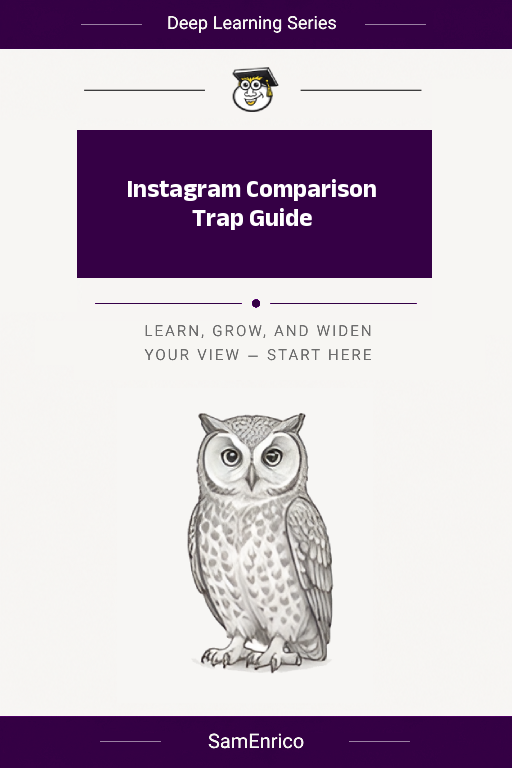
Non-FictionMental WealthEnvy ManagementSelf-Help
Instagram Comparison Trap Guide eBook
Recognize how curated feeds fuel inadequacy and br
Recognize how curated feeds fuel inadequacy and break the cycle of upward social comparison.
Formats
Free sample
Chapter 1: The Scroll That Steals--–- The morning sun filters through your curtains. You’ve just poured a cup of coffee. The house is quiet. Your shoulders are relaxed. For a fleeting, precious moment, you feel something rare: contentment.
You are not comparing. You are not wanting. You are simply here.Then you pick up your phone. “Just a quick check,” you tell yourself. You tap the Instagram icon.Thirty minutes later, you look up.
The coffee is cold. Your jaw is clenched. Your chest feels tight. And somewhere between the opening scroll and now, you have accumulated a quiet, nagging sense that your life is not enough. Your body is not enough.
Your accomplishments are not enough. You close the app feeling less than when you opened it—but you cannot name exactly what happened.This is not a weakness of character. This is not a failure of willpower. This is a predictable, engineered, and repeatable outcome of a multi-billion-dollar attention economy that has weaponized a fundamental feature of human psychology. The name for what you just experienced is the Instagram Comparison Trap, and the first step to breaking free is understanding that the trap was built for you on purpose.The Three-Second Mood Shift Let’s pause and name what happened in that thirty-minute window.
Before the scroll, you were grounded. Maybe you were thinking about your plans for the day, or simply enjoying the quiet. After the scroll, you felt inadequate. That shift—from neutral or positive to negative—is not random. It is the product of a carefully designed feedback loop.In behavioral psychology, this is sometimes called the social comparison cascade.
You see a photo of a friend’s vacation. Then a stranger’s engagement announcement. Then an influencer’s “morning routine” that includes a green smoothie, a Peloton workout, and a view of the ocean. Each image lands like a small weight on the scale of your self-worth. Alone, any one of these posts might be harmless.
But stacked together, in an infinite scroll with no natural stopping point, they create a cumulative effect: you begin to feel that everyone is living a better, more beautiful, more successful life than you are.The cruel irony is that you did not choose to feel this way. Your brain did what brains are designed to do—it looked around for social information to evaluate where you stand. The problem is that Instagram has hacked that ancient survival mechanism and turned it against you.Social Comparison Theory: The Ancient Instinct Instagram Hijacked In 1954, a social psychologist named Leon Festinger proposed a theory that would become one of the most cited in the history of psychology. He called it Social Comparison Theory. Festinger argued that human beings have an innate drive to evaluate their own opinions, abilities, and social status.
But because objective measures are often unavailable—there is no ruler for “good parent” or scale for “worthy person”—we turn to comparisons with others.Festinger identified two types of comparison. Downward comparison happens when we compare ourselves to someone we perceive as worse off. This can make us feel relieved or grateful. Upward comparison happens when we compare ourselves to someone we perceive as better off. This can inspire us—or it can crush us.Instagram has supercharged upward comparison to a degree Festinger could never have imagined.
In the 1950s, the people you compared yourself to were mostly your neighbors, coworkers, and relatives—people whose lives you could see with relative clarity, imperfections included. Today, you compare yourself to millions of strangers whose entire existence, as presented to you, has been edited, filtered, staged, and curated. You are not comparing your life to their life. You are comparing your behind-the-scenes to their highlight reel. And that is a rigged game.Why Your Brain Cannot Tell the Difference Here is where the trap gets biological.
Your brain evolved in an environment where social information was scarce and survival-critical. Knowing who was stronger, who had more food, and who posed a threat mattered for staying alive. Your brain developed specialized circuitry to process social standing, and it did so with remarkable speed.That circuitry still exists. It has not been updated for the age of infinite scroll.When you see an image of someone who appears happier, richer, more attractive, or more successful than you, your brain processes that information as a threat. Not a physical threat, but a social one.
Deep in your limbic system, the amygdala (your brain’s alarm system) activates. The anterior cingulate cortex—a region that registers physical pain—lights up when you feel socially rejected or comparatively inferior. You are not imagining the hurt. You are feeling it, literally, in the same neural tissue that processes a burn or a cut.This is why you cannot “just stop comparing.” The comparison is automatic. It happens in milliseconds, below the level of conscious thought.
By the time you notice the feeling of inadequacy, your brain has already run the comparison, registered the discrepancy, and released a cascade of stress hormones.The Algorithm That Feeds on Your Pain Most people believe they are in control of what they see on Instagram. They are not. The algorithm is.Instagram’s ranking system is designed to maximize one metric: time spent on the app. It shows you content that it predicts will keep you scrolling. And after analyzing billions of data points, the algorithm has learned a disturbing truth: content that triggers upward comparison—content that makes you feel a little envious, a little inadequate, a little “less than”—is extraordinarily effective at holding your attention.Think about that for a moment.
The algorithm has learned, through relentless optimization, that your pain is profitable.When you linger on a post that makes you feel envious, the algorithm notes that linger time. It shows you more posts like that one. Over time, your feed becomes a customized museum of inadequacy, filled with people who seem to be living the life you wish you had. You are not being shown what is beautiful. You are being shown what hurts—because what hurts also hooks.This is not a conspiracy.
It is a business model. The attention economy runs on engagement, and negative social emotions—envy, resentment, FOMO, inadequacy—are among the most reliable engagement drivers in existence. A post that makes you feel warm and content is a post you will scroll past. A post that makes you feel a pang of envy is a post you will stop to examine. The algorithm is not against you.
It is simply indifferent to you. It wants your time, and it has learned that your pain is the most efficient path to getting it.The Hidden Cost of the Scroll The psychological research on social media and mental health is now too extensive to ignore. A 2019 study published in the Journal of Social and Clinical Psychology found that limiting social media use to 30 minutes per day significantly reduced depression and loneliness. A 2021 meta-analysis of over 100 studies concluded that passive consumption of social media (scrolling without interacting) is consistently associated with lower well-being.But the most striking findings concern…
This is the end of the free sample. Get the eBook to keep going. Buy now
About this book
Details
- Author
- Emanuel Madaline
- Publisher
- SamEnrico
- Language
- English
- Genre
- Non-Fiction, Mental Wealth, Envy Management, Self-Help, Digital Wellness
- Released
- 2026-06-07
- Pages (approx.)
- 121
- Available as
- eBook, Audiobook

Read better in the ZLOADR app
Your eBooks on your phone or tablet. Sign in with your SamEnrico account and start reading.
More by Emanuel Madaline
 Virtual Speaking BusinessEmanuel Madaline$11.99
 Upwork Project Catalog LaunchEmanuel Madaline$11.99
 Immigrant Landscaping EmpireEmanuel Madaline$11.99
 Diaphragm GuideEmanuel Madaline$11.99
 The Betrayed Partner's Healing GuideEmanuel Madaline$11.99
 Spouse Homicide GriefEmanuel Madaline$11.99
 The Self Hypnosis for ConfidenceEmanuel Madaline$11.99
 Kurt Cobain JournalsEmanuel Madaline$11.99
 The Dancer Who Defied Kings: María de las Nieves and the Birth of Latin American BalletEmanuel Madaline$11.99
 Baldr's Last Lesson: The Viking Warrior Who Defied FateEmanuel Madaline$11.99
 Growing Cedrus (Cedar)Emanuel Madaline$11.99
 A Collector's Handbook to the Skoda Felicia SuperEmanuel Madaline$11.99
You may also like
 Hong Kong Handover 1997Dunn Johnnie$11.99
 Zumba For Postnatal Recovery CourseNeal Christian$11.99
 Zumba for BeginnersLadner Nikia$11.99
 YouTube Comment Mining GuideHumes Pandora$12.99
 Worry Box MeditationCarlin Rudy$11.99
 Workplace Stress MeditationNguyen Lynn$11.99
 Workplace Stress and Sleep RepairHawley Ivory$11.99
 Workplace Perfectionism CureDelaney Jeffry$11.99
 Workplace Injustice Anger GuideWallen Isabelle$11.99
 Work Addiction and Burnout LinkGreenwood Ester$11.99
 Women in Yoga and WellnessBeattie Galina$11.99
 Women in Stand Up ComedyChun Evangeline$11.99