
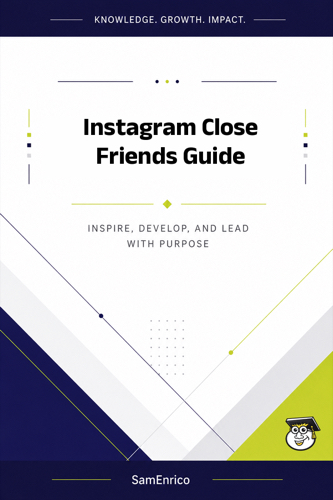
Non-FictionSelf-HelpFriendshipBelonging
Instagram Close Friends Guide eBook
Stop comparing your inner circle to others' close
Stop comparing your inner circle to others' close friends lists and exclusivity.
Formats
Free sample
Chapter 1: The Peek Epidemic--–- Three times in one hour, she opened Instagram, navigated to the Close Friends section of a woman she hadn't spoken to in four years, and felt her chest tighten when she saw a green ring around a story she couldn't view. This was not jealousy of an ex or longing for a vacation. This was something quieter and more pervasive: the slow drip of comparison that had no target, no resolution, and no end. She didn't even like this woman anymore. But the green circle had become a door she couldn't stop checking, even though she knew it would never open for her.This is the Peek Epidemic, and if you are reading this book, you have likely caught it.The Close Friends feature on Instagram was launched in 2018 with a straightforward purpose: to let users share certain stories with a smaller, handpicked group.
No drama, no exclusivity politics, just a privacy filter. But within two years, the green badge had become something else entirely. It became a status signal. A belonging barometer. A silent weapon in the quiet war of who is in and who is out.
And most dangerously, it became a mirror that millions of people now hold up to their own self-worth several times per day.This chapter is not about how to build your Close Friends list. It is not about who to include or exclude. Those conversations come later. This chapter is about something more fundamental and more uncomfortable: why you cannot stop looking at what you cannot see, why other people's green circles have power over your emotional state, and what the Peek Epidemic reveals about the gap between the intimacy you crave and the access you are actually being denied.The Anatomy of a Peek Let us name the behavior before we analyze it. A "peek" is any moment when you intentionally view or attempt to view content that signals exclusivity you do not fully share.
On Instagram Close Friends, this takes three forms.First, the direct peek. You see a green ring around someone's story, you tap it, and you are granted access because you are on their list. This seems harmless. But the damage happens not during the viewing but in the seconds before and after. Before you tap, your brain briefly wonders: "What will I see?
Will it be something special? Will it make me feel included or just aware of what I am not seeing elsewhere?" After you tap, you compare the content to your own life. A friend's messy kitchen. A crying selfie. A backstage pass to a concert you weren't invited to.
None of this is threatening. But your brain processes it as social information that must be ranked.Second, the ghost peek. You see a green ring, you tap, and you are denied. You are not on that person's Close Friends list. This is the most painful variation because your brain fills the gap with worst-case assumptions.
You do not know what you are missing, so you imagine the most intimate, exciting, or validating content possible. A study on the "information gap theory" by behavioral economist George Loewenstein found that people assign higher value to unknown information than to known information, especially when they believe others have access to it. The ghost peek exploits this perfectly. You do not know what is behind the green circle, so you assume it is better than whatever you are currently seeing on your own feed.Third, the comparative peek. You do not even tap the story.
You simply note who has posted to Close Friends and who has not. You scan a list of names with green rings and unconsciously rank them: who is closer to whom? Why did she post to CF but not to main? Why did he include her but not me? This form of peeking requires no content at all.
The mere existence of the green badge triggers social comparison. This is Instagram's most insidious design choice. Unlike a locked door that simply says "private," the Close Friends badge announces that there is something inside worth protecting, and you are either inside or outside. There is no neutral position.The Neurochemistry of Exclusion To understand why the Peek Epidemic feels so physically painful, we have to look inside the brain. Social rejection and exclusion activate the same neural pathways as physical pain.
In a landmark study at UCLA, researchers found that the dorsal anterior cingulate cortex — a region associated with the distressing aspect of physical pain — lights up when people are excluded from a simple ball-tossing game. Not a real game. A computer simulation. The brain cannot reliably distinguish between being left out of a virtual game and being left out of a Close Friends list.This is not a character flaw. This is evolution.For most of human history, exclusion from the group meant death.
Humans survived not because they were faster or stronger than predators, but because they cooperated in tribes of roughly 150 people. Being pushed out of that tribe meant no protection, no food sharing, no mating opportunities. Your brain developed an early warning system specifically calibrated to detect signs of social exclusion. That system does not know the difference between a tribe of hunter-gatherers and a Close Friends list of thirty acquaintances.When you see a green circle you cannot access, your brain releases cortisol and norepinephrine. Your heart rate increases.
Your attention narrows. You do not consciously think "I am going to die," but your body prepares for a social threat as if you might. This is why checking Close Friends stories can feel exhausting even when you see nothing upsetting. Your nervous system is being activated dozens of times per day for threats that do not exist.The problem is compounded by Instagram's variable reward schedule. You do not know who will post to Close Friends or when.
You do not know whether you will be included or excluded from any given story. This unpredictability is the same mechanism that makes slot machines addictive. Behavioral psychologist B.F. Skinner demonstrated that rats pressing a lever for food pellets pressed more frequently and persistently when the reward was unpredictable than when it came every time. The green circle is your lever.
Sometimes it opens to a boring selfie. Sometimes to a vulnerable confession. Sometimes to nothing at all because you are not on the list. The unpredictability keeps you checking.What You Are Actually Looking For Here is the question that most writing on social comparison avoids: if the green circle is causing you distress, why do you keep looking? The obvious answer is habit.
But beneath habit lies a series of unmet needs that your brain has mistakenly learned to satisfy through peeking.The first unmet need is belonging. Humans need to feel part of a group that knows them and accepts them. When belonging is lacking in real life — because of loneliness, transition, or shallow friendships — the brain seeks belonging anywhere it can find it. A Close Friends list offers a shortcut version of belonging. You do not need to share a meal or a vulnerable conversation.
You just need to be included on a list. This is why being excluded from someone's CF list feels like…
This is the end of the free sample. Get the eBook to keep going. Buy now
About this book
Details
- Author
- Matlock Colby
- Publisher
- SamEnrico
- Language
- English
- Genre
- Non-Fiction, Self-Help, Friendship, Belonging
- Released
- 2026-06-08
- Pages (approx.)
- 124
- Available as
- eBook, Audiobook

Read better in the ZLOADR app
Your eBooks on your phone or tablet. Sign in with your SamEnrico account and start reading.
More by Matlock Colby
 Assertiveness in ParentingMatlock Colby$11.99
 Storm Phobia TreatmentMatlock Colby$11.99
 Opioid Sober Living Home GuideMatlock Colby$11.99
 Family Healing After AlcoholismMatlock Colby$11.99
 The Silk & Gold Merchants: Florence’s Banking RevolutionMatlock Colby$11.99
 Ancient ReenactmentMatlock Colby$11.99
 Gen Z Global Spending GuideMatlock Colby$12.99
 Regulatory Notification ClockMatlock Colby$12.99
 How to Become a Jewel-bearing BroacherMatlock Colby$11.99
 Understanding Inclusion ConjunctivitisMatlock Colby$17.99
You may also like
 Hong Kong Handover 1997Dunn Johnnie$11.99
 Zumba For Postnatal Recovery CourseNeal Christian$11.99
 Zumba for BeginnersLadner Nikia$11.99
 YouTube Comment Mining GuideHumes Pandora$12.99
 Worry Box MeditationCarlin Rudy$11.99
 Workplace Stress MeditationNguyen Lynn$11.99
 Workplace Stress and Sleep RepairHawley Ivory$11.99
 Workplace Perfectionism CureDelaney Jeffry$11.99
 Workplace Injustice Anger GuideWallen Isabelle$11.99
 Work Addiction and Burnout LinkGreenwood Ester$11.99
 Women in Yoga and WellnessBeattie Galina$11.99
 Women in Stand Up ComedyChun Evangeline$11.99