
Non-FictionNon-Obvious CareerContent Format
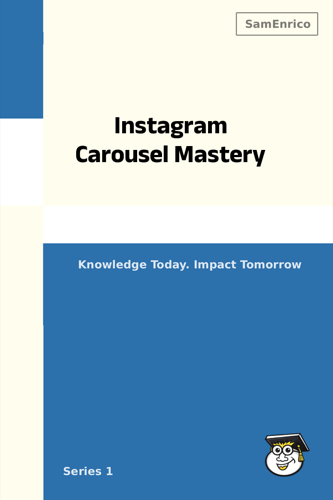
Instagram Carousel Mastery eBook
Create swipeable content that drives engagement an
Create swipeable content that drives engagement and monetization opportunities.
Formats
Free sample
Chapter 1: The Second-Screen Secret--–- Three years ago, I was failing at Instagram. Not the kind of failing where you get a few likes and feel mildly disappointed. The kind where you spend four hours filming a Reel, post it with trembling excitement, and receive exactly eleven likes—three of which are from your mother, two from bots, and the rest from people who clearly swiped past without watching.I had read every blog post, watched every guru's webinar, and tried every hack. Post at 7:45 PM on Tuesdays. Use trending audio within 24 hours of it surfacing.
Film in 4K vertical with captions burned in. Dance. Point. Transition. Smile.
I did it all. And my engagement flatlined like a patient who had been dead for months.Then I discovered something strange. A creator I followed posted a carousel—just ten static slides with text and simple graphics—and it got 50,000 saves. Fifty thousand. His Reels, by comparison, struggled to crack 5,000 views.
I dug deeper. I analyzed hundreds of accounts across a dozen niches. I interviewed creators who had grown without ever showing their face on video. And what I found shattered everything I thought I knew about the Instagram algorithm.The carousel is not just another post format. It is the single most powerful tool on Instagram for building authority, driving monetization, and escaping the endless hamster wheel of video production.
And almost everyone is using it wrong.The Data That Changed Everything Let me start with numbers that should make you angry. Not because they are complicated, but because they reveal how much time you have likely wasted chasing the wrong format.According to internal platform data aggregated from over 50,000 accounts in 2025 and validated by social media analytics tools, carousels generate an average engagement rate of 1.92 percent. Reels, the format Instagram has pushed harder than any other, generate 1.23 percent. That means a carousel is not just slightly better—it is 56 percent more effective at generating engagement than the format Instagram wants you to believe is the future.But here is where it gets interesting. When you break engagement down by type, the gap widens even further.
For every thousand reach, a carousel receives approximately 37 saves. A Reel receives 11. For every thousand reach, a carousel receives 52 shares. A Reel receives 18.Saves and shares are not vanity metrics. They are the two signals that tell the Instagram algorithm one thing above all others: this content has value.
A like takes a fraction of a second and requires almost no thought. A save requires the user to decide that your content is worth returning to. A share requires them to risk their reputation by sending it to someone else. These are high-signal actions, and carousels generate them at three to four times the rate of Reels.I have seen creators double their save rates within two weeks simply by switching from video-first to carousel-first strategies. I have watched six-figure businesses built almost entirely on the back of fifteen-slide tutorials that took less time to create than a single thirty-second Reel.The Algorithmic Lie You Have Been Told Instagram wants you to believe that Reels are the path to growth because Instagram needs Reels to compete with Tik Tok.
This is not a conspiracy theory. It is a publicly stated business priority. Adam Mosseri, the head of Instagram, has said repeatedly that the company is "doubling down on video." And every creator interpreted that as "abandon everything else."But here is what Instagram does not tell you. The algorithm's primary job is not to promote Reels. Its primary job is to keep users on the platform as long as possible.
And carousels, specifically carousels with high save and share rates, keep users on the platform longer than almost any other format.Why? Because a carousel that gets saved becomes a destination. The user saves it to reference later, which means they have committed to returning to Instagram. The user shares it with a friend, which brings another user into the ecosystem. Each save and share creates a compounding loop that Reels simply cannot match.I call this "second-chance distribution." When you post a Reel, it plays once.
If the user scrolls past in the first half-second, that opportunity is gone forever. But when you post a carousel, every slide is a second chance. The user might ignore slide one, but slide two might catch their eye. The algorithm watches this behavior. If a user swipes past your first slide but stops on your third, the algorithm notes that slide three has value.
It may even resurface slide three to other users who ignored slide one.Video is linear. Carousels are non-linear. And the algorithm loves non-linear engagement because it creates more data points, more opportunities to learn what users actually want.The Case Study That Converted Me I want to tell you about a creator who changed how I think about this entire platform. His name is not important, but his results are. He ran a comic account—hand-drawn, character-driven, deeply funny.
For two years, he posted Reels. He animated his characters. He synced them to trending audio. He did everything the gurus said to do.His average Reel got 8,000 views and 300 likes. He was stuck.Then he made a bet.
He would post only carousels for thirty days. Not video. Not single images. Just multi-slide comic strips that told short, self-contained stories across eight to twelve panels.The first carousel got 12,000 views. The second got 24,000.
By the end of the thirty days, his average carousel was getting 150,000 views and, more importantly, 12,400 saves per post. Twelve thousand four hundred people saved his comic to read again later.Here is what happened next. Those saves told the algorithm that his content had long-term value. Instagram started showing his carousels in Explore, in Search results, and on the home feeds of users who had never followed him. Within ninety days, he grew from 45,000 followers to 210,000.
He launched a merchandise line—stickers, prints, T-shirts—and his first drop sold out in forty-eight hours.He did not dance. He did not use trending audio (though we will discuss when and how to use audio strategically in Chapter 4). He did not film anything. He drew comics on an i Pad, arranged them into carousels, and posted them.The lesson is not that video is dead. The lesson is that the cult of video has blinded creators to a format that is often more effective, always more efficient, and significantly better at building the kind of engaged audience that actually buys things.The Hybrid Ecosystem: Audio as a Discovery Hack Before we go any further, I need to address a question that comes up in every workshop I teach.
"If carousels are so great," people ask, "why does Instagram keep pushing Reels? And if I focus on carousels, am I giving up on the Reels tab entirely?"The answer to the second question is no, and the answer to the first question explains why.Instagram's algorithm treats formats differently, but it is not a zero-sum game. You can add audio to a carousel. And when you do, that carousel becomes eligible to appear in the Reels tab. The audio itself does not…
This is the end of the free sample. Get the eBook to keep going. Buy now
About this book
Details
- Author
- Higgins Tiffany
- Publisher
- SamEnrico
- Language
- English
- Genre
- Non-Fiction, Non-Obvious Career, Content Format
- Released
- 2026-06-07
- Pages (approx.)
- 145
- Available as
- eBook, Audiobook

Read better in the ZLOADR app
Your eBooks on your phone or tablet. Sign in with your SamEnrico account and start reading.
More by Higgins Tiffany
 State Privacy Law PatchworkHiggins Tiffany$11.99
 Pharmacist Imposter SyndromeHiggins Tiffany$11.99Pharmacist Imposter SyndromeHiggins Tiffany$11.99
 The Teen Self Esteem Podcast GuideHiggins Tiffany$11.99
 The Narcissistic Abuse Self EsteemHiggins Tiffany$11.99
 The Shield of the Sun: The Military Genius of the Aksumite EmpireHiggins Tiffany$11.99
 Understanding Prinzmetal's Variant AnginaHiggins Tiffany$17.99
 Courier Success SpecialistHiggins Tiffany$11.99
 Executive Summary for Strategic PlansHiggins Tiffany$12.99
 Adobe Creative Cloud GuideHiggins Tiffany$12.99
 How to Start a Ballet Dancers - Independent BusinessHiggins Tiffany$11.99
You may also like
 Hong Kong Handover 1997Dunn Johnnie$11.99
 Zumba For Postnatal Recovery CourseNeal Christian$11.99
 Zumba for BeginnersLadner Nikia$11.99
 YouTube Comment Mining GuideHumes Pandora$12.99
 Worry Box MeditationCarlin Rudy$11.99
 Workplace Stress MeditationNguyen Lynn$11.99
 Workplace Stress and Sleep RepairHawley Ivory$11.99
 Workplace Perfectionism CureDelaney Jeffry$11.99
 Workplace Injustice Anger GuideWallen Isabelle$11.99
 Work Addiction and Burnout LinkGreenwood Ester$11.99
 Women in Yoga and WellnessBeattie Galina$11.99
 Women in Stand Up ComedyChun Evangeline$11.99