
Non-FictionHealth & WellnessInsomnia
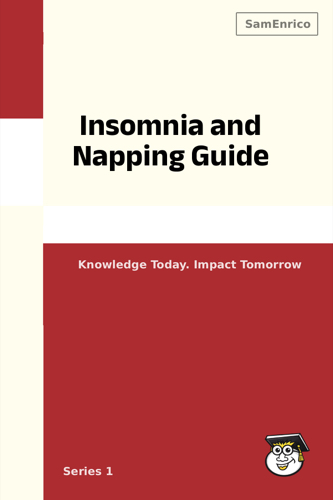
Insomnia and Napping Guide eBook
Navigate napping when you have trouble sleeping at
Navigate napping when you have trouble sleeping at night.
Formats
Free sample
Chapter 1: The Two Enemies--–- You have two enemies living inside you. They are not demons or psychological flaws. They are biological processes, and they have been fighting each other every single day of your life. One wants you to sleep. The other decides when.
And if you have insomnia, these two enemies are not just fighting—they are actively sabotaging you.Their names are homeostatic sleep drive and the circadian rhythm. Understanding them is not optional. It is the foundation upon which every nap, every night of sleep, and every moment of wakefulness in this book rests. Without this knowledge, you are guessing. With it, you become your own sleep scientist.Let me tell you a story.For six years, I believed I was broken.
I would lie awake at 2 AM, staring at the ceiling, replaying every mistake I had made in the past decade. I tried everything: warm milk, no screens, meditation apps, prescription pills that turned me into a zombie. Nothing worked consistently. Then a sleep specialist sat me down and drew two lines on a whiteboard. One line went steadily up.
The other line went up and down like a wave. "These," she said, "are the only two things that control your sleep. You have been fighting the wrong one."That conversation changed everything. And it will change how you think about napping.The Debt Collector: Understanding Homeostatic Sleep Drive Homeostatic sleep drive is the simpler of your two enemies—which is to say, it is still brutally complex, but at least it plays fair. Here is how it works: from the moment you wake up, your brain begins accumulating a pressure to sleep.
Think of it as a debt. Every hour you stay awake, you add another coin to a jar. After twelve hours, the jar is heavy. After sixteen hours, it is overflowing. After eighteen hours, you are nodding off at your desk, and after twenty hours, you are a danger to yourself and everyone around you.This is called sleep drive, and it is homeostatic because your body is trying to maintain homeostasis—balance.
The longer you stay awake, the more you need sleep. When you finally sleep, that debt gets paid down. A full night’s rest empties the jar almost completely. A short nap empties it a little.Here is what most people get wrong about sleep drive: they think it builds at a constant, predictable rate. It does not.
It builds faster in the morning, slower in the afternoon (thanks to your circadian rhythm, which we will get to), and then accelerates again in the evening. This is why you can feel exhausted at 10 AM, perfectly alert at 2 PM, and then barely keep your eyes open at 9 PM. Your sleep drive is not broken. It is just uneven.For people with insomnia, the problem is rarely that sleep drive does not build. It almost always builds just fine.
The problem is that something else—anxiety, pain, medication, or a misaligned circadian clock—blocks your ability to feel that drive or to act on it. You are exhausted, but you cannot fall asleep. You have the debt, but the collection agency refuses to take your payment.This is where napping becomes dangerous or therapeutic, depending entirely on how you use it. A nap reduces your sleep drive. That is its job.
If you take a nap that is too long, too late, or too deep, you will empty the jar just enough that when bedtime arrives, you are not sufficiently tired. Your sleep drive is low, so you lie awake. Then you wake up exhausted the next day, take another nap to cope, and the cycle repeats.But here is the counterintuitive truth that most insomnia books will not tell you: a small, strategic nap can actually improve your night sleep by reducing the anxiety that comes with crushing exhaustion. When you are so tired that you cannot think straight, your brain goes into a survival mode that actually makes it harder to fall asleep. It is a paradox, but it is real.
A short nap—ten to twenty minutes—can lower that survival-mode anxiety without reducing your sleep drive enough to matter. You wake up calmer, and calmer brains fall asleep faster.The key is precision. You are not taking a nap to feel rested. You are taking a nap to reset your nervous system. That is a very different goal.The Clock: Understanding Your Circadian Rhythm If sleep drive is a debt collector that gets louder the longer you stay awake, your circadian rhythm is the clock that tells the debt collector when to knock.
It is a roughly twenty-four-hour cycle that governs not just sleep but also body temperature, hormone release, metabolism, and even mood. Every cell in your body has its own tiny clock, and they are all synchronized by a master clock in your brain called the suprachiasmatic nucleus, located just above where your optic nerves cross.Your circadian rhythm does not care how much sleep you have had. It cares about time of day. That is why you can be awake for eighteen hours and still feel alert at noon, but after only ten hours awake, you can feel groggy at 3 AM. The clock overrides the debt collector.Here is the most important thing to understand about your circadian rhythm: it is not fixed.
It changes across your lifespan. Teenagers naturally have a delayed rhythm—they want to sleep from 2 AM to 10 AM. Older adults often have an advanced rhythm—they want to sleep from 8 PM to 4 AM. And some people are simply night owls or morning larks by genetics. None of these are disorders.
They are variations.Insomnia happens when your circadian rhythm and your sleep drive fall out of sync. The classic example is the night owl forced to wake at 6 AM for work. Their sleep drive builds normally, but their circadian rhythm is still in "night mode" at 10 PM. They lie awake because their body thinks it is afternoon. Then they finally fall asleep at 2 AM, only to be dragged awake four hours later.
They are exhausted, but their clock will not budge.For these people, napping is not just helpful—it is essential. A strategically timed nap can bridge the gap between their biological night and their social schedule. But the timing must be precise. Nap too early, and you will reduce sleep drive before your body is ready to build it again. Nap too late, and you will interfere with your already-delayed bedtime.
Nap too long, and you will confuse your clock even further.The Collision: What Happens When the Two Enemies Fight In a healthy sleeper, sleep drive and circadian rhythm work together like a well-rehearsed duet. Sleep drive builds throughout the day. Circadian rhythm sends a strong "sleepy" signal in the evening (triggered by darkness and a drop in core body temperature) and a strong "alert" signal in the morning (triggered by light and a rise in temperature). The two signals overlap, you fall asleep, you stay asleep for seven to nine hours, and you wake up feeling refreshed.In an insomniac, the duet becomes a knife fight. Here are…
This is the end of the free sample. Get the eBook to keep going. Buy now
About this book
Details
- Author
- Dorsey Celinda
- Publisher
- SamEnrico
- Language
- English
- Genre
- Non-Fiction, Health & Wellness, Insomnia
- Released
- 2026-06-06
- Pages (approx.)
- 130
- Available as
- eBook, Audiobook

Read better in the ZLOADR app
Your eBooks on your phone or tablet. Sign in with your SamEnrico account and start reading.
More by Dorsey Celinda
 Dental Anxiety Breath AidDorsey Celinda$11.99
 The Veggie Sailing DietDorsey Celinda$11.99
 The Boy Scout TraffickingDorsey Celinda$11.99
 Executive Summary Persuasion TacticsDorsey Celinda$11.99
 CPR Certification RenewalDorsey Celinda$11.99
 Gratitude for Small BusinessesDorsey Celinda$11.99
 Pinterest Influencer JourneyDorsey Celinda$11.99
 Wine And Longevity TruthDorsey Celinda$11.99
 The Last Witness of the Iron MaskDorsey Celinda$11.99
 The Alchemist’s Canvas: Secrets of the Forbidden PaletteDorsey Celinda$11.99
 Echoes of the Lost Colony: Roanoke’s Time-Loop EnigmaDorsey Celinda$11.99
 How to Start a Public Administration of Housing Programmes Business (Beginners Guide)Dorsey Celinda$11.99
You may also like
 Hong Kong Handover 1997Dunn Johnnie$11.99
 Zumba For Postnatal Recovery CourseNeal Christian$11.99
 Zumba for BeginnersLadner Nikia$11.99
 YouTube Comment Mining GuideHumes Pandora$12.99
 Worry Box MeditationCarlin Rudy$11.99
 Workplace Stress MeditationNguyen Lynn$11.99
 Workplace Stress and Sleep RepairHawley Ivory$11.99
 Workplace Perfectionism CureDelaney Jeffry$11.99
 Workplace Injustice Anger GuideWallen Isabelle$11.99
 Work Addiction and Burnout LinkGreenwood Ester$11.99
 Women in Yoga and WellnessBeattie Galina$11.99
 Women in Stand Up ComedyChun Evangeline$11.99