
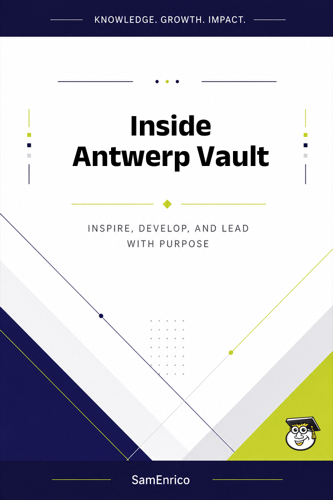
Non-FictionTrue Crime / Security
Inside Antwerp Vault eBook
undefined
by Busby Ardith
undefined
Formats
Free sample
Chapter 1: The Square Mile of Ice--–- The first thing you notice about the Antwerp Diamond District is how ordinary it looks. There are no golden spires, no marble monuments, no triumphal arches celebrating the billions that change hands inside its narrow streets. Instead, you find a few blocks of unremarkable real estate tucked near the city's central train station—a labyrinth of short thoroughfares with names like Hoveniersstraat, Schupstraat, and Pelikaanstraat. The buildings are modest, many of them dating back to the early twentieth century, their facades stained by decades of diesel exhaust and Belgian rain. Street-level shops sell cheap electronics, falafel sandwiches, and discount luggage.
On a gray Tuesday morning, a casual visitor might walk right through the district without realizing where they are. They might notice the unusually high number of security cameras—one on every corner, another above every doorway—but they would probably assume the neighborhood has a petty crime problem. They would be wrong about the crime, but right about the cameras.The secret of Antwerp's diamond district is that it hides in plain sight. Roughly eighty percent of the world's rough diamonds pass through these few blocks. Every year, stones worth tens of billions of dollars arrive from mines in Russia, Botswana, Canada, South Africa, and Australia.
They come in padded envelopes, in the lined pockets of couriers, in diplomatic pouches, and sometimes, allegedly, in the luggage of passengers who have no idea what they are carrying. Once inside the district, these diamonds are sorted, cut, polished, certified, traded, and shipped out again—often within forty-eight hours. A diamond that leaves a mine in Siberia on Monday morning can be in a jeweler's display case in New York by Friday afternoon, provided it makes the right connections in Antwerp. And almost all of them do.This is not an accident of geography. Antwerp has been the diamond capital of the Western world for nearly six centuries, ever since the first rough stones arrived from India via Portuguese trading routes in the fifteenth century.
The city's diamond district survived the Spanish Inquisition, the Napoleonic Wars, two World Wars, the Holocaust, and the rise of competing markets in Tel Aviv, Mumbai, and Dubai. It survived because the people who work there built something more durable than any building: a system of trust so absolute that a handshake can move millions of dollars, and a word broken means exile from the community for life. The diamond district runs on honor, on family ties, on centuries-old traditions that predate modern banking, and on a shared understanding that in this business, reputation is the only currency that matters.But the district also runs on paranoia. Walk into any diamond office on Hoveniersstraat and you will find bulletproof glass separating the merchant from his clients. You will find armed guards at the doors, security cameras in the ceilings, and panic buttons under the desks.
The merchants themselves wear plain clothes—often dark suits or simple sweaters—because displaying wealth in the diamond district is considered vulgar, even dangerous. The man who looks like a retired accountant might be worth fifty million dollars; the woman in the modest floral dress might have just closed a deal for three million in rough stones. The district operates on a fundamental contradiction: it is built on trust, but it is fortified like a military installation.This chapter is about that contradiction. It is about the world that Leonardo Notarbartolo studied for two years before he walked into the most secure vault on earth and walked out with five hundred million dollars in diamonds. To understand how he did it, you must first understand what he was up against—not just the steel doors and the magnetic locks and the seismic sensors, but the culture, the history, and the human beings who thought their fortress was invincible.The Three Tribes The Antwerp diamond district is not a monolith.
It is a collection of three distinct communities, each with its own language, its own customs, its own way of doing business, and its own carefully guarded territory within the district's few square blocks. These three groups have coexisted for generations, trading with each other, trusting each other up to a point, and never quite forgetting that they are, in the end, separate tribes.The first and oldest group is the Hasidic Jewish community. They have been the backbone of Antwerp's diamond trade since the nineteenth century, when Jewish merchants fleeing poverty in Eastern Europe discovered that diamond dealing required no formal education, no family connections, and no start-up capital—only a sharp eye, a steady hand, and an absolute commitment to honest dealing. The Hasidim brought with them a culture of trust rooted in religious law. In Jewish tradition, a verbal agreement is binding.
To break one's word is not merely bad business; it is a sin. Over generations, this religious obligation became the foundation of the diamond district's honor system. A Hasidic merchant can close a million-dollar deal with a handshake and the Yiddish phrase "mazel un broche"—luck and blessing. If he tries to cheat, word spreads through the community within hours, and he will never work in the district again.Today, the Hasidic presence in Antwerp is immediately visible to any visitor. The men wear black hats and long coats, even in summer.
They speak Yiddish among themselves, though they also speak Flemish, French, English, and often Hebrew. Their side of the district has its own kosher bakeries, its own synagogues, its own schools. On Friday afternoons, the district empties out as the Sabbath begins, and for twenty-four hours, the diamond trade falls silent. The Hasidic merchants are famously tough negotiators—they have to be, because they are often trading with their own money or their family's money, not a corporation's—but they are also famously honest. A handshake with a Hasidic diamond merchant is legally binding in Belgian courts, a fact that has been tested more than once.The second group is the Indian Gujarati community.
They arrived in Antwerp much later, beginning in the 1960s and 1970s, when Indian immigrants discovered that Antwerp offered something their home market did not: access to rough diamonds directly from the mines. The Gujarati community is predominantly Jain, and their religious tradition emphasizes non-violence and strict honesty in business. Like the Hasidim, they operate on a system of trust and reputation. Unlike the Hasidim, they specialize in cutting and polishing. Most of the world's diamond cutting was once done in India, but the Gujarati merchants of Antwerp realized they could do it better and faster by bringing the rough stones to Europe, cutting them with advanced technology, and shipping them back to India for final finishing.
Today, the Gujarati community controls much of the diamond manufacturing sector in Antwerp. Their offices tend to be more modern than the Hasidic ones, their dress more Western, but their commitment to the honor system is just as absolute.The third group is the Lebanese community, primarily Lebanese Christians who fled the civil war in the 1970s and 1980s. They are the newest arrivals, and they have carved out a specific niche: trading in rough diamonds from West Africa.…
This is the end of the free sample. Get the eBook to keep going. Buy now
About this book
Details
- Author
- Busby Ardith
- Publisher
- SamEnrico
- Language
- English
- Genre
- Non-Fiction, True Crime / Security
- Released
- 2026-06-09
- Pages (approx.)
- 129
- Available as
- eBook, Audiobook

Read better in the ZLOADR app
Your eBooks on your phone or tablet. Sign in with your SamEnrico account and start reading.
More by Busby Ardith
 Bosnian War Family StoryBusby Ardith$11.99
 Self Esteem for Interfaith CouplesBusby Ardith$11.99
 Remote Team Expense GuideBusby Ardith$11.99
 Positive Emotion CultivationBusby Ardith$11.99
 The Eisenhower Matrix GuideBusby Ardith$11.99
 Sober Curious Exploration GuideBusby Ardith$11.99
 The Stockholm Forgery: The Art Heist That Turned DeadlyBusby Ardith$11.99
 The Golden Voices of the Nile: Opera and Majesty in Ancient KemetBusby Ardith$11.99
 How to Produce Hair Care KitsBusby Ardith$11.99
 Mastering The Art of IndiaBusby Ardith$11.99
 A Collector's Handbook to the Dkw Meisterklasse F2Busby Ardith$11.99
 ISO 26000 Social ResponsibilityBusby Ardith$12.99
You may also like
 Hong Kong Handover 1997Dunn Johnnie$11.99
 Zumba For Postnatal Recovery CourseNeal Christian$11.99
 Zumba for BeginnersLadner Nikia$11.99
 YouTube Comment Mining GuideHumes Pandora$12.99
 Worry Box MeditationCarlin Rudy$11.99
 Workplace Stress MeditationNguyen Lynn$11.99
 Workplace Stress and Sleep RepairHawley Ivory$11.99
 Workplace Perfectionism CureDelaney Jeffry$11.99
 Workplace Injustice Anger GuideWallen Isabelle$11.99
 Work Addiction and Burnout LinkGreenwood Ester$11.99
 Women in Yoga and WellnessBeattie Galina$11.99
 Women in Stand Up ComedyChun Evangeline$11.99