
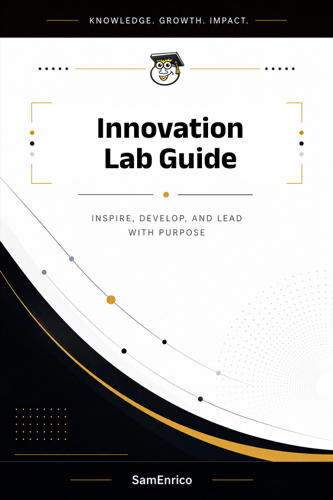
Free sample
Chapter 1: The Graveyard of Ping-Pong Tables...--In 2017, a Fortune 500 retailer cut a ribbon on what the press called "the most beautiful innovation center in the Midwest." Three thousand square feet of exposed brick, a $200,000 espresso machine, nap pods imported from Japan, and a ping-pong table that cost more than a used Honda Civic. The head of innovation gave TEDx-style talks about "creative collision spaces." The CEO posed for photos holding a beanbag chair. Eighteen months later, the space was empty. The ping-pong table was covered in dust. The espresso machine had been moved to the executive break room.
The head of innovation was fired in a quiet December reorg that nobody outside the company noticed. The space became a storage closet for office supplies.This is not an unusual story. It is, in fact, the most common story.Corporate America has built thousands of innovation labs over the past decade. According to a Capgemini study, nearly seventy percent of large enterprises have created some form of innovation lab, incubator, or accelerator. And by most estimates, between sixty and ninety percent of those labs fail within three years.
They fail not because the people running them are stupid or lazy. They fail because nobody asked the single most important question before the first piece of furniture was ordered.What is this lab actually for?The Ping-Pong Trap The problem begins with a misunderstanding so fundamental that most leaders never even notice they have it. When a CEO says "we need an innovation lab," they rarely mean the same thing as the head of product, who rarely means the same thing as the CFO, who rarely means the same thing as the designer they hire to run the space. Everyone uses the same words. Everyone nods in agreement.
And everyone walks away with a completely different picture of what the lab is supposed to deliver.Let me give you a taxonomy of the most common misunderstandings.Some leaders believe an innovation lab is a physical place. A building. A room. A campus. They believe that if you build the right environment, with the right furniture and the right snacks and the right lighting, creativity will magically emerge.
This is the "if you build it, they will innovate" fallacy. It confuses the container with the content. A beautiful laboratory does not produce beautiful science; scientists produce beautiful science, sometimes in basements.Other leaders believe an innovation lab is a brand signal. They want to be seen as innovative by investors, by employees, by the press. The lab exists not to produce new products but to produce press releases.
This is the "innovation theatre" trap. The lab looks like innovation, sounds like innovation, and costs like innovation, but it never actually innovates because innovation was never the goal. The goal was signaling.Still other leaders believe an innovation lab is a skunkworks. A secret team operating outside the rules, unburdened by process, free to break things. This is the romantic view, borrowed from stories of Lockheed Martin's legendary Skunk Works, where engineers built the SR-71 Blackbird in a rented circus tent.
The problem is that corporate skunkworks almost always get shut down. They operate in secret, so nobody understands what they do. When budget cuts come, nobody defends them. They produce cool things that don't fit the core business, so they never launch. They die quiet deaths, followed by bewildered post-mortems where everyone agrees the lab was "ahead of its time."And finally, some leaders believe an innovation lab is an insurance policy.
A hedge against disruption. A way to say "we're working on it" when the board asks what they're doing about AI or blockchain or whatever the next wave might be. These labs exist to provide cover, not to produce results. They are expensive fig leaves.Here is the truth that the ping-pong table graveyard teaches us: an innovation lab is not a place, not a brand signal, not a secret team, and not an insurance policy. An innovation lab is a strategic capability.
It is a way of working, a set of tools and disciplines and decision rights, that allows an organization to explore uncertain futures without destroying its ability to execute in the present. The physical space, if there is one, is merely a convenient container for that capability. The brand value, if there is any, is a byproduct. The secrecy, if it exists, is tactical, not existential.The Three Horizons Model To understand what a lab should do, you first have to understand what the company needs. This is where the Three Horizons Model, developed by Mc Kinsey and popularized in The Alchemy of Growth, becomes indispensable.Horizon 1 is the core business.
These are the products and services that generate cash today. The work of Horizon 1 is optimization: reducing costs, improving efficiency, defending market share. Success in Horizon 1 is measured in quarterly profits, EBITDA, and customer satisfaction scores. The time horizon is zero to twelve months. The work is largely predictable.
You know who your customers are, what they want, and roughly how to deliver it.Horizon 2 is adjacent growth. These are new products or services that extend the core business into new markets, new geographies, or new customer segments. The work of Horizon 2 is expansion: building new capabilities, entering new channels, adapting existing assets to new uses. Success in Horizon 2 is measured in new customer acquisition, market share in new segments, and revenue from products launched in the past twelve to twenty-four months. The work is partially predictable.
You have some data, some analogues, some reason to believe.Horizon 3 is transformational innovation. These are genuinely new offerings that may require new business models, new capabilities, even new customers. The work of Horizon 3 is exploration: testing hypotheses, running experiments, searching for product-market fit. Success in Horizon 3 is measured in learning velocity, falsifiable insights, and the ability to pivot. The work is fundamentally unpredictable.
You have no data, no analogues, no clear path.Most companies are excellent at Horizon 1. They have spent decades optimizing their core. Many companies are decent at Horizon 2. They know how to launch adjacent products, even if the success rate is modest. Almost no companies are good at Horizon 3.
The skills that make you successful at Horizon 1—discipline, efficiency, risk aversion, predictability—are actively harmful at Horizon 3. The finance director who asks "what's the ROI on this experiment" is doing their job perfectly while simultaneously killing the very possibility of breakthrough innovation.Here is where the ping-pong table labs go wrong. They are almost always built for Horizon 3. The CEO wants a moon shot. The board wants to see "disruptive innovation." The lab is chartered to find the next big thing.
But the budgeting process, the promotion incentives, the performance metrics, and the organizational attention are all still aligned with Horizon 1. The lab is a Horizon 3 capability trapped inside a Horizon 1 machine. And when the lab fails to produce Horizon 1 results—quarterly revenue, predictable ROI, low-risk wins—the machine crushes it.The Mandate Canvas If you are running or building an innovation lab, or if you are considering doing so, you need a tool to prevent this tragedy. I have developed something called the Mandate…
This is the end of the free sample. Get the eBook to keep going. Buy now
About this book
Details
- Author
- Ricker Omega
- Publisher
- SamEnrico
- Language
- English
- Genre
- Non-Fiction, Self-Help
- Released
- 2026-06-06
- Pages (approx.)
- 144
- Available as
- eBook, Audiobook

Read better in the ZLOADR app
Your eBooks on your phone or tablet. Sign in with your SamEnrico account and start reading.
More by Ricker Omega
 Bedbound Pain PracticeRicker Omega$11.99
 Al Anon for Family MembersRicker Omega$11.99
 Alexa Household ManagementRicker Omega$11.99
 Yellow Desert DiariesRicker Omega$11.99
 The Financial Stress and FuneralsRicker Omega$11.99
 Weekly Review for TherapistsRicker Omega$11.99
 Meditation for OsteoarthritisRicker Omega$11.99
 Where the River Whispers Her NameRicker Omega$11.99
 The Marble Conspiracy: Michelangelo's Hidden WarRicker Omega$11.99
 How to Produce Exercise and Gym Mat Storage Racks and CartsRicker Omega$11.99
 A Collector's Handbook to the Abarth Record MonzaRicker Omega$11.99
 VAT Fiscal Representative GuideRicker Omega$12.99
You may also like
 Hong Kong Handover 1997Dunn Johnnie$11.99
 Zumba For Postnatal Recovery CourseNeal Christian$11.99
 Zumba for BeginnersLadner Nikia$11.99
 YouTube Comment Mining GuideHumes Pandora$12.99
 Worry Box MeditationCarlin Rudy$11.99
 Workplace Stress MeditationNguyen Lynn$11.99
 Workplace Stress and Sleep RepairHawley Ivory$11.99
 Workplace Perfectionism CureDelaney Jeffry$11.99
 Workplace Injustice Anger GuideWallen Isabelle$11.99
 Work Addiction and Burnout LinkGreenwood Ester$11.99
 Women in Yoga and WellnessBeattie Galina$11.99
 Women in Stand Up ComedyChun Evangeline$11.99