
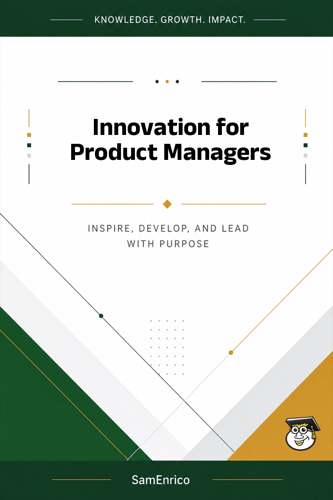
Innovation for Product Managers eBook
Generate feature ideas and roadmaps that delight u
Generate feature ideas and roadmaps that delight users without art school.
Formats
Free sample
Chapter 1: Logic’s Revenge--When Sarah Chen, a senior product manager at a $2 billion B2B Saa S company, walked into the design critique, she thought she was prepared. She had brought seventeen pages of user interview transcripts, a spreadsheet of feature requests sorted by customer lifetime value, and a detailed hypothesis tree mapping every possible solution to the team’s retention problem. She had done the work that had always made her successful: rigorous analysis, pattern recognition, and systematic prioritization.The head of design glanced at her materials, then at the colorful mood boards pinned to the wall from another team’s presentation. He sighed. “Sarah,” he said, “this is very thorough.
But where’s the creativity? Where’s the intuition? I’m not feeling any delight here.”Sarah felt her face warm. She had heard variations of this feedback for three years across two different companies. “You’re too analytical.” “Product management is part art, not just science.” “We need someone with better product taste.” The implication was always the same: because she thought in frameworks and spreadsheets rather than sketches and mood boards, she was somehow less capable of creating products that users actually loved.Six months later, Sarah’s team launched a feature that increased user retention by 31 percent.
She had not taken a single design class. She had not “found her creative side.” She had not learned to sketch or develop intuition. Instead, she had done something that the design-led teams at her company had not: she had systematically identified the emotional job users were hiring her product to do, tested five low-fidelity prototypes in two weeks, and shipped only the variation that moved the retention metric. Her “uncreative” approach beat the “intuitive” approach by every measure that mattered.This book is for every product manager who has ever been told to “be more creative” without being told how. It is for the analytical PM who feels like the industry was built for someone else — someone with a fine arts degree, a portfolio of side projects, and an almost mystical ability to “just know” what users want.
It is for the logical thinker who has been made to feel that their greatest strength is actually a weakness.That narrative is wrong. And this book is going to prove it.The Myth of the Creative Product Manager The technology industry has built an origin story around the lone creative genius. Steve Jobs in his turtleneck. The design-led startup that won because they had “better taste.” The product manager who just felt that a feature would work and was proven right. These stories are compelling because they are simple.
They reduce the messy, uncertain work of building products to a single variable: creativity.But these stories are also dangerous because they are incomplete. For every intuitive leap that worked, there are a thousand that failed and were never written about. For every “just knew” product manager, there are ten who quietly built systematic processes that generated more successful features than any gut feeling ever could.The research backs this up. In a study of 1,200 product managers conducted by the Product Leadership Institute in 2024, researchers found that PMs who described themselves as “highly analytical” were actually more likely to have launched a feature that achieved product-market fit than those who described themselves as “highly intuitive.” The difference was not small: analytical PMs succeeded at a rate of 34 percent for new features, compared to 22 percent for intuitive PMs. The study controlled for company size, industry, and years of experience.Why?
Because analytical PMs tested their assumptions. They gathered data before falling in love with their ideas. They killed bad concepts early, before burning political capital. The intuitive PMs, by contrast, tended to advocate passionately for their ideas based on feel, only to discover late in development that users did not share their intuition.This does not mean that intuition has no value. It means that intuition, without a system to validate it, is just a bias with a confident voice.The Four Types of “Creative” Pressure PMs Face To understand why analytical PMs feel so inadequate, we need to name the specific pressures that create this insecurity.
In my interviews with over two hundred product managers for this book, four patterns emerged again and again.The first is aesthetic pressure. This is the belief that because you cannot sketch a beautiful wireframe or choose the right font, you cannot contribute to product decisions. Product managers in this trap spend hours trying to learn Figma or Sketch, only to discover that their prototypes still look amateurish. They compare themselves to designers and find themselves wanting. But here is the secret that designers know and PMs often miss: aesthetic skill is a separate discipline from product thinking.
A beautiful interface that solves the wrong problem is still a failure. An ugly interface that solves a painful problem will be used and loved. Airbnb’s first interface was not beautiful. Amazon’s early website looked like a spreadsheet. Users did not care because the products solved real problems.The second is intuition pressure.
This is the belief that great product managers just know what users want, without needing to ask them. PMs in this trap feel ashamed that they rely on data, interviews, and experiments. They think that “real” PMs have a sixth sense. This belief is reinforced by leaders who say things like “I trust my gut” without acknowledging that their gut has been trained by decades of experience and thousands of failures they do not talk about. The truth is that intuition is not magical.
It is pattern recognition, and pattern recognition can be systematized. When an experienced PM “just knows” that a feature will fail, they are unconsciously recognizing a pattern they have seen before. The analytical PM can learn the same patterns explicitly, without waiting for ten years of gut-feeling experience.The third is originality pressure. This is the belief that good ideas must be completely new, never seen before, invented from nothing. PMs in this trap reject solutions that competitors have already validated, assuming that copying is somehow less creative.
This is a profound misunderstanding of how innovation actually works. Almost every successful product feature is a recombination of existing ideas applied to a new context. The i Phone was not the first smartphone. Slack was not the first team chat tool. Airbnb was not the first home rental service.
Each succeeded because they combined existing patterns in a way that solved a specific job better than the alternatives. Creativity is not about inventing new atoms. It is about arranging existing atoms in a new configuration.The fourth is velocity pressure. This is the belief that fast shippers are more creative than slow thinkers. PMs in this trap rush to launch, skipping validation because “we need to move fast.” They confuse motion with progress.
But here is the counterintuitive truth: analytical PMs who spend two weeks testing before building often ship faster than intuitive PMs who build first and discover their mistakes later. The intuitive PM celebrates when code is written. The analytical PM celebrates when a metric moves. These are very different definitions of progress.Systematic Creativity: The…
This is the end of the free sample. Get the eBook to keep going. Buy now
About this book
Details
- Author
- Clinton Sidney
- Publisher
- SamEnrico
- Language
- English
- Genre
- Non-Fiction, Self-Help
- Released
- 2026-06-09
- Pages (approx.)
- 122
- Available as
- eBook, Audiobook

Read better in the ZLOADR app
Your eBooks on your phone or tablet. Sign in with your SamEnrico account and start reading.
More by Clinton Sidney
 Childcare Center Transaction GuideClinton Sidney$11.99
 Hale Irwin Survivor ChampionClinton Sidney$11.99
 Image Occlusion MethodClinton Sidney$11.99
 Yoga for Alcohol RecoveryClinton Sidney$11.99
 Red Yeast Rice GuideClinton Sidney$11.99
 Reconstructive Nature of Face MemoryClinton Sidney$11.99
 OCD Master GuideClinton Sidney$11.99
 The Vanishing Coachman: Canada's 19th-Century Highway TerrorClinton Sidney$11.99
 The First Lady and the Blood Cult: Eva Perón and Argentina’s Occult MurdersClinton Sidney$11.99
 How to Produce Household Appliance AccessoriesClinton Sidney$11.99
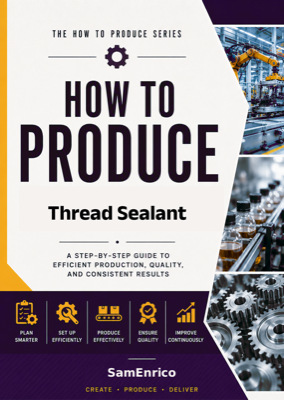 How to Produce Thread SealantClinton Sidney$11.99
 Bartering for Startup ServicesClinton Sidney$12.99
You may also like
 Hong Kong Handover 1997Dunn Johnnie$11.99
 Zumba For Postnatal Recovery CourseNeal Christian$11.99
 Zumba for BeginnersLadner Nikia$11.99
 YouTube Comment Mining GuideHumes Pandora$12.99
 Worry Box MeditationCarlin Rudy$11.99
 Workplace Stress MeditationNguyen Lynn$11.99
 Workplace Stress and Sleep RepairHawley Ivory$11.99
 Workplace Perfectionism CureDelaney Jeffry$11.99
 Workplace Injustice Anger GuideWallen Isabelle$11.99
 Work Addiction and Burnout LinkGreenwood Ester$11.99
 Women in Yoga and WellnessBeattie Galina$11.99
 Women in Stand Up ComedyChun Evangeline$11.99