
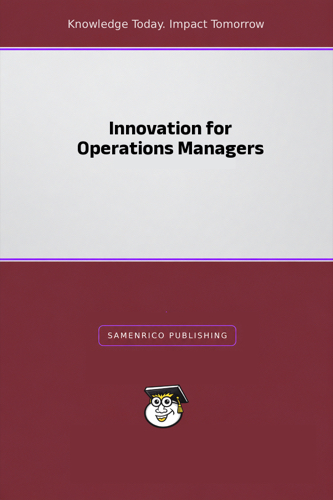
Innovation for Operations Managers eBook
Redesign processes and workflows with fresh eyes t
by Leone Armida
Redesign processes and workflows with fresh eyes to cut waste and boost efficiency.
Formats
Free sample
Chapter 1: The Efficiency Trap--–- Maya’s phone buzzed at 6:47 PM on a Tuesday. It was her boss, the Vice President of Operations. The message was short: “Great job on the automation project. Throughput is up 22%. You’re getting a bonus.
Let’s discuss your career path next quarter.”Maya should have been thrilled. She had just spent four months and $180,000 leading a cross-functional team to automate a critical error-correction process in her logistics company. The old process required seven people to manually review misrouted packages, correct address errors, and resubmit shipping labels. It took an average of forty-eight hours per correction. The new automated system reduced that to just under four hours.
The dashboard was green. The metrics were up. The bonus was real.But Maya stared at her screen with a hollow feeling in her chest. Because she had also been watching another set of numbers—the ones her boss did not ask about. Customer churn had increased 15 percent over the same four months.
Repeat errors on the same accounts had doubled. Her frontline team, once energetic in their morning huddles, now moved in silence. They were not celebrating the automation. They were drowning in a new kind of work: managing the escalations from customers who received the wrong packages faster than ever before.Maya had just committed the single most expensive mistake in operations management. She had optimized a corpse.The seduction of speed Every operations manager knows the pressure.
Faster throughput. Lower unit costs. Shorter cycle times. These are the metrics that appear on dashboards, in bonus calculations, and in the quarterly reviews that determine careers. The logic seems unassailable: if you can do the same work in less time, you have improved.
If you can process more units with the same headcount, you have created value.This logic is not just wrong. It is dangerous.The Efficiency Trap is the false belief that optimization can substitute for innovation. It is the assumption that making a process faster, cheaper, or more automated is always a step forward. It is the reason that millions of dollars are poured into “digital transformation” projects that automate processes that should never have existed in the first place.Consider what Maya automated. Her company had a problem: packages were being misrouted because address data entered at checkout was frequently incorrect.
The root cause was a web form that allowed customers to type anything into the address field—apartment numbers in the street line, zip codes that did not match the city, special characters that broke the shipping carrier’s API. Instead of fixing the form, Maya’s predecessors had built an entire error-correction department. Seven people spent their days cleaning up the mess created by a stupid form. When Maya arrived, she was told to “make it faster.” She automated the cleanup. She did not ask whether the cleanup should exist at all.That is the Efficiency Trap.What is organizational sludge?The late Nobel laureate Daniel Kahneman and his collaborator Cass Sunstein popularized the term “sludge” to describe the friction that makes it hard for people to get things done.
In the private sector, sludge takes the form of redundant approvals, obsolete reports, endless compliance checkboxes, meetings that exist solely to discuss other meetings, and processes that persist long after the problem they solved has disappeared.Organizational sludge is different from the waste that Lean manufacturing taught us to see. Lean’s seven wastes—overproduction, waiting, transport, inappropriate processing, excess inventory, unnecessary motion, and defects—are visible. You can see a pallet of unsold inventory. You can watch a worker waiting for parts. You can measure the distance a product travels across a factory floor.Sludge is invisible because it lives in the spaces between work.
It is the approval that adds no insight but adds two days of delay. It is the report that no one reads but that takes three hours to produce. It is the policy that made sense in 2017 but has not been questioned since. It is the email thread with seventeen people cc’d, none of whom are the decision maker.Sludge accumulates slowly. No one wakes up one morning and decides to add twelve approval steps to a purchase request.
But over years, as new managers add new layers and new compliance requirements add new forms, the sludge builds. And because it builds incrementally, it becomes invisible. It becomes “the way we do things here.”The most insidious feature of sludge is that it disguises itself as productivity. When Maya’s team was manually correcting address errors, they were busy. They had full inboxes.
They had urgent problems to solve. Their busyness felt like work. But it was not value-creating work. It was the work of compensating for a broken process. Efficiency made them faster at the compensation, not faster at the value.The difference between improvement and innovation This book draws a sharp distinction between two activities that most managers treat as the same.Improvement is making the existing path faster, cheaper, or more reliable.
Improvement asks: How can we do what we are currently doing, but better? Improvement is valuable when the path is sound. If your customer onboarding process is already efficient and error-free, making it 10 percent faster is a win.Innovation is changing the path entirely—or eliminating it. Innovation asks: Should we be doing this at all? What would happen if we stopped?
What would we design if we started from zero? Innovation is necessary when the path is broken. When the process exists to compensate for a failure elsewhere, innovation kills the process instead of speeding it up.The Efficiency Trap occurs when managers apply improvement to a process that requires innovation. They see a slow process and assume speed is the answer. They invest in automation, re-engineering, or additional headcount to make the broken process run faster.
The result is not a better outcome. It is faster failure.Maya’s automation project was a textbook example of the trap. She improved the error-correction process by a factor of twelve. But the error-correction process should never have existed. The real problem was the address entry form.
By improving the correction process, Maya made the real problem invisible for longer. The form stayed broken. The errors kept coming. And because corrections now happened in hours instead of days, customers received wrong packages faster. Churn increased.Improvement without innovation is not progress.
It is acceleration in the wrong direction.The Fresh Eyes Audit: Your weekly escape from the trap The remainder of this chapter introduces a simple, low-cost protocol that will serve as the foundation for every tool in this book. The Fresh Eyes Audit takes thirty minutes per week. It requires no software, no budget approval, and no special skills. It requires only the willingness to ask one uncomfortable question.Each week, you will select one process that you or your team performs routinely. It can be a formal process with documented steps, or it can be an informal routine—the way you run your weekly staff meeting, the way you approve expense reports, the way you hand off work to the next shift.
Then you ask:“If this process did not exist today, would I invent it?”That is the question. It is devastating in…
This is the end of the free sample. Get the eBook to keep going. Buy now
About this book
Details
- Author
- Leone Armida
- Publisher
- SamEnrico
- Language
- English
- Genre
- Non-Fiction, Self-Help
- Released
- 2026-06-10
- Pages (approx.)
- 149
- Available as
- eBook, Audiobook

Read better in the ZLOADR app
Your eBooks on your phone or tablet. Sign in with your SamEnrico account and start reading.
More by Leone Armida
 Bempedoic Acid GuideLeone Armida$11.99
 Alcohol Recovery FinancesLeone Armida$11.99
 Annika Sorenstam PrecisionLeone Armida$11.99
 Roofing Contractor Multiples GuideLeone Armida$11.99
 Harm OCD ExplainedLeone Armida$11.99
 Pre Lineup Instructions MatterLeone Armida$11.99
 Employer Remote Work PolicyLeone Armida$11.99
 The Storm from the Steppe: Subutai's Unstoppable Campaigns (1220-1241)Leone Armida$11.99
 Hippocrates to Hippocrates: The Western Medical RevolutionLeone Armida$11.99
 How to Produce a Thor Washing MachineLeone Armida$11.99
 A Collector's Handbook to the Franklin 15Leone Armida$11.99
 How to Produce Hot Stamping FoilLeone Armida$11.99
You may also like
 Hong Kong Handover 1997Dunn Johnnie$11.99
 Zumba For Postnatal Recovery CourseNeal Christian$11.99
 Zumba for BeginnersLadner Nikia$11.99
 YouTube Comment Mining GuideHumes Pandora$12.99
 Worry Box MeditationCarlin Rudy$11.99
 Workplace Stress MeditationNguyen Lynn$11.99
 Workplace Stress and Sleep RepairHawley Ivory$11.99
 Workplace Perfectionism CureDelaney Jeffry$11.99
 Workplace Injustice Anger GuideWallen Isabelle$11.99
 Work Addiction and Burnout LinkGreenwood Ester$11.99
 Women in Yoga and WellnessBeattie Galina$11.99
 Women in Stand Up ComedyChun Evangeline$11.99