
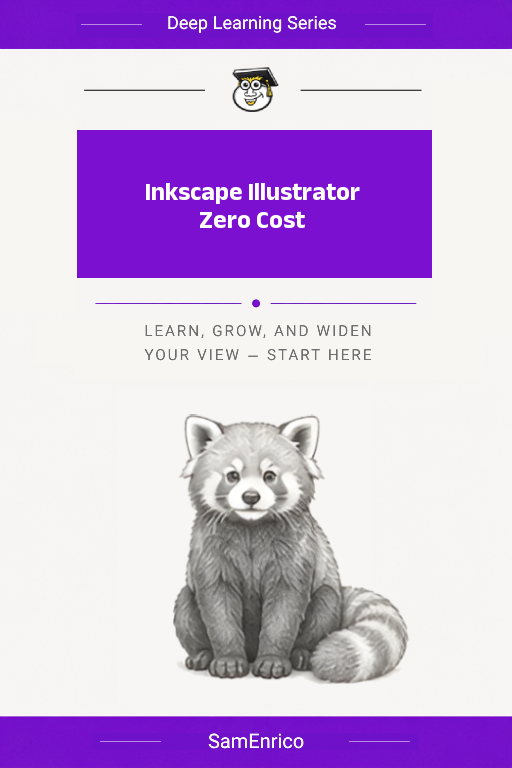
Non-FictionStartup GuideVector Design
Inkscape Illustrator Zero Cost eBook
Design vector graphics and logos using free Inksca
by Nadeau Emiko
Design vector graphics and logos using free Inkscape. This guide replaces Adobe Illustrator for bootstrapped founders needing professional branding.
Formats
Free sample
Chapter 1: The Adobe Tax--–- Let me tell you something most design books won't: You are probably wasting six hundred dollars a year on software you don't actually need. That number—600—istheapproximateannualsubscriptioncostforasingleseatof Adobe Illustrator.Ifyouarereadingthisbook,youarelikelyabootstrappedfounder,asolopreneur,orasmallbusinessowneroperatingonfumesandambition.That600—is the approximate annual subscription cost for a single seat of Adobe Illustrator. If you are reading this book, you are likely a bootstrapped founder, a solopreneur, or a small business owner operating on fumes and ambition. That 600—istheapproximateannualsubscriptioncostforasingleseatof Adobe Illustrator.Ifyouarereadingthisbook,youarelikelyabootstrappedfounder,asolopreneur,orasmallbusinessowneroperatingonfumesandambition.That600 is not pocket change. That 600isaweekof Facebookadsthatcouldfindyourfirsttencustomers.That600 is a week of Facebook ads that could find your first ten customers.
That 600isaweekof Facebookadsthatcouldfindyourfirsttencustomers.That600 is three months of cloud hosting for your Saa S prototype. That $600 is ten customer development interviews over coffee, each one teaching you something about your market that no design tool ever could.But here is the real kicker: Most founders never question the Adobe subscription. They assume that professional design requires professional tools, and professional tools cost money. They assume that "free" means "amateur." They assume that Inkscape—the open-source vector graphics editor that powers this book—is a toy for hobbyists and Linux enthusiasts, not a serious weapon for brand-building.Every single one of those assumptions is wrong.The Psychology of the Subscription Trap Before we open Inkscape, before we draw a single shape or choose a single font, we need to talk about money. Not because money is the only consideration—quality matters, efficiency matters, and your brand's professional appearance matters enormously.
But because your relationship with money as a bootstrapped founder is different from that of an established agency or an in-house design department at a Fortune 500 company.Adobe's pricing model is built for enterprises. It assumes a line item called "creative software" that gets approved once a year and never questioned. It assumes that the person paying for the software is not the person feeling the pinch of that payment. For a solo founder writing checks from their personal savings account or scraping together revenue from their first few customers, the math looks very different.Consider the psychology of the 600subscription.Thatmoneycomesoutofyourbankaccounteverysinglemonth,600 subscription. That money comes out of your bank account every single month, 600subscription.Thatmoneycomesoutofyourbankaccounteverysinglemonth,50 at a time, or every single year in a lump sum that hurts.
You feel it. And because you feel it, you create a mental narrative: I'm paying for this, so it must be better. I'm paying for this, so I can't afford to switch. I'm paying for this, so every logo I design in a free tool would somehow be lesser.That narrative is what I call the Adobe Tax Fallacy. It is the mistaken belief that the price of a tool correlates directly with the quality of the work you can produce with it.
In the physical world, this is sometimes true. A 10hammerfromadiscountstorewillbreakfasterthana10 hammer from a discount store will break faster than a 10hammerfromadiscountstorewillbreakfasterthana40 hammer from a professional brand. A 200laptopwillstruggletorunbasicsoftware,whilea200 laptop will struggle to run basic software, while a 200laptopwillstruggletorunbasicsoftware,whilea2,000 laptop will handle heavy workloads with ease.But software is not hardware. And vector graphics—the mathematical language of logos, icons, and illustrations—is not dependent on the application you use to create it. A cubic Bézier curve defined by four coordinates is mathematically identical whether you draw it in Adobe Illustrator, Inkscape, Affinity Designer, or even a text editor.
The output is the same. The only difference is the interface you use to manipulate it.What Bootstrapped Founders Actually Need Before we go any further, let me ask you a brutally honest question: What do you actually need from a design tool?Not what Adobe's marketing team wants you to believe you need. Not what professional designers with ten years of experience need. What do you, a bootstrapped founder trying to build a brand on a shoestring budget, actually require?Here is my answer, based on conversations with hundreds of early-stage founders. You need to:Create a professional-looking logo that doesn't embarrass you when a potential investor looks at your pitch deck.Design social media graphics (Instagram posts, Linked In banners, X headers) that look consistent and polished.Produce a one-page brand style guide so you can hand off assets to freelancers or employees later.Export files in the right formats (SVG for web, PNG for social, PDF for print) without needing a degree in color spaces.Iterate quickly when a friend, mentor, or early customer says, "Have you tried making the logo blue instead of green?"Spend exactly zero dollars on software so you can reinvest that money into customer acquisition and product development.Notice what is not on that list.
You do not need to master every vector manipulation technique ever invented. You do not need to collaborate with a team of twenty designers using shared cloud libraries. You do not need to automatically generate hundreds of brand assets from a single master file. You do not need to integrate with Adobe Fonts or Adobe Stock or Adobe Creative Cloud or any other ecosystem designed to keep you locked in.You need a tool that gets out of your way, does what you ask it to do, and costs nothing. That tool is Inkscape.The Case Studies You Won't Find in Adobe's Marketing I want to tell you about three fictional—but entirely realistic—startups.
Their names have been changed, but their stories are happening every single day in garages, coffee shops, and co-working spaces around the world.Startup A: Saa S Dashboard for Freelancers. The founder, Maria, had zero design budget. She downloaded Inkscape on a Tuesday, followed a tutorial for creating a simple geometric logo using only rectangles and circles, and had a finished brand mark by Thursday. She spent the $600 she saved on Google Ads. That campaign brought in her first twenty paying customers.
Eighteen months later, when Maria raised a seed round, she hired a professional designer to refine her brand. The designer opened the Inkscape SVG file, exported it to Illustrator without losing a single curve, and charged Maria exactly zero dollars for "cleanup." Because there was nothing to clean up.Startup B: Organic Skincare Line. The founder, James, had a hand-drawn sketch of a leaf that his sister had doodled on a napkin. He scanned it, imported it into Inkscape, and traced it using the Trace Bitmap feature. He added a gradient to make the leaf look glossy and set the brand colors to match his actual product labels.
He printed his own business cards using a local print shop, sending them a PDF exported directly from Inkscape. The print shop owner asked James what software he used, then said, "I would have charged you extra if you sent me a Canva file. This PDF is perfect."Startup C: Nonprofit Literacy Program. The founder, Aisha, needed to create a logo, a flyer, a website header, and a donation form graphic. She had exactly zero money for design.
She used Inkscape to build a master template with clones—linked copies of her logo that would update everywhere if she changed the original. When a board member suggested she change the font, she made the edit…
This is the end of the free sample. Get the eBook to keep going. Buy now
About this book
Details
- Author
- Nadeau Emiko
- Publisher
- SamEnrico
- Language
- English
- Genre
- Non-Fiction, Startup Guide, Vector Design
- Released
- 2026-06-01
- Pages (approx.)
- 147
- Available as
- eBook, Audiobook

Read better in the ZLOADR app
Your eBooks on your phone or tablet. Sign in with your SamEnrico account and start reading.
More by Nadeau Emiko
 The Geothermal Capital OutlookNadeau Emiko$11.99
 Tenzing British Expedition ViewsNadeau Emiko$11.99
 RLS Temperature Therapy Hot And ColdNadeau Emiko$11.99
 NVC For Customer Service GuideNadeau Emiko$11.99
 Twelve Step for PerfectionistsNadeau Emiko$11.99
 Isaac Abarbanel Bible CommentariesNadeau Emiko$11.99
 Cool Down Techniques for OfficesNadeau Emiko$11.99
 Collection Agency StrategyNadeau Emiko$11.99
 Mind Reading Anger TrapNadeau Emiko$11.99
 The Trial of the Poetess: Nefertiti's Verse and the Pharaoh's JusticeNadeau Emiko$11.99
 The Bone Whisperers of Angkor: Unmasking the Dead in Ancient CambodiaNadeau Emiko$11.99
 The Whispering Walls of the OverlookNadeau Emiko$11.99
You may also like
 Hong Kong Handover 1997Dunn Johnnie$11.99
 Zumba For Postnatal Recovery CourseNeal Christian$11.99
 Zumba for BeginnersLadner Nikia$11.99
 YouTube Comment Mining GuideHumes Pandora$12.99
 Worry Box MeditationCarlin Rudy$11.99
 Workplace Stress MeditationNguyen Lynn$11.99
 Workplace Stress and Sleep RepairHawley Ivory$11.99
 Workplace Perfectionism CureDelaney Jeffry$11.99
 Workplace Injustice Anger GuideWallen Isabelle$11.99
 Work Addiction and Burnout LinkGreenwood Ester$11.99
 Women in Yoga and WellnessBeattie Galina$11.99
 Women in Stand Up ComedyChun Evangeline$11.99