
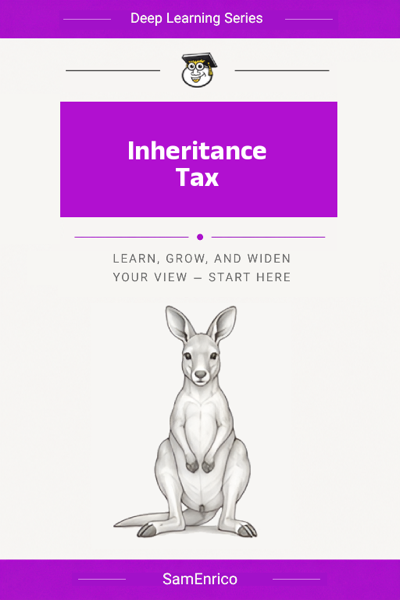
Non-FictionInformativeEducational
Inheritance Tax eBook
A Coursebook on Inheritance Tax
A Coursebook on Inheritance Tax
Formats
Free sample
Chapter 1: The Voluntary Tax...--–- Most people believe inheritance tax is a toll booth at the end of life’s highway—an unavoidable charge collected by the government before you’re allowed to pass your hard-earned assets to the people you love. They are wrong. Spectacularly wrong.In fact, inheritance tax (IHT) is best understood as a voluntary tax. You read that correctly. Voluntary.
The government has constructed a system so riddled with exemptions, reliefs, and planning opportunities that only those who fail to plan—or who actively choose to ignore the rules—end up paying the full rate. This chapter will reframe everything you think you know about IHT, transforming it from a terrifying threat into a manageable, even optimizable, financial variable.This book is not an academic exercise. It is a coursebook for action. By the time you finish these twelve chapters, you will understand not only what the rules are but exactly how to use them to protect your family’s future. And it begins here, with the architecture of the tax itself.The Great Misunderstanding: What Inheritance Tax Really Is Most people, when asked to define inheritance tax, will say something like: “It’s the tax the government takes from your estate when you die.” That definition is incomplete to the point of being misleading.Inheritance tax is not, strictly speaking, a tax on death.
It is a tax on transfers of value—transfers made during your lifetime and transfers made upon your death. The government cares less about the event of your passing than it does about the movement of wealth from one person to another. This distinction is not academic pedantry; it is the key that unlocks every planning strategy in this book.Consider two people: Alice and Bob. Alice gives her daughter £50,000 as a wedding gift while Alice is alive and well. Bob leaves his daughter £50,000 in his will after he dies.
Under the IHT rules, both transfers are examined through the same lens. Both are “transfers of value.” Both may attract tax. But—and this is crucial—both may also be rendered completely tax-free if planned correctly.The unified transfer tax system is the name for this single framework that governs both lifetime gifts and death estates. The government created this unified system to close a loophole that existed decades ago, when wealthy families could simply give everything away on their deathbeds and pay no tax at all. Today, the system looks back over time—specifically, seven years—to capture transfers made shortly before death.
But as you will learn in Chapter 6, even that seven-year rule can be navigated.The Political and Social Rationale: Why This Tax Exists Before you learn to avoid a tax, you should understand why it exists. Inheritance tax is one of the most politically controversial taxes in the Western world, yet it has survived for over a century because it serves three distinct social purposes.First, wealth redistribution. The gap between inherited wealth and earned wealth is a central feature of modern capitalism. A person who inherits a house from their parents starts life with an enormous advantage over a person who does not. Inheritance tax is designed to modestly reduce that advantage by skimming a portion off the largest estates and returning it to the general treasury, funding public services that benefit everyone.Second, preventing dynastic fortunes.
Without an inheritance tax, wealthy families could accumulate assets across generations, creating permanent economic dynasties. The Vanderbilt family in the United States, the aristocracy in the United Kingdom—these concentrations of wealth were the original targets of inheritance taxation. The tax is meant to ensure that each generation builds its own fortune rather than simply managing the fortune of the previous generation.Third, encouraging charitable giving. Nearly every inheritance tax system in the world offers substantial benefits for donors who leave money to charity. In the UK, leaving 10% or more of your net estate to charity reduces your overall IHT rate from 40% to 36%.
This is not accidental. The government has calculated that it would rather see money go to hospitals, universities, and arts organizations than to the tax collector.None of these rationales will comfort you when you are facing a six-figure tax bill. But understanding them helps explain why the rules are structured the way they are—and, more importantly, why the government has deliberately created so many exemptions and reliefs. The goal is not to confiscate family wealth. The goal is to prevent extreme concentrations while encouraging productive uses of capital.The Three Categories of Transfers (A Critical Distinction)Here is where most inheritance tax guides go wrong.
They throw a hundred rules at you without first establishing the fundamental framework that organizes those rules. You will not make that mistake.Every transfer of value—every gift, every inheritance, every trust contribution—falls into exactly one of three categories. Once you understand these three categories, the entire inheritance tax system becomes a matter of sorting and planning.Category One: Exempt Transfers Exempt transfers are gifts that are completely and permanently free of inheritance tax. They never enter the cumulative calculation. They never count against your allowances.
They are, for tax purposes, invisible.Examples include the annual exemption (gifting up to a certain amount each year), the small gifts exemption, gifts between spouses who are domiciled in the same country, and gifts to qualifying charities. Chapter 2 is devoted entirely to these powerful tools. For now, simply understand that exempt transfers are your first line of defense—and for most families, they are sufficient to eliminate IHT entirely.Key takeaway: Exempt transfers = invisible to the tax system. Use them first.Category Two: Potentially Exempt Transfers (PETs)Potentially Exempt Transfers are gifts that may or may not attract tax depending on how long the donor survives. This is the famous “seven-year rule” that you have probably heard about in vague terms.When you make a gift that is not otherwise exempt, it becomes a PET.
If you survive for seven years after making that gift, the PET becomes fully exempt—as if it had been an exempt transfer all along. If you die within seven years, the PET becomes a chargeable transfer and is added back into your estate for tax purposes, though with reducing penalties (called “taper relief”) as the seven-year mark approaches.PETs are the workhorses of inheritance tax planning for wealthy families. Chapter 6 explains them in exhaustive detail, including the complex rules around taper relief and the interaction with the nil-rate band.Key takeaway: PETs = tax-free if you live seven years. Most people do. Use them aggressively.Category Three: Chargeable Lifetime Transfers (CLTs)Chargeable Lifetime Transfers are gifts that attract immediate inheritance tax at the time they are made.
You might wonder why anyone would make such a gift. The answer is trusts.When you transfer assets into most types of trust, that transfer is treated as a CLT. You pay tax immediately (or at least account for it) on the value transferred above the nil-rate band. However, once the assets are inside the trust, they are generally outside your personal estate for future IHT purposes. Trusts have their own tax regime—including the notorious ten-year anniversary charge—which…
This is the end of the free sample. Get the eBook to keep going. Buy now
About this book
Details
- Author
- Clifton Lakeshia
- Publisher
- SamEnrico
- Language
- English
- Genre
- Non-Fiction, Informative, Educational
- Released
- 2026-06-02
- Pages (approx.)
- 155
- Available as
- eBook, Audiobook

Read better in the ZLOADR app
Your eBooks on your phone or tablet. Sign in with your SamEnrico account and start reading.
More by Clifton Lakeshia
 Visceral Fat Reduction PlanClifton Lakeshia$11.99
 Keto For Endurance Athletes CourseClifton Lakeshia$11.99
 MAT Buprenorphine GuideClifton Lakeshia$11.99
 Leading Overland Sahara Western RouteClifton Lakeshia$11.99
 Letters from the Silk Road: The Secret Art of War and LoveClifton Lakeshia$11.99
 How to Produce Camera Silencers and Sound BlimpsClifton Lakeshia$11.99
 Learning Curve Analysis Study GuideClifton Lakeshia$12.99
 How to Start a Lozenge (not Medicated) Business (Beginners Guide)Clifton Lakeshia$11.99
You may also like
 Hong Kong Handover 1997Dunn Johnnie$11.99
 Zumba For Postnatal Recovery CourseNeal Christian$11.99
 Zumba for BeginnersLadner Nikia$11.99
 YouTube Comment Mining GuideHumes Pandora$12.99
 Worry Box MeditationCarlin Rudy$11.99
 Workplace Stress MeditationNguyen Lynn$11.99
 Workplace Stress and Sleep RepairHawley Ivory$11.99
 Workplace Perfectionism CureDelaney Jeffry$11.99
 Workplace Injustice Anger GuideWallen Isabelle$11.99
 Work Addiction and Burnout LinkGreenwood Ester$11.99
 Women in Yoga and WellnessBeattie Galina$11.99
 Women in Stand Up ComedyChun Evangeline$11.99