
Informational Interview Guide eBook
Prepare three specific questions, take notes durin
Request, prepare for, and follow up on career conversations that build mentor relationships.
Formats
Free sample
Chapter 1: The Insider’s Shortcut...--The most valuable information in your entire career is not on Google. It is not in a job description. It is not hiding in an AI model or buried in a Linked In Learning course. It lives inside the heads of people who have already done what you are trying to do. And they are willing to give it to you for free—if you know how to ask.This chapter is about unlearning almost everything you think you know about networking.
It is about identifying the one person in a hundred who can change your trajectory in twenty minutes. And it is about avoiding the ninety-nine who will waste your time.The $10,000 Coffee (Revisited)Let us begin with a story that sounds like luck but is actually a system.A few years ago, a career changer named Maria wanted to move from nonprofit fundraising into product management at a B2B software company. She had no tech background, no engineering degree, and no internal referrals. What she had was a list of forty-seven people she had met at various networking events over the previous three years. She had their business cards in a drawer.
She had never contacted most of them.Following the method you will learn in this book, Maria did not email all forty-seven people. She did not send a mass Linked In message. She did not ask anyone for a job. Instead, she spent ninety minutes identifying exactly three people from that list who met three specific criteria: they worked in product management at B2B software companies, they had been in their roles for less than eighteen months, and they had a public presence (a blog post, a conference talk, or a detailed Linked In profile) that revealed something specific about how they thought about their work.She emailed each of them a four-sentence note. Two replied within twenty-four hours.
One agreed to a fifteen-minute call.During that call, Maria asked three questions—the same three you will learn in Chapter 3 of this book. The product manager mentioned a specific analytics tool (Mode) that her company used, a common failure point for new product managers (over-indexing on stakeholder requests instead of user data), and a piece of advice that Maria would later call "the key that opened the door": "We are desperate for people who can translate customer pain into technical requirements. No one teaches that in school. If you can learn to do that, you will get hired even without a tech background."Maria spent the next two weeks doing exactly that. She took a free online course on writing user stories.
She analyzed three public product requirement documents she found on a tech blog. She built a one-page portfolio showing how she would improve a feature in the company's own product.Then she sent a thirty-day follow-up note to the product manager—not asking for a job, but showing what she had built. The product manager forwarded that note to a hiring manager. Maria had an interview within a week. She was offered the role ten days later.The coffee during that informational interview cost 4.Thesalarywas4.
The salary was 4.Thesalarywas120,000.This is not a story about luck. It is a story about leverage. Maria did not spend months applying online. She did not spam her resume to two hundred job postings. She identified the right person, asked the right questions, and acted on the answers.
The entire sequence from first email to job offer took thirty-eight days.The Pareto Principle of People Most networking advice is backwards. It tells you to cast a wide net, to go to more events, to collect more business cards, to connect with everyone you have ever met. This is a recipe for exhaustion, not results.The Pareto Principle—also known as the 80/20 Rule—states that roughly 80 percent of effects come from 20 percent of causes. In the context of informational interviews, this translates to a stark reality: twenty percent of the people in your network will provide eighty percent of your actionable intelligence. The other eighty percent will provide stories you could have found on Reddit, generic advice about "following your passion," and a pleasant but ultimately forgettable conversation.The key to unlocking the power of informational interviews is not doing more of them.
It is doing fewer of them with the right people.Who is the right person? The answer is counterintuitive. It is not the senior vice president with thirty years of experience. It is not the famous author or the TED speaker. It is not the person who has been in their role for a decade and has seen everything.The right person is what this book calls an Insider.
An Insider is someone who is two to three steps ahead of you in your desired career path, has made a recent transition, and still remembers what it felt like to be where you are now. They have battle scars that are still fresh. They have not yet forgotten the confusion, the fear, and the specific tactical questions that kept them up at night.Let us break down why each of these characteristics matters.First, two to three steps ahead. If you are a college student wanting to become a management consultant, the right Insider is not the partner who has been at Mc Kinsey for twenty years. That partner operates at a level of abstraction that will not help you get your first job.
The right Insider is a first-year analyst who started eighteen months ago. They remember exactly which case prep materials actually worked. They remember which interviewers were kind and which were brutal. They remember the specific excel shortcuts that saved them in their first week. They are close enough to your position to offer tactical advice but far enough ahead to see what is coming.Second, recent transition.
Someone who has been in their role for five years has forgotten what it was like to learn the basics. Their advice will tend toward the abstract: "Be persistent," "Show initiative," "Network authentically." These statements are true and useless. Someone who made a transition within the last eighteen months can still remember the specific resume format that got them past the automated screen, the exact wording of the email that got a response, and the name of the recruiter who actually read applications.Third, accessible specificity. The best Insiders leave digital breadcrumbs. They write blog posts.
They speak on panels. They have detailed Linked In profiles that show not just their job titles but the projects they worked on. They share articles with commentary. These breadcrumbs are not random acts of self-promotion. They are invitations.
They tell you what this person cares about, what problems they are currently solving, and how they think. If you cannot find anything specific about how a person approaches their work in under five minutes of searching, they are probably not the right Insider for you.The Taker vs. The Learner Before you send a single email, you must understand the single biggest reason why informational interviews fail. It is not a bad question. It is not poor follow-up.
It is a faulty mindset.Most people approach informational interviews as takers. They want something. A job. A referral. An introduction.…
This is the end of the free sample. Get the eBook to keep going. Buy now
About this book
Details
- Author
- Hutto Dominique
- Publisher
- SamEnrico
- Language
- English
- Genre
- Non-Fiction, First 30 Days, Interview Prep, Follow-Up, Self-Help, Career Exploration
- Released
- 2026-05-30
- Pages (approx.)
- 147
- Available as
- eBook, Audiobook

Read better in the ZLOADR app
Your eBooks on your phone or tablet. Sign in with your SamEnrico account and start reading.
More by Hutto Dominique
 The Assertiveness for Salespeople GuideHutto Dominique$11.99
 Infertility Couples Stress GuideHutto Dominique$11.99
 Mitch Kapor LotusHutto Dominique$11.99
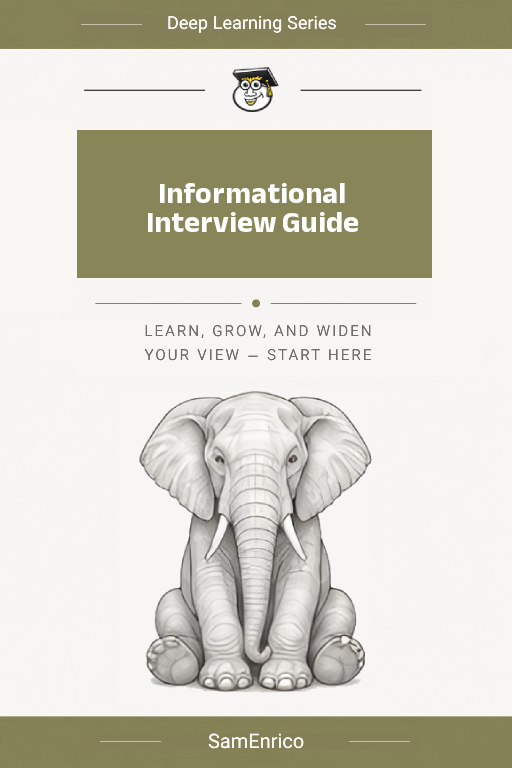 Informational Interview GuideHutto Dominique$12.99
 Teen Emotion DecodeHutto Dominique$11.99
 Belgian Congo CatastropheHutto Dominique$11.99
 Persuasive Website Redesign BriefHutto Dominique$11.99
 Peasant Participation GuideHutto Dominique$11.99
 Bias Blind Spot AwarenessHutto Dominique$11.99
 The Silent Bridge: How a Forgotten Diplomat Averted Nuclear WarHutto Dominique$11.99
 Harmony of the Spheres: Kepler’s Musical CosmosHutto Dominique$11.99
 The Feast of Genius: A Culinary Celebration of Black Nobel Laureates in ScienceHutto Dominique$11.99