
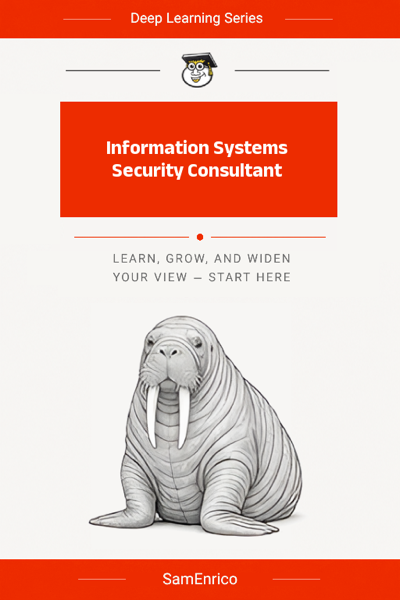
Non-FictionInformativeEducational
Information Systems Security Consultant eBook
A Coursebook on Information Systems Security Consu
A Coursebook on Information Systems Security Consultant
Formats
Free sample
Chapter 1: The Trust Mandate...--The first time I watched a security consultant fail, it was spectacular. Not because of a breach, not because of a technical oversight, but because he opened his mouth and never stopped talking about encryption algorithms.The client’s Chief Financial Officer—a woman who had just survived a hostile takeover attempt and was carrying the weight of twelve thousand employees on her shoulders—leaned back in her chair after forty-five minutes of technical monologue and asked a single question: “So how much money are we going to lose if we do nothing?”The consultant blinked. He had prepared sixty-three slides. He had explained AES-256 versus RSA-4096. He had diagrammed the difference between hashing and encryption.
He had used the word “cryptographically secure” eleven times. And he had absolutely no answer to that question.The meeting ended seven minutes later. The contract, worth two hundred and forty thousand dollars, was never signed.That consultant was me.I was thirty-one years old. I held the CISSP, the CISM, and a master’s degree in information security. I had passed every technical exam the industry could throw at me.
I had spent three thousand hours studying network protocols, access control models, and penetration testing methodologies. And I was completely, utterly useless to the person who was about to write the check.That was the day I learned the first and most important truth of security consulting, a truth that every top book on the subject—from the IEEE guides to the (ISC)² handbooks—dances around but rarely states plainly: Technical expertise is table stakes. Trust is the currency.You can know every vulnerability in every system ever built. You can recite the MITRE ATT&CK matrix from memory. You can configure a zero-trust architecture in your sleep.
If the client does not trust you—truly trust you, not just believe that you know things—you will fail. You will deliver reports that go unread. You will make recommendations that go unimplemented. You will bill your hours, collect your paycheck, and wonder why your career feels hollow while your inbox stays empty.This book exists because that pattern is epidemic in our profession. I have trained over four hundred aspiring security consultants in the decade since that humiliating meeting.
I have watched the same mistakes repeat across firms of every size, from solo practitioners to the Big Four. And I have distilled what works into a single framework: the shift from technician to trusted arbiter.The 70/30 Rule Let me give you a number that will change how you think about your career. Seventy percent of your success as a security consultant will come from skills that have nothing to do with technology. Thirty percent will come from technical depth. This is not an opinion.
It is a pattern I have observed across four continents, two hundred engagements, and every industry from banking to oil and gas to retail.The seventy percent includes: active listening, emotional regulation during conflict, the ability to translate risk into financial terms, project management, expectation setting, negotiation, report writing that non-technical readers can understand and act upon, and the quiet, unteachable art of knowing when to speak and when to be silent.The thirty percent includes everything else. Yes, you still need to know how to read a packet capture. Yes, you still need to understand the difference between a false positive and a true positive in a vulnerability scan. Yes, you still need to stay current on emerging threats, new attack vectors, and evolving compliance requirements. But that knowledge is the entry ticket, not the main event.Here is the harsh truth that the certification industry will never tell you: The CISSP does not teach you how to consult.
The CISM does not prepare you for the boardroom. The OSCP does not explain why a client would choose to accept a risk you have clearly documented as critical. These credentials prove that you have learned a body of knowledge. They do not prove that you can apply that knowledge in a way that creates value for a paying customer.This chapter is about closing that gap. It is about redefining your identity not as a technician who happens to talk to clients, but as an arbiter who happens to know technology.The Arbiter Mindset The word “arbiter” comes from the Latin arbiter, meaning a witness, a judge, or one who has the power to decide.
In ancient Rome, an arbiter was not a ruler; he was someone whose judgment was trusted because he understood both sides of a dispute and could see a path through that neither party could see alone.That is exactly what a security consultant does. You sit between two worlds that speak different languages. The technical world speaks in CVSS scores, CVE identifiers, encryption protocols, and access control lists. The business world speaks in revenue, margin, risk appetite, competitive advantage, and quarterly earnings. Neither world is wrong.
Both worlds are incomplete. You are the translator. You are the witness who sees the whole picture. You are the arbiter.This mindset shift is not abstract philosophy. It has concrete, observable consequences in how you conduct every phase of an engagement.Consider the discovery workshop.
A technician walks into the client’s office with a checklist of questions about firewall configurations, patch management cadence, and identity provider integrations. The technician takes notes, nods at technical answers, and leaves with a binder full of data that no one else in the organization understands or cares about.An arbiter walks into the same office and asks a different set of questions. “What keeps you up at night?” “What would happen to your business if you couldn’t process payments for forty-eight hours?” “If you had to choose between security and speed to market, where would you draw the line?” The arbiter listens—really listens—to the answers, noting not just the words but the hesitations, the deflections, the moments when the client’s eyes flick away because they are telling you something uncomfortable.The technician collects data about the system. The arbiter collects intelligence about the organization—its fears, its constraints, its real priorities beneath the stated ones. The technician asks “how.” The arbiter asks “why” and then “why” again and then “why” one more time.The Junior Consultant’s Trap Let me tell you about Alex.
Alex was brilliant. He had graduated top of his class from a well-regarded cybersecurity program. He had earned his OSCP before his twenty-fourth birthday. He could break into almost anything. His managers loved him because his technical work was flawless.During a routine penetration test for a mid-sized healthcare provider, Alex discovered a critical vulnerability in the client’s patient portal.
An unauthenticated attacker could extract the medical records of any patient in the system. The CVSS score was 9.8. This was not a theoretical risk; Alex demonstrated it with a proof of concept that retrieved a live patient’s medication list in under four seconds.Alex wrote his report. His technical findings were impeccable. He documented the vulnerable endpoint, the missing authentication control, and the specific lines of code that needed to be fixed.
He delivered the report to the client’s IT director, who thanked him politely and filed it away.Three months later, the…
This is the end of the free sample. Get the eBook to keep going. Buy now
About this book
Details
- Author
- Dawkins Vanna
- Publisher
- SamEnrico
- Language
- English
- Genre
- Non-Fiction, Informative, Educational
- Released
- 2026-05-07
- Pages (approx.)
- 154
- Available as
- eBook, Audiobook

Read better in the ZLOADR app
Your eBooks on your phone or tablet. Sign in with your SamEnrico account and start reading.
More by Dawkins Vanna
 Study Break Recovery GuideDawkins Vanna$11.99
 Anger Advantages DisadvantagesDawkins Vanna$11.99
 Affirmation Reminder SystemDawkins Vanna$11.99
 Affluenza Recovery WorkbookDawkins Vanna$11.99
 The HGH Anti Aging Clinic GuideDawkins Vanna$11.99
 The Silent Operatives: Mime and Espionage in the Golden Age of Australia/New ZealandDawkins Vanna$11.99
 10 Ways to Use Flax Seeds (Recipe Book)Dawkins Vanna$11.99
 Promotion Case Peer Data GuideDawkins Vanna$12.99
 BOP Energy Product GuideDawkins Vanna$12.99
 Understanding Vacterl HydrocephalyDawkins Vanna$17.99
You may also like
 Hong Kong Handover 1997Dunn Johnnie$11.99
 Zumba For Postnatal Recovery CourseNeal Christian$11.99
 Zumba for BeginnersLadner Nikia$11.99
 YouTube Comment Mining GuideHumes Pandora$12.99
 Worry Box MeditationCarlin Rudy$11.99
 Workplace Stress MeditationNguyen Lynn$11.99
 Workplace Stress and Sleep RepairHawley Ivory$11.99
 Workplace Perfectionism CureDelaney Jeffry$11.99
 Workplace Injustice Anger GuideWallen Isabelle$11.99
 Work Addiction and Burnout LinkGreenwood Ester$11.99
 Women in Yoga and WellnessBeattie Galina$11.99
 Women in Stand Up ComedyChun Evangeline$11.99