
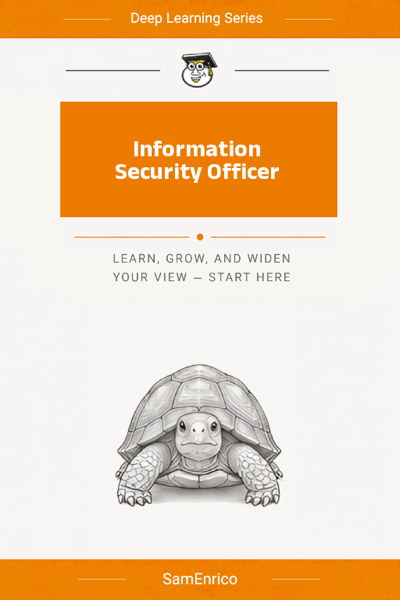
Non-FictionInformativeEducational
Information Security Officer eBook
A Coursebook on Information Security Officer
A Coursebook on Information Security Officer
Formats
Free sample
Chapter 1: The Permission Revolution...–- The first thing they never tell you about becoming an Information Security Officer is that your technical skills will not save you. In fact, if you walk into your first ISO meeting and open your mouth to talk about firewall rules, CVSS scores, or the latest zero-day exploit, you have already lost. Not because those things are unimportant—they are absolutely critical—but because no one in that room cares about them the way you do. The Chief Financial Officer cares about quarterly earnings. The Chief Operating Officer cares about production throughput.
The Chief Executive Officer cares about shareholder value. And if you cannot translate your security concerns into their language, you will be ignored, bypassed, or—worst of all—politely nodded at while everyone quietly continues doing exactly what they were doing before you spoke.This chapter is not about technology. It is about survival. It is about the single most important mindset shift that separates ISOs who flame out within eighteen months from those who rise to become trusted strategic advisors. That shift is the move from being the Department of No to becoming the architect of what I call the Permission Revolution.The Graveyard of the Technically Correct Let us begin with a story.
It is anonymized because the ISO involved still works in the industry, and he has asked not to be named. But the details are real.A mid-sized financial services firm hired a new ISO. He had impeccable credentials: twenty years in security, multiple certifications, and a reputation for technical brilliance. In his first week, he ran a vulnerability scan against the company's external-facing applications. The results were alarming.
Critical vulnerabilities everywhere. Unpatched systems. Weak cipher suites. He documented everything meticulously and walked into the weekly executive staff meeting with a fifty-three-page report.He presented his findings with passion and precision. He explained the risk of remote code execution.
He detailed the potential for data exfiltration. He listed compliance violations. He was, by every technical measure, absolutely correct.Three months later, his budget was cut. Six months after that, he was asked to "transition out."What went wrong? He was right.
That is what makes his story so frightening. He was technically correct, and it cost him his job.The CFO did not care about CVSS scores because she did not understand them. The COO did not care about weak cipher suites because he had never heard of them. And when the ISO refused to approve a new product launch because the server configuration had not been hardened to his standard, he became known not as a protector but as an obstacle. The organization did not fire him for being wrong.
They fired him for being irrelevant.The "Chief Fear Officer" Trap This pattern is so common that it has a name: the Chief Fear Officer syndrome. The CFO in this context stands not for Chief Financial Officer but for Chief Fear Officer—the security leader who believes that their job is to point out every possible danger, say no to every request that carries any risk, and wait for the organization to thank them for their vigilance. That thank-you never comes.Why? Because organizations are not built to minimize risk. They are built to pursue reward.
Every business decision is a trade-off between risk and return. The CEO who approves a new product launch knows there is a chance it will fail. The CFO who signs off on an acquisition knows integration might be messy. The COO who pushes for faster production knows quality might suffer. These leaders accept risk every single day because that is how value is created.When an ISO walks into a room and says only "no," they are not being prudent.
They are being a bottleneck. And bottlenecks get routed around.Shadow IT exists because your developers found a cloud service that lets them work faster, and your approval process took six weeks. Workarounds exist because your security policies made the legitimate path unbearable. The "I'll just ask for forgiveness instead of permission" mindset exists because you trained your colleagues to expect rejection.The Chief Fear Officer is not protecting the organization. They are driving risk underground, where it becomes invisible and unmanaged.
That is far more dangerous than any vulnerability scan will reveal.The Two Questions That Change Everything Early in my career, I worked with a mentor who had been a CISO at three Fortune 500 companies. He was not the most technically brilliant security professional I had ever met. He could not write a buffer overflow exploit. He had never performed a memory forensics dump. But he lasted longer and achieved more than any of his more technical peers because he understood something they did not.He told me: "When someone comes to you with a request, you have two choices.
You can say no, and they will find a way around you. Or you can say yes, if—and then you control the terms."That is the Permission Revolution. It is the shift from prohibition to conditional approval. It is the move from "You cannot do that" to "You can do that, provided you meet these three security requirements."The first question every ISO should ask when presented with a business request is not "Is this secure?" It is "What is the business trying to achieve?" Because once you understand the goal, you can design a secure path to reach it.The second question is "What would have to be true for me to say yes to this?" That question forces you to articulate your conditions clearly, specifically, and in language the business can understand. Not "This needs to be patched" but "We can launch this product once the authentication module supports multi-factor authentication, which will take your engineering team approximately two weeks to implement."Suddenly you are not an obstacle.
You are a partner. You are helping the business achieve its goals, not blocking them.The "Yes, If" Framework in Action Let me give you a concrete example. A product manager comes to you with a request: she wants to use a new third-party analytics service on the company's customer-facing website. The tool will collect user behavior data and feed it back to the marketing team.The traditional ISO says: "No. We have not vetted this vendor.
It is not on our approved list. We do not know where the data is stored or who has access to it. Come back after you have completed our six-week vendor risk assessment process."The product manager leaves frustrated. She signs up for the service using her personal credit card and routes the data to a shadow AWS account. You never see the traffic until the vendor gets breached six months later.The Permission Revolution ISO says: "Yes, you can use this tool, if you meet three conditions.
First, you must use our corporate account for the subscription so we can monitor access. Second, the data must be pseudonymized before it leaves our network. Third, you will work with my team to complete a streamlined vendor assessment in five business days, not six weeks. Here is the timeline. Can you agree to…
This is the end of the free sample. Get the eBook to keep going. Buy now
About this book
Details
- Author
- Mccurdy Hershel
- Publisher
- SamEnrico
- Language
- English
- Genre
- Non-Fiction, Informative, Educational
- Released
- 2026-05-11
- Pages (approx.)
- 143
- Available as
- eBook, Audiobook

Read better in the ZLOADR app
Your eBooks on your phone or tablet. Sign in with your SamEnrico account and start reading.
More by Mccurdy Hershel
 Workplace Assertiveness Training WorkbookMccurdy Hershel$11.99
 Sunrise Hilltop VisualizationMccurdy Hershel$11.99
 Escalator Trance InductionMccurdy Hershel$11.99
 Canadian Seller Amazon USMccurdy Hershel$11.99
 The Loving Kindness for Performance AnxietyMccurdy Hershel$11.99
 Whispers in the Mist: The Druid’s Shadow NetworkMccurdy Hershel$11.99
 How to Start a Naphtha (LDF) Business (Beginners Guide)Mccurdy Hershel$11.99
 Understanding Refractory AnemiaMccurdy Hershel$17.99
 Hardware Store GuideMccurdy Hershel$12.99
 Amazon Jumia Alibaba Seller GuideMccurdy Hershel$12.99
You may also like
 Hong Kong Handover 1997Dunn Johnnie$11.99
 Zumba For Postnatal Recovery CourseNeal Christian$11.99
 Zumba for BeginnersLadner Nikia$11.99
 YouTube Comment Mining GuideHumes Pandora$12.99
 Worry Box MeditationCarlin Rudy$11.99
 Workplace Stress MeditationNguyen Lynn$11.99
 Workplace Stress and Sleep RepairHawley Ivory$11.99
 Workplace Perfectionism CureDelaney Jeffry$11.99
 Workplace Injustice Anger GuideWallen Isabelle$11.99
 Work Addiction and Burnout LinkGreenwood Ester$11.99
 Women in Yoga and WellnessBeattie Galina$11.99
 Women in Stand Up ComedyChun Evangeline$11.99