
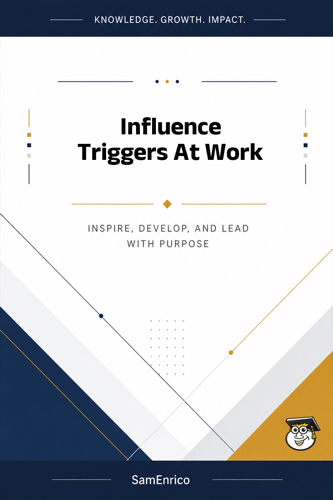
Non-FictionSelf-HelpOrganizational Psychology
Influence Triggers At Work eBook
Applies psychological shortcuts to negotiations an
by Watson Neil
Applies psychological shortcuts to negotiations and daily meetings.
Formats
Free sample
Chapter 1: The Autopilot Assassin--–- You are about to lose an argument you have already won.The data is on your side. The spreadsheet, color-coded and triple-checked, sits in front of you. You have anticipated every objection, rehearsed every counterpoint, and arrived fifteen minutes early to secure the seat nearest the whiteboard. The Power Point deck—lean, logical, irrefutable—is loaded and ready.You present. The room listens.
Heads nod in the right places. You reach the conclusion, pause for effect, and ask the question that should be a formality: "Does anyone have any concerns before we move forward?"Silence. Then, from the far end of the table, a voice: "I don't know. Something about this just doesn't feel right."Someone else chimes in: "Let's form a subcommittee to look into it further."Your boss, who nodded along through every slide, suddenly remembers a "scheduling conflict" and glances at their watch. The meeting ends.
No decision is made. Your logic, your data, your months of preparation—all of it evaporates into the fluorescent haze of another inconclusive conference room.You walk back to your desk, not entirely sure what just happened. You were right. You proved you were right. And you lost anyway.Here is the uncomfortable truth this book will teach you to weaponize: Your logic was never the problem.
And your logic was never the solution.The problem is an invisible force that operates in every meeting, every negotiation, and every hallway conversation you will ever have. Call it the Autopilot Assassin. It lives in the brain of every person in that room—including your own. It is fast, automatic, and utterly indifferent to the quality of your arguments. It decides "yes" or "no" before your Power Point reaches slide three.
And it has been beating you for years without you even knowing it existed.This chapter is your first lesson in hunting the assassin.The Two-Brain Trap To understand why you keep losing arguments you have already won, you need to understand something that Daniel Kahneman discovered and for which he won a Nobel Prize: your brain is not one brain. It is two.System 1 is the autopilot. It is fast, automatic, emotional, and energy-efficient. It makes snap judgments, recognizes faces, flinches at loud noises, and decides whether a stranger is trustworthy in less than a second. System 1 runs constantly in the background, handling thousands of decisions per hour without you ever noticing.
It is the reason you can drive home from work and realize you remember nothing about the last ten minutes. It is also the reason a colleague says "no" before you finish your sentence.System 2 is the pilot. It is slow, deliberate, logical, and exhausting. It solves math problems, evaluates evidence, compares prices, and plans for the future. System 2 requires effort.
It burns calories. It is lazy by design. Your brain would rather let System 1 handle almost everything and only wake up System 2 when absolutely necessary.Here is the trap: You believe you are convincing people with System 2 logic, but you are speaking to a brain that is running on System 1 autopilot.Consider the numbers. The average professional attends 25 to 30 meetings per week. The average decision in a meeting takes less than eight seconds of conscious deliberation before someone commits to a position.
Eight seconds. That is not enough time for System 2 to evaluate a single spreadsheet cell, let alone a complex proposal.By the time you finish your opening sentence, every person in that room has already made an unconscious bet on whether they will support you, oppose you, or remain silent. The rest of your presentation is just confirmation bias playing out in slow motion.This is not a flaw in your colleagues. It is a feature of human neurology. And until you learn to work with it instead of against it, you will continue to lose to the Autopilot Assassin.The Click-Whirr Response Let me tell you about a bird.
Not because you need ornithology to succeed at work, but because this bird's behavior explains why your boss just said "let's circle back" instead of "yes."The mother turkey is a devoted parent. She will sit on anything that makes the "cheep-cheep" sound of her chicks. Scientists discovered that a stuffed polecat—a natural predator of turkeys—dragged past a mother turkey will trigger a ferocious attack. But when the same stuffed polecat is fitted with a small speaker playing "cheep-cheep," the mother turkey stops attacking and instead tucks the predator under her warm feathers.The sound overrides the sight. A single stimulus—"cheep-cheep"—triggers an entire fixed action pattern.
The ethologists called this the click-whirr response: a specific trigger clicks on, and a pre-programmed behavior whirrs into action.Humans are not so different. We like to believe we are rational actors weighing evidence, but the research says otherwise. A well-dressed stranger asks to cut in line at the photocopier. The request alone works 60% of the time. The same request with the word "because"—"May I cut in line because I need to make copies?"—works 93% of the time.
The reason is circular. It adds no information. But the word "because" clicks the trigger, and compliance whirrs out.Your colleague who said "something about this just doesn't feel right" was not making a logical argument. They were experiencing a click-whirr response. Something in your presentation—a word, a gesture, the way you stood, the color of your tie—triggered an automatic "no." They do not know why they said no.
They just felt it.And because you were arguing with logic, you had no defense against a feeling.The Cognitive Load Trap Here is where the Autopilot Assassin becomes truly dangerous. System 1 does not just operate alongside System 2. It actively takes over when System 2 is busy.Cognitive load is the amount of mental effort your brain is using at any given moment. When cognitive load is low, you have the energy to engage System 2. You can compare options, evaluate evidence, and make careful decisions.
When cognitive load is high—when you are tired, stressed, multitasking, or time-pressured—System 2 checks out and System 1 takes command.Now consider the average workplace meeting.You have back-to-back calls. Your inbox is overflowing. You ate lunch at your desk while reviewing a report. You are thinking about the email your boss sent at 4:58 PM. The meeting is running long and your next one starts in seven minutes.
The agenda has twelve items for a forty-five-minute block.Your cognitive load is not just high. It is maxed out.In that state, your System 2 is useless. You are not making decisions. You are reacting. And the Autopilot Assassin is running the show.This explains so much workplace frustration.
You send a carefully crafted email with data, analysis, and a clear recommendation. The reply comes back seventeen seconds later: "Let's discuss." They did not read your email. They could not read your email. Their cognitive load was too high for System 2 to engage. The word "discuss" was a trigger response, not a considered opinion.You propose a new process in a meeting.
Someone objects. You explain why their objection is based on outdated information. They double down. You provide more evidence. They…
This is the end of the free sample. Get the eBook to keep going. Buy now
About this book
Details
- Author
- Watson Neil
- Publisher
- SamEnrico
- Language
- English
- Genre
- Non-Fiction, Self-Help, Organizational Psychology
- Released
- 2026-06-06
- Pages (approx.)
- 137
- Available as
- eBook, Audiobook

Read better in the ZLOADR app
Your eBooks on your phone or tablet. Sign in with your SamEnrico account and start reading.
More by Watson Neil
 Burn Dressing SelectionWatson Neil$11.99
 Exhaustion Recovery WorkbookWatson Neil$11.99
 EQ for Sales ProfessionalsWatson Neil$11.99
 Glucose Alcohol Detox GuideWatson Neil$11.99
 The Remote HR Time GuideWatson Neil$11.99
 Birth Trauma TriggersWatson Neil$11.99
 Tennis Serve Hypnosis GuideWatson Neil$11.99
 Ultimate Handbook Guide to Jiangyin : (China) Travel GuideWatson Neil$11.99
 The Ghosts of the Andes: The First Credit Card Fraud RingWatson Neil$11.99
 The Bone Thieves of New Orleans: The Unsolved Grave Robbing Spree of the 1960sWatson Neil$11.99
 How to Produce Sandblasting CabinetsWatson Neil$11.99
 Reverse Auction Pricing WorkbookWatson Neil$12.99
You may also like
 Hong Kong Handover 1997Dunn Johnnie$11.99
 Zumba For Postnatal Recovery CourseNeal Christian$11.99
 Zumba for BeginnersLadner Nikia$11.99
 YouTube Comment Mining GuideHumes Pandora$12.99
 Worry Box MeditationCarlin Rudy$11.99
 Workplace Stress MeditationNguyen Lynn$11.99
 Workplace Stress and Sleep RepairHawley Ivory$11.99
 Workplace Perfectionism CureDelaney Jeffry$11.99
 Workplace Injustice Anger GuideWallen Isabelle$11.99
 Work Addiction and Burnout LinkGreenwood Ester$11.99
 Women in Yoga and WellnessBeattie Galina$11.99
 Women in Stand Up ComedyChun Evangeline$11.99