
Non-FictionSelf-HelpCopywriting
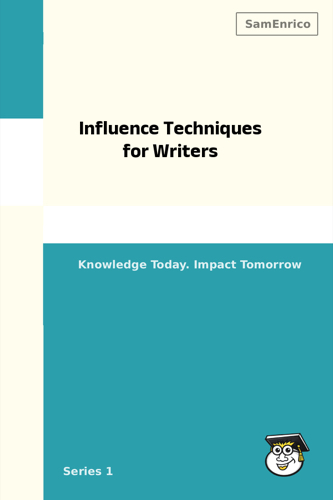
Influence Techniques for Writers eBook
Persuades readers through copy and content.
by Wolf Stanton
Persuades readers through copy and content.
Formats
Free sample
Chapter 1: The Reptilian Trap--–- You are about to make a decision. Not a big one—just a small, unconscious choice about whether to keep reading this sentence or glance at your phone. That decision will happen in less than a second. You will not deliberate. You will not weigh pros and cons.
You will simply feel something—curiosity, boredom, impatience, intrigue—and then your logical brain will invent a reason for whatever you just did.That is the single most important fact about human psychology that every persuasive writer must internalize. And most writers get it exactly backwards.They believe that readers are rational creatures who carefully evaluate arguments, compare evidence, and then make logical decisions. This belief is wrong. It is not just slightly inaccurate; it is fundamentally, catastrophically inverted. The truth—confirmed by decades of neuroscience research, replicated in hundreds of studies, and demonstrated by every successful advertiser who has ever lived—is that human beings make decisions emotionally and then rationalize those decisions logically.
Emotion writes the check. Logic cashes it.This chapter dismantles the myth of the rational reader. It introduces the neuroscientific framework that will underpin every technique in this book: the distinction between the ancient, survival-oriented reptilian brain and the slow, analytical neocortex. You will learn why your reader's internal "executive editor" is working against you, how to bypass that editor entirely, and how to use the Emotion-to-Logic Bridge to make your persuasive writing feel inevitable rather than manipulative. By the end of this chapter, you will never look at a headline, an email subject line, or a call-to-action button the same way again.The Myth of the Rational Reader Let us begin with an uncomfortable question.
When was the last time you made a significant purchase—a laptop, a car, a course, a piece of software—and then found yourself scrambling to justify it to a friend, a partner, or even to yourself? You bought it because it felt right. It felt exciting, or necessary, or like a relief from a persistent frustration. Then, when someone asked why, you produced reasons. "It has more RAM." "The resale value is higher." "It was on sale."Those reasons were not the cause of your decision.
They were the effect. Your logical brain, arriving late to the party, constructed a plausible story to explain what your emotional brain had already done.Psychologists call this post-hoc rationalization. Neuroscientists call it the interpreter effect—the left hemisphere's relentless drive to weave a coherent narrative out of decisions that were made unconsciously. The writer and copywriting expert Andy Maslen, after a series of conversations with a neuroscientist over coffee, summarized it this way: "The brain is not a logic machine. It is a storytelling machine that uses logic as its raw material."Consider the famous experiment by neuroscientist Antonio Damasio.
He studied patients with damage to the ventromedial prefrontal cortex—the part of the brain that processes emotion. These patients had intact IQs, perfect memories, and flawless logical reasoning. They could list every pro and con of a decision with mathematical precision. But they could not make decisions. At all.
They would spend hours deliberating over trivial choices—whether to use a blue pen or a black pen, whether to schedule an appointment for Tuesday or Wednesday—because without an emotional signal to say "this feels right," logic offered no way to choose.The implications for writers are staggering. If your reader cannot access an emotional signal, they will not act. They will remain frozen in analysis paralysis, scrolling past your beautifully reasoned argument because it never triggered the one thing that actually moves people: a feeling.The Two Brains: Reptilian vs. Neocortex To write persuasively, you need a working mental model of the brain's architecture. Fortunately, you do not need a medical degree.
You need only understand the functional distinction between two systems: the reptilian complex (often called the R-complex or simply the "old brain") and the neocortex (the "new brain").The Reptilian Brain: Your Reader's Real Decision-Maker The reptilian brain is the oldest part of the human central nervous system, evolutionarily speaking. It emerged hundreds of millions of years ago, and we share it with lizards, snakes, and birds. Its job is simple: keep the organism alive. It monitors for threats (predators, poisons, falling rocks), opportunities (food, mates, shelter), and social cues (dominance, submission, belonging). It operates entirely outside conscious awareness.
You never "decide" to feel afraid when you hear a sudden loud noise. You just feel afraid. That is the reptilian brain at work.For the persuasive writer, the reptilian brain is the only audience that matters. Because here is the critical insight: every purchasing decision, every click, every email signup, every moment of sustained attention is mediated by the reptilian brain. Your reader's neocortex—the part that reads words, processes grammar, and evaluates arguments—is actually the junior partner.
It receives instructions from below. It does not issue commands.The reptilian brain cares about exactly four things:Survival. Will this kill me? Will this protect me? Is this safe?Resources.
Will this give me more of what I need (money, time, status, food, sex)?Certainty. Can I predict what happens next? Is this familiar or alarming?Social Standing. Does this make me look good or bad to my tribe?Any persuasive message that does not address one of these four domains will be ignored. Not rejected—ignored.
The reptilian brain will simply flag it as irrelevant and move on. This is why a headline that says "Our software has a new UI" fails, while "Stop losing four hours a week to confusing menus" succeeds. The first is abstract. The second triggers survival (stop losing), resources (four hours), and certainty (confusing menus are bad).The Neocortex: The Justification Engine The neocortex is the wrinkled outer layer of the brain, responsible for language, abstract reasoning, planning, and self-awareness. It is what makes humans capable of calculus, sonnets, and philosophical debates about free will.
It is also, for the purposes of persuasive writing, mostly a distraction.The neocortex does not make decisions. It simulates decision-making. After the reptilian brain has committed to an action—click, buy, sign up, keep reading—the neocortex constructs a logical-sounding explanation. "I bought this because it had the best reviews." "I signed up because the discount ends tonight." "I kept reading because the headline promised a solution to my problem."These explanations are not necessarily false. They are just post-hoc.
They are the press release, not the negotiation.Here is the practical takeaway for you, the writer: Do not try to persuade the neocortex directly. It will not work. You will end up writing dense, logical, evidence-heavy prose that your reader's reptilian brain will tag as "irrelevant" within two seconds. Instead, write for the reptilian brain first. Trigger a feeling of survival, resource gain, certainty, or social standing.
Then, once the reader is emotionally committed, feed the neocortex just enough logic to rationalize the decision it has already made.The Executive Editor: Your Invisible Adversary Every reader has an internal gatekeeper. Call it the executive editor. This is the voice that reads your opening sentence and immediately asks: "Why should I care? Is…
This is the end of the free sample. Get the eBook to keep going. Buy now
About this book
Details
- Author
- Wolf Stanton
- Publisher
- SamEnrico
- Language
- English
- Genre
- Non-Fiction, Self-Help, Copywriting
- Released
- 2026-06-07
- Pages (approx.)
- 160
- Available as
- eBook, Audiobook

Read better in the ZLOADR app
Your eBooks on your phone or tablet. Sign in with your SamEnrico account and start reading.
More by Wolf Stanton
 Anticipatory Grief In Blended FamiliesWolf Stanton$11.99
 NICU Graduate Postpartum GuideWolf Stanton$11.99
 Bedtime Breath Meditation GuideWolf Stanton$11.99
 Sunday Drive Stress ReductionWolf Stanton$11.99
 Hypervigilance Reduction TechniquesWolf Stanton$11.99
 Chemotherapy For Breast CancerWolf Stanton$11.99
 Group Brainstorming AlternativesWolf Stanton$11.99
 The Echo of the Accused: How Victim Impact Statements Reshaped JusticeWolf Stanton$11.99
 Hippocrates' Legacy: The Birth of Western MedicineWolf Stanton$11.99
 A Collector's Handbook to the Triumph EstateWolf Stanton$11.99
 How to Become a Corduroy-cutter OperatorWolf Stanton$11.99
 Letter of Credit Pitfalls for ExportersWolf Stanton$12.99
You may also like
 Hong Kong Handover 1997Dunn Johnnie$11.99
 Zumba For Postnatal Recovery CourseNeal Christian$11.99
 Zumba for BeginnersLadner Nikia$11.99
 YouTube Comment Mining GuideHumes Pandora$12.99
 Worry Box MeditationCarlin Rudy$11.99
 Workplace Stress MeditationNguyen Lynn$11.99
 Workplace Stress and Sleep RepairHawley Ivory$11.99
 Workplace Perfectionism CureDelaney Jeffry$11.99
 Workplace Injustice Anger GuideWallen Isabelle$11.99
 Work Addiction and Burnout LinkGreenwood Ester$11.99
 Women in Yoga and WellnessBeattie Galina$11.99
 Women in Stand Up ComedyChun Evangeline$11.99