
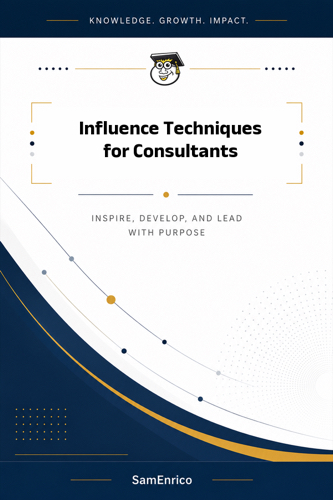
Non-FictionSelf-HelpConsulting
Influence Techniques for Consultants eBook
Sells recommendations to resistant clients.
Sells recommendations to resistant clients.
Formats
Free sample
Chapter 1: The Paradox of Expertise--–- It was 3:47 on a Thursday afternoon when Sarah, a partner at a mid-sized strategy firm, lost the biggest deal of her career. Not because her data was wrong. Not because her recommendation was flawed. Not even because the client had a better option. She lost it because she was right – and she couldn't stop proving it.The client, a regional bank struggling with legacy technology, had hired Sarah's firm to diagnose why their digital transformation was stalling.
After eight weeks of deep analysis, Sarah had the answer: the bank's head of operations, a 28-year veteran named Frank, had built a shadow IT system that directly contradicted the official strategy. Frank was beloved, powerful, and wrong. Sarah's recommendation was clear: dismantle the shadow system, reassign Frank to a non-technical role, and consolidate all technology under the CTO.She presented the data impeccably. Thirty-seven slides. Fourteen case studies.
A regression analysis showing the shadow system cost the bank $2.1 million annually in inefficiency. She was confident, precise, and utterly persuasive.Frank sat in silence for the entire presentation. When she finished, he looked at the CEO and said four words: "She doesn't understand our culture."The CEO nodded. The deal died. Sarah flew home confused, humiliated, and convinced she had failed at persuasion.She hadn't failed at persuasion.
She had failed at influence – and the difference is everything.The Consultant's Curse: Why Being Right Makes You Wrong Every consultant knows this moment. You have done the work. You have the receipts. You have the airtight logic. And yet, the client resists – not because they disagree with your conclusion, but because your conclusion threatens something they cannot articulate.This is the Paradox of Expertise: clients hire you for your answers, but your answers trigger their defenses.
The more certain you sound, the more they feel their autonomy slipping away. And when people feel their autonomy threatened, they do not say "thank you for the data." They say "let me think about it," or "that doesn't fit our context," or – most devastatingly – nothing at all.The consulting industry is built on a lie. The lie is that clients want the truth. They do not. They want their truth, validated by your expertise, delivered in a way that makes them look smart.
When you hand them a recommendation that forces them to admit they were wrong, you have not helped them. You have humiliated them. And humiliation is not a sales strategy.This chapter is about unlearning everything you think you know about persuasion. It is about replacing the "expert as hero" model with something far more effective: the Trusted Adversary – a guide who walks alongside the client through their own resistance, rather than trying to bulldoze through it.The Two Types of Resistance (And Why Most Consultants Treat Them the Same)Before we can solve the problem, we must diagnose it. Resistance is not a single thing.
It comes in two fundamentally different forms, and applying the wrong cure makes everything worse.Technical Resistance is when the client genuinely disagrees with your facts. They say things like: "Your sample size is too small," or "You didn't account for our seasonal fluctuations," or "That study doesn't apply to our industry." Technical resistance is rational, specific, and – crucially – fixable. More data, better methodology, or a revised analysis can address it.Adaptive Resistance is when the client agrees with your facts but rejects your conclusion because of what it implies about them. They say things like: "That might work elsewhere, but we're different," or "You don't understand our culture," or – the classic – "Let me think about it." Adaptive resistance is not about data. It is about identity, fear, and loss of control.
And it is not fixable with more data. In fact, more data makes it worse.Here is the problem: 80 percent of consulting resistance is adaptive. And 90 percent of consultants treat it as technical. We respond to "you don't understand our culture" with "let me show you five more case studies" – which only proves that we are not listening.Sarah, the partner who lost the bank deal, made this exact mistake. Frank's objection ("She doesn't understand our culture") was pure adaptive resistance.
He was not disputing her numbers. He was saying: Your recommendation threatens my identity, my power, and my 28 years of being the smartest person in this room. Sarah responded by preparing more data. She should have responded by putting down her pointer and saying: "Frank, you've been here longer than anyone. Help me understand what I'm missing."She didn't.
And the deal died.The Universal Rule: Never Defend. Always Ask.Every technique in this book flows from a single, non-negotiable rule. Memorize it. Write it on a sticky note and put it on your monitor. Say it to yourself before every client meeting.Never defend.
Always ask.Defending triggers more resistance. It signals: "I am right. You are wrong. Let me prove it." The moment a client hears that, their amygdala activates. They stop listening for truth and start listening for threats.
Their cognitive bandwidth shifts from "problem-solving" to "self-protection."Asking does the opposite. It signals: "I am curious. Your perspective matters. Help me understand." This deactivates the threat response and opens the door to collaboration. The client goes from "you vs.
me" to "us vs. the problem."Consider the difference:Defending Asking"Let me show you why our approach works.""What concerns you most about this approach?""The data clearly shows...""Where does my analysis diverge from your experience?""You're misunderstanding the methodology.""Help me see what I'm missing."The defensive consultant sounds smart. The asking consultant sounds safe. And in consulting, safety sells.This does not mean you abandon your expertise. It means you deliver your expertise through questions rather than at the client.
The difference is subtle but profound. A defensive consultant says: "You need to consolidate your supply chain vendors." An asking consultant says: "What would change if you consolidated your supply chain vendors? What would you gain? What would you lose?" Same recommendation. Radically different delivery.The Trusted Adversary: A New Identity for Consultants Most consultants see themselves as experts.
This is the wrong identity for selling recommendations to resistant clients. Experts are evaluated on their answers. When an expert's answer is rejected, they take it personally. They double down. They defend.
They lose.The more effective identity is the Trusted Adversary – a guide who walks through resistance rather than trying to eliminate it.Think of a physical therapist. When you go to physical therapy with a torn hamstring, you want the therapist to be an expert. But you also know that the therapy will hurt. You will resist certain movements. You will say "I can't do that" or "that's too painful." A good therapist does not respond by saying "actually, the science says you can." They respond by saying: "I hear you.
Let's try a smaller range of motion. What does that feel like?" They do not abandon their expertise. They deliver it through your resistance, not against it.The Trusted Adversary mindset has four core tenets:1. Resistance is not an obstacle. It is data.
Every "no" tells you something about what the client needs to feel safe. Your job is to decode it, not…
This is the end of the free sample. Get the eBook to keep going. Buy now
About this book
Details
- Author
- Mclean Gidget
- Publisher
- SamEnrico
- Language
- English
- Genre
- Non-Fiction, Self-Help, Consulting
- Released
- 2026-06-11
- Pages (approx.)
- 137
- Available as
- eBook, Audiobook

Read better in the ZLOADR app
Your eBooks on your phone or tablet. Sign in with your SamEnrico account and start reading.
More by Mclean Gidget
 Career Pivot After 40Mclean Gidget$11.99
 Road Rage Progressive Muscle RelaxationMclean Gidget$11.99
 Postpartum Identity LossMclean Gidget$11.99
 Breast Health For Trans WomenMclean Gidget$11.99
 Beach Sunset MeditationMclean Gidget$11.99
 Victim Shame Trigger WorkMclean Gidget$11.99
 Group Creativity for HealthcareMclean Gidget$11.99
 The Rise of the Air Jordan: How a Basketball Shoe Became a Cultural IconMclean Gidget$11.99
 Echoes of the Savannah: The Unsung Heroes of African Film MusicMclean Gidget$11.99
 How to Produce Cookware AccessoriesMclean Gidget$11.99
 A Collector's Handbook to the Triumph MayflowerMclean Gidget$11.99
 Argentina University Enrollment TimelineMclean Gidget$12.99
You may also like
 Hong Kong Handover 1997Dunn Johnnie$11.99
 Zumba For Postnatal Recovery CourseNeal Christian$11.99
 Zumba for BeginnersLadner Nikia$11.99
 YouTube Comment Mining GuideHumes Pandora$12.99
 Worry Box MeditationCarlin Rudy$11.99
 Workplace Stress MeditationNguyen Lynn$11.99
 Workplace Stress and Sleep RepairHawley Ivory$11.99
 Workplace Perfectionism CureDelaney Jeffry$11.99
 Workplace Injustice Anger GuideWallen Isabelle$11.99
 Work Addiction and Burnout LinkGreenwood Ester$11.99
 Women in Yoga and WellnessBeattie Galina$11.99
 Women in Stand Up ComedyChun Evangeline$11.99