
Non-FictionHealth & WellnessCognitive Therapy
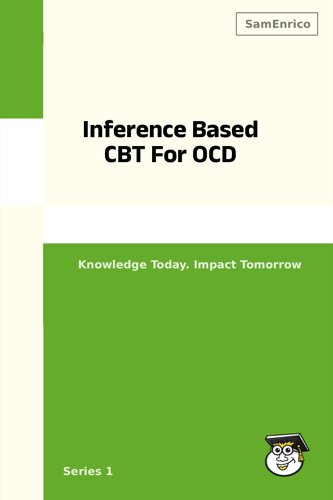
Inference Based CBT For OCD eBook
Challenge the reasoning errors that make obsessive
Challenge the reasoning errors that make obsessive doubts feel real.
Formats
Free sample
Chapter 1: The Story Trap--You have been lied to about what OCD actually is. Not by accident, not by malice, but by the entire way we have learned to talk about this condition. The lie sounds compassionate. It sounds scientific. It has been repeated by therapists, books, support groups, well-meaning friends, and even the diagnostic manual for decades.
The lie is this: OCD is an anxiety disorder. You are afraid of something—contamination, harm, losing control, being imperfect, offending God—and your compulsions are desperate, irrational attempts to manage that fear.This is not completely wrong. You are afraid. You do feel anxiety. Your compulsions do reduce that anxiety temporarily.
But naming OCD as an anxiety disorder is like naming a forest fire by its smoke. It mistakes the symptom for the cause. The smoke is real. The smoke is painful. The smoke can even kill you.
But the smoke is not the fire. The fire is something else entirely, something burning deeper, something that most treatments never touch.Here is the truth that changes everything: OCD is not a disorder of fear. It is a disorder of reasoning. You do not doubt because you are anxious. You are anxious because you have used faulty reasoning to turn a neutral thought, a harmless object, a normal bodily sensation, or an ordinary situation into a terrifying fiction.
The anxiety is the result, not the origin. And this distinction is not academic. It is not a matter of semantics. It is the difference between spending years learning to tolerate your fears and spending weeks learning to see through them entirely.This chapter introduces the central concept that will guide everything that follows in this book. It sounds like clinical jargon, but it describes something you experience every single day, often multiple times per hour, of your life with OCD.
That concept is inferential confusion. Inferential confusion is the inability to distinguish between a vividly imagined possibility and an actual probability. It is the moment when your brain stops treating a "what if" as a hypothetical exercise and starts treating it as a factual reality. It is the switch that flips a neutral trigger into a full-blown obsession in less time than it takes to blink.You are about to learn that the knife on the kitchen counter is not the problem. The intrusive thought about the knife is not the problem.
The problem is the story you told yourself about the knife in the 0.3 seconds after you saw it. And once you see that story for what it truly is—a fiction, a narrative, a piece of imaginative literature that you mistook for reality—the knife loses its power. Not because you faced your fear. Not because you tolerated the anxiety. Not because you breathed deeply or practiced mindfulness.
But because you recognized, clearly and finally, that there was never anything to fear in the first place. The danger existed only in the story.Let us begin the work of seeing through the story.The Day the Story Started Think back to the last time OCD caught you completely off guard. You were going about your day, maybe even feeling good, maybe even feeling hopeful that you were finally getting better. And then something happened. You touched a surface.
You had a thought. You felt a sensation in your body. You saw an object. You heard a word. And within seconds, you were gone—spiraling, checking, ruminating, seeking reassurance, washing, ordering, praying, confessing, lost in a world of doubt and dread that felt more real than the room around you.What happened in those seconds?
What actually occurred between the trigger and the obsession? If you could slow time down, frame by frame, what would you see?If you are like most people with OCD, you believe the trigger caused the obsession. The doorknob caused the contamination fear. The intrusive thought about harming a loved one caused the guilt and the checking. The feeling of incompleteness caused the need to rearrange the items on your desk.
The image of a religious figure caused the blasphemous thought. This is the most natural explanation in the world. It is also completely and demonstrably wrong.The doorknob is a piece of metal, plastic, or wood. It has no intentions. It has no power.
It has no consciousness. It sits there, neutral and indifferent, while millions of people touch it every day and walk away without a second thought. The same doorknob, the same surface, the same situation produces terror in you and nothing in them. The difference is not the doorknob. The difference is not your brain chemistry, though that plays a role.
The difference is the story you tell yourself about the doorknob in the milliseconds after you touch it.Let me prove this to you with an exercise you can do right now, without moving from where you are sitting. Think of your most common trigger. It could be anything. A public restroom. A knife in the kitchen.
A religious symbol. A number. A person you love. A specific word. A feeling in your body.
Now ask yourself a question that you have probably never asked before: Does this object, situation, thought, or sensation have the power to hurt me on its own? Not through a story. Not through a chain of "what ifs." Not through a hypothetical sequence of events that has never happened before. Directly and immediately, right now, in this moment.A knife sitting on a counter cannot stab you. It requires a hand, an arm, an intention, a decision.
A public restroom cannot infect you. It contains surfaces that might have bacteria, but bacteria are everywhere, and your immune system is remarkably competent. A thought about pushing someone cannot make your body move against your will. Your brain does not work that way. The object is neutral.
The situation is neutral. The thought is neutral. The only thing that makes any of it dangerous is the narrative you have attached to it.I want to be very clear about something. I am not blaming you. I am not saying you are making this up.
I am not saying you are weak or irrational or broken. I am saying that OCD operates through a specific mechanism—a reasoning error, a logical glitch—and once you see that mechanism clearly, you can learn to dismantle it. The mechanism is not your fault. You did not choose it. You did not invent it.
But you can learn to override it.The Narrative Switch Every obsession, without exception, begins with a moment that I want you to learn to recognize so clearly that you can spot it in the dark, in the middle of a panic attack, in the middle of the night. I call this moment the Narrative Switch.Before the switch, you are sensing reality. You see the knife. You feel the surface of the doorknob. You notice the thought pass through your mind.
You are in direct, unmediated contact with the world through your five senses. This is the state that every other animal on earth lives in permanently, effortlessly, without training. A dog does not look at a leash and…
This is the end of the free sample. Get the eBook to keep going. Buy now
About this book
Details
- Author
- Hauser Nikole
- Publisher
- SamEnrico
- Language
- English
- Genre
- Non-Fiction, Health & Wellness, Cognitive Therapy
- Released
- 2026-06-06
- Pages (approx.)
- 150
- Available as
- eBook, Audiobook

Read better in the ZLOADR app
Your eBooks on your phone or tablet. Sign in with your SamEnrico account and start reading.
More by Hauser Nikole
 Mindful Breathing for Stress ReliefHauser Nikole$11.99
 Airline Passenger Rage GuideHauser Nikole$11.99
 Agile Creativity GuideHauser Nikole$11.99
 Survey Data Stratification with AIHauser Nikole$11.99
 The Silk Road Conspiracy: How a Lost Empire Shaped the Modern WorldHauser Nikole$11.99
 Understanding Cannabis DependenceHauser Nikole$17.99
 10 Ways to Use Chamaesyce Serpyllifolia (Recipe Book)Hauser Nikole$11.99
 Belgian University Master GuideHauser Nikole$12.99
 Research Assistantship Without PapersHauser Nikole$12.99
You may also like
 Hong Kong Handover 1997Dunn Johnnie$11.99
 Zumba For Postnatal Recovery CourseNeal Christian$11.99
 Zumba for BeginnersLadner Nikia$11.99
 YouTube Comment Mining GuideHumes Pandora$12.99
 Worry Box MeditationCarlin Rudy$11.99
 Workplace Stress MeditationNguyen Lynn$11.99
 Workplace Stress and Sleep RepairHawley Ivory$11.99
 Workplace Perfectionism CureDelaney Jeffry$11.99
 Workplace Injustice Anger GuideWallen Isabelle$11.99
 Work Addiction and Burnout LinkGreenwood Ester$11.99
 Women in Yoga and WellnessBeattie Galina$11.99
 Women in Stand Up ComedyChun Evangeline$11.99