
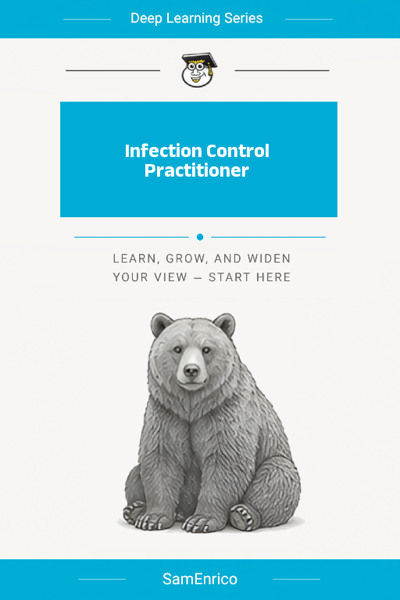
Non-FictionInformativeEducational
Infection Control Practitioner eBook
A Coursebook on Infection Control Practitioner
by Hogan Perry
A Coursebook on Infection Control Practitioner
Formats
Free sample
Chapter 1: The Forgotten Detectives--The year is 1976. In a Philadelphia hotel, members of the American Legion have gathered for their annual convention. Within days, 221 people are stricken with a mysterious, violent pneumonia. Thirty-four die. The nation panics.
No one knows what is killing these men. The CDC sends a team of epidemiologists, but the organism—later named Legionella pneumophila—hides in plain sight for months. It is not a doctor who finally cracks the case. It is not a hospital administrator. It is a quiet, methodical infection control nurse who notices that every single victim had walked past the same decorative fountain in the hotel lobby.
That observation changes everything.This chapter is the story of how that nurse—and thousands like her—built a profession from scratch. It is the story of how infection control went from a part-time duty assigned to the most exhausted nurse on the ward to a recognized, certified, life-saving specialty. And it is the story of where you, the Infection Control Practitioner, fit into the modern healthcare machine. By the end of this chapter, you will understand not only what an ICP does, but why hospitals cannot function without one. You will see the invisible war that happens in every patient room, every operating theater, every intensive care bed.
And you will begin to see yourself as the detective, the educator, the negotiator, and the last line of defense between a routine hospital stay and a preventable death.The Birth of a Profession: From Hospital Infection Sister to Modern ICPBefore the 1970s, the concept of infection control as a dedicated specialty did not exist. Hospitals had "Hospital Infection Sisters"—usually senior nurses who, in addition to their full-time patient load, kept handwritten logs of which surgical patients developed fevers or wound drainage. These logs were neither standardized nor analyzed. If a cluster of infections occurred, it was often noticed weeks later, if at all. The prevailing attitude was fatalistic: hospitals are full of sick people, and sick people get infections.
Nothing can be done about it.That fatalism shattered in the 1970s. Three forces collided to create the modern ICP. First, the Legionella outbreak of 1976 demonstrated, on national television, that hospitals and public health agencies were dangerously unprepared to identify and stop outbreaks. Second, a landmark study published in The Lancet in 1970 showed that hospitals with dedicated infection control nurses had significantly lower infection rates than those without—a finding that finally gave hospital administrators a financial incentive to hire them. Third, the rise of antibiotic-resistant bacteria, particularly methicillin-resistant Staphylococcus aureus (MRSA), created a new kind of threat that required continuous surveillance, not periodic attention.In 1972, the Centers for Disease Control and Prevention launched the Hospital Infections Program, and with it, the first formal training for infection control nurses.
The Association for Practitioners in Infection Control (now APIC) was founded in 1972 with just a few hundred members. Today, APIC has over 15,000 members worldwide. The Certification in Infection Control (CIC) exam was introduced in 1981, establishing a standardized body of knowledge that every ICP must master. What began as a part-time, underappreciated role has become a mandatory position in every accredited hospital in the developed world.But let us be clear about what this history means for you. You are not merely a nurse or a technologist who has been assigned infection control duties.
You are part of a lineage. The Hospital Infection Sisters of the 1970s built the first surveillance systems from index cards and colored pins. They convinced surgeons to wash their hands when handwashing was still controversial. They stood in front of hospital boards and presented data that no one wanted to hear. They were fired, ignored, and belittled.
And they kept showing up. That is your inheritance. Honor it.Defining the Modern Infection Control Practitioner: The Three Competencies What, exactly, does an ICP do? The answer is broader than most healthcare workers realize. A modern ICP is not a single specialist but a fusion of three distinct professional identities.
You must be all of them, often in the same hour.Competency One: The Clinical Detective The first competency is clinical. You must be able to recognize an infection when you see it. This sounds obvious, but it is not. A post-operative patient with a fever of 38.5°C could have a surgical site infection, a urinary tract infection from an indwelling catheter, a bloodstream infection from a central line, pneumonia from the ventilator, or none of the above—the fever could be a drug reaction or a blood clot. The ICP reads the chart, reviews the lab results, examines the patient's clinical course, and determines whether the criteria for a healthcare-associated infection (HAI) have been met.
This is not clerical work. It is diagnostic work, requiring the same clinical judgment that a physician uses when diagnosing a disease.The clinical detective also knows when to escalate. A single case of Candida auris in a long-term care facility is not just an infection; it is a potential outbreak requiring immediate containment. A cluster of three Pseudomonas infections in the neonatal intensive care unit is not a coincidence; it is a signal that something in the environment or equipment has failed. The ICP sees what others overlook because the ICP is looking for patterns, not just treating individual patients.Competency Two: The Analytical Scientist The second competency is analytical.
Infection control is a data-driven profession. Every day, the ICP collects numerators (infections) and denominators (patient-days, device-days, procedures). These numbers are entered into surveillance systems, trended over time, and compared against national benchmarks from the National Healthcare Safety Network (NHSN) or similar databases in other countries. When infection rates rise above the expected range, the ICP investigates. When they fall, the ICP celebrates—and then looks for the next opportunity to improve.This analytical work requires statistical literacy.
You do not need to be a biostatistician, but you must understand the difference between a rate and a ratio, between incidence density and cumulative incidence, between a statistically significant finding and a clinically meaningful one. You must be able to present data to a hospital board in a way that drives action, not confusion. We will cover these skills in depth in Chapter 7. For now, understand that your spreadsheet is as important as your stethoscope.Competency Three: The Educator and Change Agent The third competency is educational. This is the competency that separates effective ICPs from ineffective ones.
You can have perfect clinical judgment and flawless data analysis, but if you cannot convince a surgeon to change his antibiotic prophylaxis protocol or persuade a nurse to stop hanging her stethoscope on the bed rail, your technical skills will produce no real-world improvement.The ICP is a teacher. You teach hand hygiene technique to medical students who think they already know it. You teach transmission-based precautions to travel nurses who have never worked in an airborne infection isolation room. You teach environmental cleaning protocols to housekeeping staff who speak a different primary language. And you do all of this without authority.
You are not the surgeon's boss. You are not the nurse manager. You have no power to fire or discipline. You have only your knowledge, your data, and…
This is the end of the free sample. Get the eBook to keep going. Buy now
About this book
Details
- Author
- Hogan Perry
- Publisher
- SamEnrico
- Language
- English
- Genre
- Non-Fiction, Informative, Educational
- Released
- 2026-06-02
- Pages (approx.)
- 148
- Available as
- eBook, Audiobook

Read better in the ZLOADR app
Your eBooks on your phone or tablet. Sign in with your SamEnrico account and start reading.
More by Hogan Perry
 The Climate Tech Operations GuideHogan Perry$11.99
 Emotion Myths Debunked GuideHogan Perry$11.99
 Dreams Of Bullying RecoveryHogan Perry$11.99
 The Student Time Management GuideHogan Perry$11.99
 DBT For AthletesHogan Perry$11.99
 The Waltz Kings: Vienna’s Golden SoundHogan Perry$11.99
 Pop Up Permits Lagos GuideHogan Perry$12.99
 Teaching Experience for PhDHogan Perry$12.99
 Understanding SyringomasHogan Perry$17.99
 How to Start a Wineries BusinessHogan Perry$11.99
You may also like
 Hong Kong Handover 1997Dunn Johnnie$11.99
 Zumba For Postnatal Recovery CourseNeal Christian$11.99
 Zumba for BeginnersLadner Nikia$11.99
 YouTube Comment Mining GuideHumes Pandora$12.99
 Worry Box MeditationCarlin Rudy$11.99
 Workplace Stress MeditationNguyen Lynn$11.99
 Workplace Stress and Sleep RepairHawley Ivory$11.99
 Workplace Perfectionism CureDelaney Jeffry$11.99
 Workplace Injustice Anger GuideWallen Isabelle$11.99
 Work Addiction and Burnout LinkGreenwood Ester$11.99
 Women in Yoga and WellnessBeattie Galina$11.99
 Women in Stand Up ComedyChun Evangeline$11.99