
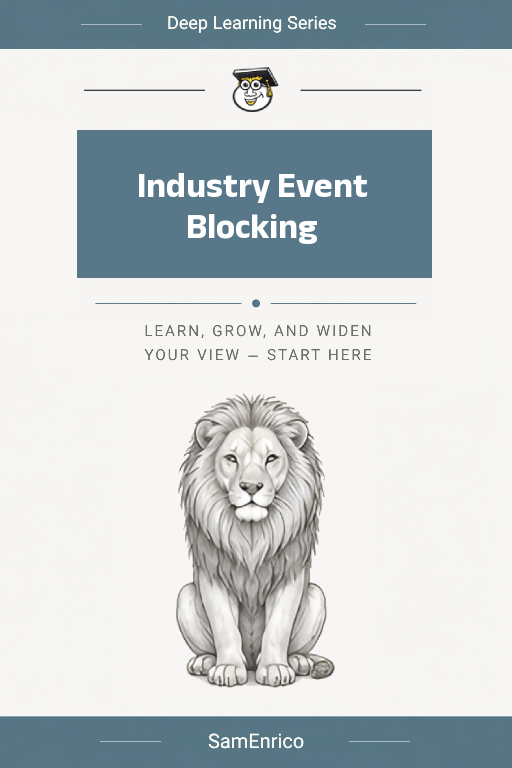
Industry Event Blocking eBook
Block travel, attendance, and follow-up time for k
Block travel, attendance, and follow-up time for key conferences and speaking engagements.
Formats
Free sample
Chapter 1: The Conference Tax...--–- The first time I calculated the true cost of a three-day conference, I nearly canceled my flight.I was sitting in gate B17 at Newark Liberty International Airport, boarding pass in hand, when I made the mistake of adding up what this trip was actually costing me. Not the registration fee. Not the hotel. Not the flight. Those were line items on a corporate credit card, easily justified and quickly forgotten.
No, I was adding up something far more precious: my time.The event was three days. Seventy-two hours. I had blocked those three days on my calendar and congratulated myself for being organized. But as I sat there, delayed for the second time, I started counting the hours I had already spent. The hour packing the night before.
The two hours of anxiety-induced scrolling through session agendas. The ninety-minute drive to the airport. The two hours of security, waiting, and now this delay. I was six hours in, and I had not yet left the ground.Then I started counting what would come after. The five-hour flight.
The hour in a taxi to the hotel. The three days of sessions, handshakes, and small talk. The flight home. The day of backlogged emails. The two days of feeling foggy and irritable.
The week it would take to actually act on any of the business cards I collected.By the time they called my boarding group, I had arrived at a number that scared me: sixty-eight hours. That three-day conference was going to consume nearly nine full workdays of my life. And I had said yes to ten of them this year.That number—680 hours—was the moment I invented what I now call the Conference Tax.The Invisible Line Item You Never See Let me be direct with you. If you are like most professionals who speak at or attend industry events, you are currently lying to yourself about how much time they actually cost. You are not alone, and you are not stupid.
You are simply using the wrong accounting system.Most of us treat conferences like this: we look at the dates on the calendar, subtract our normal workdays, and call it even. The conference is four days, we tell ourselves. Four days out of the office. Then we return, work a little harder to catch up, and move on with our lives. This accounting is dangerously incomplete.The Conference Tax is the gap between the time you think an event costs and the time it actually costs.
In my experience working with hundreds of executives, speakers, and sales professionals, that gap is consistently three to five times larger than most people estimate.Here is what you are missing.Every conference creates a lifecycle of time consumption that extends far beyond the event dates. There is the pre-travel phase: packing, planning, anxiety, and logistics. There is the travel phase: airports, taxis, waiting, and wandering. There is the event phase: sessions, meals, hallway conversations, and the constant cognitive load of being "on." There is the post-travel phase: unpacking, recovering, and reorienting. And there is the backlog phase: catching up on emails, meetings, and work that did not stop just because you left.Each of these phases carries a time cost.
And each phase carries an additional hidden cost: the cognitive cost of context switching.The 23-Minute Lie In their landmark study on workplace interruptions, researchers at the University of California, Irvine made a discovery that should terrify anyone who attends conferences. They found that after a typical interruption—a phone call, an email, a colleague stopping by—it takes an average of twenty-three minutes to return to the original task with the same level of focus.Twenty-three minutes. Not thirty seconds. Not five minutes. Twenty-three minutes of context switching, mental recalibration, and lost momentum.Now apply that to a typical three-day conference.
You are not in your office. You are in a convention center with five thousand other people. Your phone is buzzing with emails from your team. Your calendar is pinging with session reminders. You are moving from room to room, conversation to conversation, topic to topic.
Every one of these transitions is an interruption.I have tracked this across dozens of events. A conservative estimate is fifty interruptions per day. Fifty moments where your brain has to disengage from one context and engage with another. Fifty multiplied by twenty-three minutes is 1,150 minutes. That is nineteen hours.
Nineteen hours of your conference week spent solely on the act of refocusing.You are not at the conference for three days. You are at the conference for three days, plus nineteen hours of mental gymnastics just to keep up.The Energy Bank Account Time is not the only currency conferences withdraw. There is also your energy. And unlike time, energy cannot be borrowed, scheduled, or optimized away.I want you to imagine your cognitive energy as a bank account. Every morning, you wake up with a certain balance.
For most people, that balance is somewhere between sixteen and twenty high-quality hours. Throughout the day, every decision you make, every conversation you have, every problem you solve makes a withdrawal.Checking email? Withdrawal. Deciding what to wear? Withdrawal.
Navigating airport security? Large withdrawal. Sitting through a mediocre panel? Withdrawal with no return on investment. Smiling through small talk with a stranger?
Surprisingly large withdrawal.Here is what most people do not understand: conferences are high-withdrawal environments. They are designed to extract your energy. The bright lights, the loud sounds, the constant choices, the social performance, the lack of private space, the suboptimal food, the disrupted sleep. Every element of a conference is engineered to drain your energy bank account faster than almost any other professional activity.And what happens when you overdraw your account? You go into cognitive debt.The signs are unmistakable.
Post-event irritability. Difficulty concentrating on simple tasks. Craving sugar and caffeine. Feeling physically exhausted despite sleeping eight hours. Making decisions you later regret.
Saying things you wish you had not. Missing deadlines on work that should have been easy.I have seen executives return from conferences and immediately send rambling, emotional emails to their teams. I have seen speakers cancel critical follow-up calls because they simply could not face another conversation. I have seen sales professionals lose deals because they followed up too aggressively or not at all. These are not character flaws.
These are the symptoms of cognitive overdraft.The Backlog Vortex There is a third hidden cost that nobody talks about: the backlog vortex.When you leave your office for a conference, your work does not disappear. It waits for you. It accumulates. And it multiplies.Every day you are gone, your inbox grows. Your Slack channels fill with threads you cannot follow.
Your team makes decisions without you. Problems that could have been solved in five minutes become problems that take fifty minutes to untangle. The backlog vortex is not simply the sum of missed work. It is the compound interest of missed work.I have a client, a senior vice president at a Fortune 500 company, who tracked this rigorously. Before implementing the methods in this book, she attended…
This is the end of the free sample. Get the eBook to keep going. Buy now
About this book
Details
- Author
- Rangel Duncan
- Publisher
- SamEnrico
- Language
- English
- Genre
- Non-Fiction, Professional's Cheat Sheet, Event Management
- Released
- 2026-06-01
- Pages (approx.)
- 146
- Available as
- eBook, Audiobook

Read better in the ZLOADR app
Your eBooks on your phone or tablet. Sign in with your SamEnrico account and start reading.
More by Rangel Duncan
 Email Plain Text PreferenceRangel Duncan$11.99
 Mindfulness for Cluster HeadachesRangel Duncan$11.99
 Pinterest VA For TPT SellersRangel Duncan$11.99
 Breast Cancer Clinical TrialsRangel Duncan$11.99
 Conversation Starters for SpasRangel Duncan$11.99
 The Celestial Cartographer: Princess Hang Li Po and the Lost Star Maps of MalaccaRangel Duncan$11.99
 Ghost in the Firewall: The Untold Story of the 2015 OPM HackRangel Duncan$11.99
 Criminal Justice InstructorRangel Duncan$11.99
 Pre Seed Term Sheet GuideRangel Duncan$12.99
 Understanding Collins–sakati SyndromeRangel Duncan$17.99
 How to Start a Brattice Cloth Business (Beginners Guide)Rangel Duncan$11.99