
Non-FictionInformativeEducational
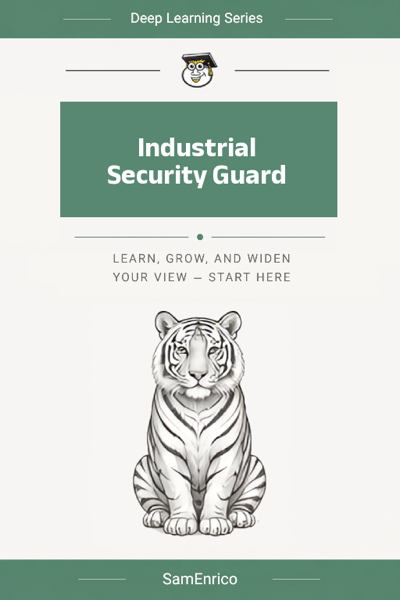
Industrial Security Guard eBook
A Coursebook on Industrial Security Guard
A Coursebook on Industrial Security Guard
Formats
Free sample
Chapter 1: The Legal Shield--The first lesson every industrial security guard must learn is this: your badge is not a shield against liability—it is a promise to act within the law, or else you become the threat you were hired to stop.On a rainy Tuesday night in 2018, a security guard named Marcus at a chemical processing plant in Louisiana heard a noise near the perimeter fence. He grabbed his flashlight, radioed dispatch, and went to investigate alone. What he found was a teenager who had climbed the fence to retrieve a lost soccer ball. Marcus detained the boy for forty-five minutes while waiting for police, refusing to let him leave despite the boy's protests and his mother's arrival at the gate. The mother sued.
The guard was fired. The security company paid $47,000 to settle the false imprisonment claim. Marcus had never laid a hand on the boy, never raised his voice, and thought he was doing his job correctly. But he was wrong because he never understood one fundamental principle: as a private security guard, you have no more legal authority than any other citizen—and sometimes less, because your employer's policies can restrict what you may do.This chapter establishes the bedrock upon which your entire career as an industrial security guard rests. Without mastering the legal framework of this profession, every patrol you walk, every alarm you investigate, and every person you stop exposes you and your employer to lawsuits, criminal charges, and career-ending liability.
The industrial environment magnifies these risks because you are not guarding a retail store or an office building. You are guarding facilities that contain heavy machinery, hazardous chemicals, valuable raw materials, proprietary technology, and hundreds or thousands of employees. The consequences of a legal misstep here are measured not in dollars alone but in lives, environmental disasters, and corporate collapse.We begin with the most important distinction in private security: the difference between what you are allowed to do and what you are empowered to do. Unlike police officers, who derive their authority from the state's power to enforce criminal law, you derive your authority from two sources only: the common law right of any citizen to make an arrest for a felony committed in their presence, and the contractual relationship between your employer and the industrial facility you protect. That second source is often the more powerful one, because it allows you to enforce company policies that go beyond criminal law.
You can deny access to someone who has done nothing illegal but has violated a safety rule. You can require random bag searches of employees who have signed consent forms as a condition of employment. You can escort a terminated worker off the property even if they have committed no crime. But these powers come with strings attached: they evaporate the moment you step outside the bounds of your employer's explicit authorization.Throughout this chapter, we will build a comprehensive legal framework organized around the core activities you will perform every day. First, we will trace the evolution of industrial security from the night watchman to the modern loss prevention officer, because understanding where you came from illuminates why the law treats you as it does today.
Second, we will distinguish proprietary security forces from contract security providers, since your legal relationship to the facility changes your rights and obligations significantly. Third, we will dissect the use-of-force continuum in industrial settings, paying special attention to the unique hazards of factories, warehouses, and chemical plants. Fourth, we will explore the criminal laws you must know cold: trespass, theft, vandalism, and sabotage, along with the industrial-specific variations that prosecutors and defense attorneys will argue about. Fifth, we will introduce the escalation matrix that governs every decision you make, providing a clear protocol for when to act alone, when to call a supervisor, and when to summon police. Finally, we will define the two-person rule and other critical safety protocols that protect both you and the public.By the end of this chapter, you will understand why the Louisiana guard was wrong, and you will never make the same mistake.The Evolution from Watchman to Asset Protector The industrial security guard of today descends from a lineage that began during the Industrial Revolution, when factory owners hired night watchmen to patrol their premises after hours.
These early watchmen carried rattles—wooden noisemakers—to summon help and oil lamps to light their way. They had no formal training, no legal guidance, and virtually no authority beyond observation and reporting. If they saw someone stealing, they yelled for others to wake up and chase the thief. The concept of detaining a suspect was foreign; the idea of using force was primitive.That model persisted largely unchanged until the mid-twentieth century, when two forces transformed industrial security. The first was the rise of organized labor and the corresponding growth of strike-related violence.
Industrial facilities suddenly needed trained personnel to manage picket lines, protect replacement workers, and prevent sabotage. The second force was the expansion of liability law. Courts began holding companies responsible not only for their own actions but also for the actions of their security guards. A guard who used excessive force could bankrupt a corporation. A guard who falsely imprisoned an employee could trigger a class-action lawsuit.These pressures professionalized the industry.
Training programs emerged. State licensing requirements appeared. Security companies developed use-of-force policies and legal compliance manuals. The night watchman with a rattle evolved into the loss prevention officer with a badge, a radio, and a duty to understand the law.Yet the legal status of the industrial security guard remains fundamentally different from that of a police officer. You are not a government actor, so the Fourth Amendment's restrictions on unreasonable searches and seizures do not apply directly to you.
That sounds like an advantage—and in some ways it is—but it also means you lack the protections that police enjoy. If a police officer makes an arrest that turns out to be unlawful, qualified immunity may shield them from civil liability. You have no such immunity. If you make an unlawful arrest, you can be sued personally, and your employer can be sued vicariously. Your homeowner's insurance will not cover the judgment.
Your career will end.This evolution also changed how industrial facilities view security. Proprietary security forces—guards directly employed by the factory or plant—became common in heavy industries like steel, automotive, and chemicals. These guards often had deep knowledge of the facility and its operations, but they also faced conflicts of interest when asked to investigate fellow employees. Contract security providers emerged to offer flexibility, specialization, and a degree of separation between the guard and the guarded. Today, both models coexist, and each has distinct legal implications.Understanding this history matters because the law still carries vestiges of the old watchman system.
In many jurisdictions, private security guards are explicitly prohibited from holding themselves out as police officers. You cannot wear a badge that says "police" or "sheriff." You cannot display a shield that mimics law enforcement insignia. These prohibitions exist precisely because the public might otherwise mistake you for someone with greater authority. That mistake can…
This is the end of the free sample. Get the eBook to keep going. Buy now
About this book
Details
- Author
- Broome Catina
- Publisher
- SamEnrico
- Language
- English
- Genre
- Non-Fiction, Informative, Educational
- Released
- 2026-05-06
- Pages (approx.)
- 153
- Available as
- eBook, Audiobook

Read better in the ZLOADR app
Your eBooks on your phone or tablet. Sign in with your SamEnrico account and start reading.
More by Broome Catina
 Receiving No with EQBroome Catina$11.99
 Eliminating Quadrant One CrisesBroome Catina$11.99
 Stress Fatigue Chronic ExhaustionBroome Catina$11.99
 Step Five Admitted to GodBroome Catina$11.99
 Whispers in the Wild: The Vanishing of the Dyatlov PassBroome Catina$11.99
 AI for Employee Sentiment AnalysisBroome Catina$12.99
 Learn to Play the Đàn GáoBroome Catina$11.99
 How to Become a Gas InspectorBroome Catina$11.99
You may also like
 Hong Kong Handover 1997Dunn Johnnie$11.99
 Zumba For Postnatal Recovery CourseNeal Christian$11.99
 Zumba for BeginnersLadner Nikia$11.99
 YouTube Comment Mining GuideHumes Pandora$12.99
 Worry Box MeditationCarlin Rudy$11.99
 Workplace Stress MeditationNguyen Lynn$11.99
 Workplace Stress and Sleep RepairHawley Ivory$11.99
 Workplace Perfectionism CureDelaney Jeffry$11.99
 Workplace Injustice Anger GuideWallen Isabelle$11.99
 Work Addiction and Burnout LinkGreenwood Ester$11.99
 Women in Yoga and WellnessBeattie Galina$11.99
 Women in Stand Up ComedyChun Evangeline$11.99