
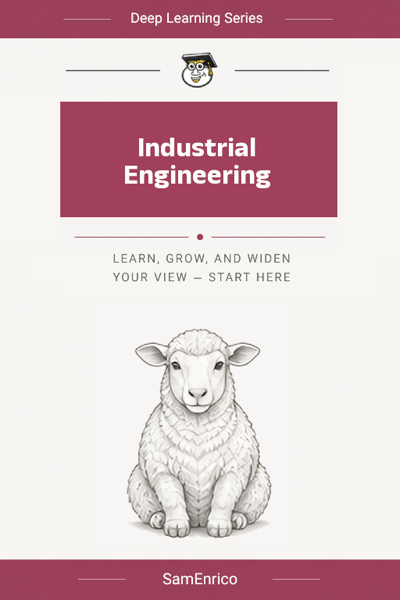
Non-FictionInformativeEducational
Industrial Engineering eBook
A Coursebook on Industrial Engineering
by Lyons Lora
A Coursebook on Industrial Engineering
Formats
Free sample
Chapter 1: The Architect’s Shift...--The email arrived at 7:43 on a Monday morning, and it changed everything about how I thought about my job. The subject line read: “Urgent: Production Meeting – 8:00 AM.” No context, no agenda, just the kind of vague urgency that makes your stomach tighten before you’ve had your first coffee. I was thirty-two years old, six months into my role as operations manager at Apex Assembly, and I had already learned one uncomfortable truth: the title on my door meant nothing if I couldn’t fix what was broken.The walk to the conference room took exactly ninety-four seconds. I know because I counted. That’s what industrial engineers do – we count things that everyone else ignores.
We count steps, seconds, defects, delays, and dollars. We count because we believe, sometimes against all evidence, that numbers tell a story that words cannot hide. On that Monday morning, the numbers were screaming.The conference room smelled of stale coffee and desperation. Around the table sat seven people who had every reason to be frustrated: the shipping manager whose trucks were idling for hours, the quality lead who had rejected three consecutive batches, the plant supervisor whose best people were threatening to quit, and the finance director who only cared about one number – the one with a minus sign in front of it. At the head of the table, looking like a man who had already calculated his own retirement date, sat Frank.
The general manager. My boss.“We have a problem,” Frank said. He slid a single sheet of paper across the table. It was a profit-and-loss statement for the previous quarter. The red numbers at the bottom were not subtle.
“We’re losing money on every unit we ship. The board wants a plan by Friday. I’m told we need to cut costs by fifteen percent. Immediately.”What happened next is the reason I am writing this book.Around the table, the solutions arrived like reflex actions. The shipping manager said they could consolidate truckloads and save three percent.
The plant supervisor said they could reduce overtime and save another two percent. The quality lead said they could loosen inspection tolerances – she actually said those words, “loosen inspection tolerances” – and save on rework labor. The finance director nodded at each suggestion, adding them to a mental spreadsheet that would, he believed, add up to fifteen percent.Nobody asked what the customer wanted. Nobody asked whether the work being done was actually necessary. Nobody asked why the factory had become so complicated that no single person could explain how a product moved from raw material to finished good.
Nobody asked about value.That is the moment this book begins. Not with a formula or a case study or a historical review of Frederick Taylor’s stopwatch. It begins with the recognition that most organizations, most managers, and most industrial engineers have gotten the fundamental question backwards. They ask: “How can we do what we’re doing more cheaply?” The right question – the only question that matters – is: “What should we be doing in the first place?”The Engineer Who Almost Wasn’t I did not set out to become an industrial engineer. Like most people who stumble into this field, I fell into it by accident, which is itself a damning commentary on how poorly we communicate what industrial engineering actually is.
I studied mechanical engineering in college because I liked the certainty of physics. A beam either holds or it breaks. A gear either meshes or it strips. There is a right answer, and the equations will find it.My first job out of school was at an automotive parts plant. I was hired as a “process engineer,” which turned out to mean “the person who gets called when the line stops.” For two years, I ran from fire to fire, solving problems that should never have existed in the first place.
A machine would break, and I would fix it. A quality issue would arise, and I would adjust the spec. A worker would get injured, and I would fill out the paperwork. I was good at it, in the same way that a firefighter is good at putting out fires started by an arsonist who lives down the hall.The turning point came during a meeting that looked almost exactly like the one I just described. We were discussing a new product launch that was already six weeks behind schedule.
The room was full of smart, well-intentioned people who were all trying to solve the wrong problem. The production manager wanted more people. The supply chain manager wanted more inventory. The design engineer wanted more time. Each of them was right, in the sense that their proposed solution would make their individual problem less painful.
And each of them was wrong, in the sense that adding people, inventory, and time to a broken process does not fix the process – it just makes the broken process more expensive.I remember raising my hand – I was young enough to still raise my hand in meetings – and asking a question that had been nagging at me for weeks. “Why do we need six different quality inspections for the same feature? Shouldn’t we just make it right the first time?” The room went quiet. The quality manager looked at me like I had suggested abolishing gravity. The production manager smirked.
And the plant manager, a woman named Diane who had started on the assembly line thirty years earlier, said something I have never forgotten.“That’s a good question,” she said. “Nobody’s asked that in twenty years.”That single question – simple, obvious, and yet somehow invisible to everyone who had been working in that plant for decades – led us to redesign the entire production process. We eliminated four of the six inspections by improving the upstream processes. We reduced defects by forty percent. We cut lead time in half.
And we did it without adding a single person, a single dollar of inventory, or a single day of schedule.That was my first real lesson in industrial engineering. It was not about efficiency. It was about effectiveness. It was not about doing things right. It was about doing the right things.
And it started with a question that everyone had forgotten to ask.The Taylorist Trap To understand why most organizations struggle with this distinction – effectiveness versus efficiency, value versus cost – we have to go back to the beginning. The beginning, for industrial engineering, is Frederick Winslow Taylor.Taylor was a brilliant and deeply flawed man. In the late nineteenth century, he watched factory workers deliberately working slowly – a practice he called “soldiering” – and decided to solve the problem with science. He broke every task into its smallest elements, timed each element with a stopwatch, and used the data to set “fair” standards for output. Workers who met the standard were paid a bonus.
Workers who did not were retrained or replaced.The results were dramatic. At Bethlehem Steel, Taylor increased the productivity of pig-iron handlers from twelve tons per day to forty-seven tons per day. The workers were exhausted, resentful, and frequently injured, but the…
This is the end of the free sample. Get the eBook to keep going. Buy now
About this book
Details
- Author
- Lyons Lora
- Publisher
- SamEnrico
- Language
- English
- Genre
- Non-Fiction, Informative, Educational
- Released
- 2026-06-03
- Pages (approx.)
- 156
- Available as
- eBook, Audiobook

Read better in the ZLOADR app
Your eBooks on your phone or tablet. Sign in with your SamEnrico account and start reading.
More by Lyons Lora
 Affirmations For LGBTQ PeopleLyons Lora$11.99
 Walking Meditation For ProcrastinationLyons Lora$11.99
 Pomodoro for Data EntryLyons Lora$11.99
 Fisheries Cooperative ManagementLyons Lora$11.99
 Assertiveness for Elder Care AdvocatesLyons Lora$11.99
 The Iron Titan: How Henry Bessemer Forged the Modern WorldLyons Lora$11.99
 How to Start a Wheat Farming BusinessLyons Lora$11.99
 Wholesale and Distribution PricingLyons Lora$12.99
 Self Taught Developer DilemmaLyons Lora$12.99
 Understanding Onychotrichodysplasia and NeutropeniaLyons Lora$17.99
You may also like
 Hong Kong Handover 1997Dunn Johnnie$11.99
 Zumba For Postnatal Recovery CourseNeal Christian$11.99
 Zumba for BeginnersLadner Nikia$11.99
 YouTube Comment Mining GuideHumes Pandora$12.99
 Worry Box MeditationCarlin Rudy$11.99
 Workplace Stress MeditationNguyen Lynn$11.99
 Workplace Stress and Sleep RepairHawley Ivory$11.99
 Workplace Perfectionism CureDelaney Jeffry$11.99
 Workplace Injustice Anger GuideWallen Isabelle$11.99
 Work Addiction and Burnout LinkGreenwood Ester$11.99
 Women in Yoga and WellnessBeattie Galina$11.99
 Women in Stand Up ComedyChun Evangeline$11.99