

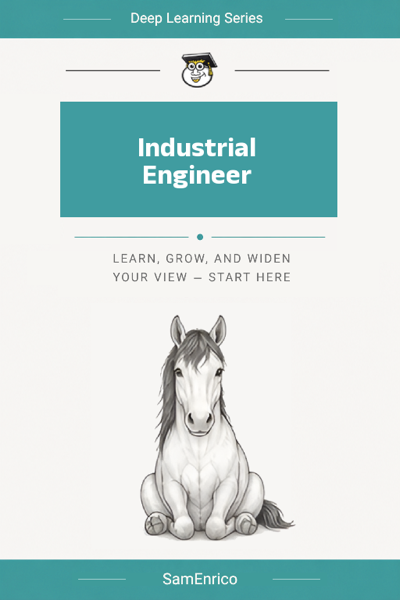
Non-FictionInformativeEducational
Industrial Engineer eBook
A Coursebook on Industrial Engineer
A Coursebook on Industrial Engineer
Formats
Free sample
Chapter 1: The Stopwatch Lie...--The first thing they teach you in nearly every introductory industrial engineering course is how to hold a stopwatch. Click it on when the worker reaches for the part. Click it off when the part drops into the bin. Do this thirty times. Average the numbers.
Apply a performance rating. Add a fatigue allowance. And congratulations—you have just manufactured a standard time.It is a seductive lie dressed in the clothing of science.Not because the math is wrong. The math is fine. But because the entire premise—that the industrial engineer’s primary job is to measure and optimize individual human motions—has not been true for at least forty years.
And yet, the myth persists. Walk into almost any manufacturing plant or logistics center today, and you will still find well-intentioned engineers clutching stopwatches (or their digital equivalents) and obsessing over seconds per cycle. They are fighting the last war. They are applying the tools of 1911 to the problems of 2026.This book exists to kill that stopwatch lie.The Ghost of Bethlehem Steel To understand why industrial engineering needs a radical reorientation, we must first visit a railway car yard in Bethlehem, Pennsylvania, in the spring of 1898. A forty-three-year-old mechanical engineer named Frederick Winslow Taylor is about to change the nature of work forever.Taylor was a man of contradictions.
He came from a wealthy Philadelphia family but chose to start his career as a pattern maker and machinist, working alongside immigrants and former laborers. He understood the shop floor from the inside. He also believed, with an almost religious fervor, that management was a science and that most workers were, by nature, "systematically soldiering"—that is, deliberately working slower than they could because they feared that higher productivity would lead to layoffs or reduced piece rates.At Bethlehem Steel, Taylor conducted what would become the most famous (and most infamous) time study in industrial history. He observed a laborer named Schmidt—a nickname for a real man whose actual identity has been lost to history—shoveling iron ore pellets into a rail car. Taylor believed that Schmidt was capable of moving 47 tons per day but was only moving 12.5.
Using stopwatch studies, Taylor determined the optimal shovel load (21 pounds), the optimal rest intervals, and the optimal motions. He then trained Schmidt to follow these instructions precisely. Schmidt’s output rose to 47 tons per day. His pay doubled. And the Bethlehem Steel company saved 78,000peryear(over78,000 per year (over 78,000peryear(over2 million in today’s money) in labor costs.To Taylor, this was proof that scientific management worked.
To generations of workers, it was proof that management would always find a way to squeeze more output from their bodies without sharing the full value of that increase. Both interpretations contain a kernel of truth. And both miss the larger point entirely.What Taylor Got Right (And What He Got Catastrophically Wrong)Let us be honest about Taylor’s contributions, because dismissing him entirely would be as foolish as worshiping him.What Taylor got right:First, he insisted that work should be studied systematically rather than left to tradition or guesswork. Before Taylor, most manufacturing methods were passed down from master to apprentice through oral tradition. No one could explain why a particular motion was performed, only that "that’s how we’ve always done it." Taylor replaced mysticism with measurement.Second, he introduced the concept of management as a distinct function separate from labor.
This seems obvious today, but in the late nineteenth century, most shop foremen were simply the strongest or most experienced workers, with no training in planning, coordination, or improvement. Taylor argued that planning should be done by specialists—engineers—who would then instruct workers.Third, he demonstrated that productivity improvements could benefit both worker and employer. Schmidt earned more money. The company earned more profit. The zero-sum assumption that one side’s gain must be the other’s loss is not always true.
Taylor proved that.What Taylor got wrong:First, and most fundamentally, Taylor treated human beings as interchangeable mechanical components. In his model, the worker’s job was to execute the motions prescribed by the engineer, nothing more. Creativity, judgment, discretion—these were not merely unnecessary but actively dangerous, because they introduced variation from the "one best way."Second, Taylor assumed that the engineer’s primary tool was observation and timing. He had no concept of variation as a statistical phenomenon (Walter Shewhart would not develop control charts until the 1920s). He had no concept of systems thinking (Jay Forrester was not born until 1918).
He could measure individual motions but could not see the organization as a whole.Third, Taylor’s method was implicitly adversarial. He believed workers were inherently lazy and needed external motivation (money or fear) to perform. This assumption poisoned labor-management relations for decades and sparked resistance that often destroyed more value than the time studies created.The tragedy is not that Taylor was wrong. The tragedy is that industrial engineering has spent 125 years trying to perfect his methods rather than questioning whether they remain the right tools for the job.The Gilbreths: Adding the Human Back In Not everyone followed Taylor blindly. Frank and Lillian Gilbreth—he an engineer, she a psychologist (and the first woman to earn a Ph.D.
in industrial psychology from Brown University)—offered a competing vision that was, in many ways, more sophisticated and more humane.Frank Gilbreth began his career as a bricklayer. He noticed that some bricklayers were dramatically faster than others, but no one could explain why. So he filmed them. Using motion picture cameras (a radical innovation in the early 1900s), Gilbreth broke bricklaying down into its constituent motions. He identified eighteen basic motion elements, which he called Therbligs (Gilbreth spelled backward, with the "th" transposed).The Therbligs were: Search, Find, Select, Grasp, Reach, Move, Position, Assemble, Use, Disassemble, Inspect, Pre-position, Release Load, Unavoidable Delay, Avoidable Delay, Plan, and Rest.This was a revolutionary insight.
Instead of measuring seconds per brick, Gilbreth measured the presence or absence of specific motion types. He realized that the fastest bricklayers minimized "Search" and "Select" (by having bricks arranged in a specific order on a scaffold) and eliminated "Avoidable Delay" (by having mortar delivered continuously). By redesigning the work method—not just timing it—Gilbreth increased bricklaying output from 120 to 350 bricks per hour, while reducing worker fatigue.But Lillian Gilbreth contributed something even more important: she insisted that the human element could not be ignored. Her background in psychology led her to study fatigue, stress, and motivation. She argued that the goal of motion study was not just efficiency but the reduction of unnecessary effort—that a well-designed workplace should leave the worker less tired, not more.The Gilbreths gave industrial engineering a dual mandate: improve the method and improve the worker’s experience.
It is a mandate that the profession has repeatedly forgotten and needs to recover.The Long Middle: Operations Research and the Computer Revolution The next major evolution arrived with World War II. Military planners faced problems that no stopwatch could solve: How many ships should sail in a convoy to minimize submarine losses while maximizing cargo…
This is the end of the free sample. Get the eBook to keep going. Buy now
About this book
Details
- Author
- Merchant Blondell
- Publisher
- SamEnrico
- Language
- English
- Genre
- Non-Fiction, Informative, Educational
- Released
- 2026-05-23
- Pages (approx.)
- 156
- Available as
- eBook, Audiobook

Read better in the ZLOADR app
Your eBooks on your phone or tablet. Sign in with your SamEnrico account and start reading.
More by Merchant Blondell
 Atacama Desert SurvivalMerchant Blondell$11.99
 Cocaine Adulterant DangersMerchant Blondell$11.99
 From the Statehouse FloorMerchant Blondell$11.99
 Pregnancy Body Image GuideMerchant Blondell$11.99
 The Silent Depths: Unlocking the Pacific's Ice Age SecretsMerchant Blondell$11.99
 The Last Broadcast of Radio LuxembourgMerchant Blondell$11.99
 How to Become a Trimming AssemblerMerchant Blondell$11.99
 Dot Africa Domain Eligibility WorkbookMerchant Blondell$12.99
 2026-2030 Edge AI OutlookMerchant Blondell$12.99
 Understanding Histidinuria Renal Tubular DefectMerchant Blondell$17.99
You may also like
 Hong Kong Handover 1997Dunn Johnnie$11.99
 Zumba For Postnatal Recovery CourseNeal Christian$11.99
 Zumba for BeginnersLadner Nikia$11.99
 YouTube Comment Mining GuideHumes Pandora$12.99
 Worry Box MeditationCarlin Rudy$11.99
 Workplace Stress MeditationNguyen Lynn$11.99
 Workplace Stress and Sleep RepairHawley Ivory$11.99
 Workplace Perfectionism CureDelaney Jeffry$11.99
 Workplace Injustice Anger GuideWallen Isabelle$11.99
 Work Addiction and Burnout LinkGreenwood Ester$11.99
 Women in Yoga and WellnessBeattie Galina$11.99
 Women in Stand Up ComedyChun Evangeline$11.99