
Non-FictionInformativeEducational
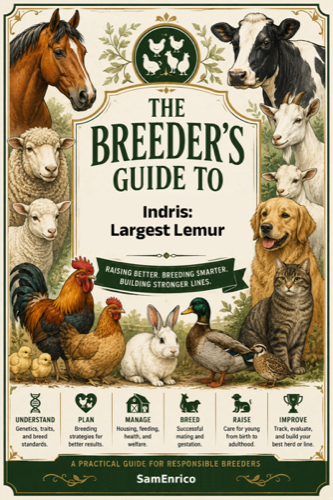
Indris: Largest Lemur eBook
This wildlife publication, published by SamEnrico,
This wildlife publication, published by SamEnrico, covers Indris: Largest Lemur
Formats
Free sample
Chapter 1: The Ghost’s Dawn...--The mist rose from the Analamazoatra Reserve like breath from a sleeping giant, curling between the buttress roots of towering Canarium trees and wrapping the rainforest in a shroud of silver-grey. It was 4:47 in the morning, still an hour before sunrise, and the eastern sky beyond Madagascar's rainforest canopy showed only the faintest bruise of violet. A guide named Tovo, who had walked these trails since he was a boy, raised his hand in a silent signal. Stop. Listen.
For a long moment, there was nothing but the drip of condensation from leaves and the distant chattering of a nocturnal Avahi woolly lemur calling its last call of the night. Then it came. A sound that has no precise equivalent in the human musical scale—part wail, part roar, part melody—rose from the treetops two hundred meters away. It started low, a guttural rumble from some immense chest, then climbed in pitch and urgency until it became a piercing, mournful cry that seemed to hang in the humid air for several seconds before fading. A second voice answered from the opposite direction, slightly higher, slightly faster.
Then a third, and a fourth. Within thirty seconds, the entire forest was singing.This was the dawn chorus of the Indri (Indri indri), the largest living lemur on Earth, and for those who hear it in its native habitat, the experience is nothing short of transformative. The nineteenth-century naturalist Alfred Grandidier, one of the first Europeans to document Madagascar's wildlife, wrote that the Indri's call was "un cri de désespoir si humain qu'il glace le sang"—a cry of despair so human that it freezes the blood. The Malagasy people, who have lived alongside this creature for at least two thousand years, call it Babakoto, which translates roughly to "father" or "ancestor." The legend is this: long ago, a human man went into the forest to hunt and did not return. His son went looking for him, found only his father's footprints leading up a tree, and called out in grief.
From the canopy above came a answering cry—the father had transformed into an Indri, and now the two sing to each other across the forest. Whether biology or mythology, the effect is the same: the Indri is not merely an animal. It is a presence, a voice, a ghost haunting the eastern rainforests of the world's most extraordinary island.The Island of Extremes To understand the Indri, one must first understand Madagascar. This is not merely a cliché of nature writing; it is a geological and biological necessity. Madagascar broke away from the African continent approximately 160 million years ago, and from the Indian subcontinent around 90 million years ago, leaving it adrift in the Indian Ocean for tens of millions of years.
That isolation created a living laboratory unlike any other on Earth. Approximately 90% of its plant species and 95% of its reptiles are endemic, found nowhere else. Its lemurs—a radiation of primates that evolved from a single rafting ancestor that crossed the Mozambique Channel sometime between 50 and 60 million years ago—fill ecological niches that elsewhere are occupied by monkeys, apes, woodpeckers, and even antelope. The Indri is the largest of these lemurs, but it is not merely large. It is a specialist so exquisitely adapted to its vertical world that it cannot survive anywhere else—not in zoos, not in other forests, not even in Madagascar's drier western regions.
It is a prisoner of its own evolutionary success.The eastern rainforest belt, where the Indri makes its home, runs like a green spine along Madagascar's length, from the Masoala Peninsula in the north to the southern reaches of the Ranomafana region. These are not the steamy, lowland jungles of popular imagination—or rather, not only those. The Indri's range spans an altitudinal gradient from sea level to nearly 2,000 meters, encompassing lowland rainforests (hot, humid, with trees reaching 40 meters or more), mid-elevation forests (cooler, with dense understory and prolific mosses), and montane forests (where temperatures can drop to near-freezing at night and the trees are stunted and wind-sculpted). Throughout this range, one constant holds: the forest is defined by verticality. The trees are not spaced like an oak forest, with broad horizontal branches.
Instead, they grow close together, their trunks rising straight and true like columns in a natural cathedral, their canopies interlocking so tightly that sunlight, when it finally penetrates, arrives as scattered coins of gold on a dark floor.This vertical architecture is the key to everything about the Indri. Its body, its behavior, its social life, and its voice have all been shaped by the need to navigate a world where the fastest route between two points is often straight up.The Challenge of the Phantom Despite its size—and this is a point worth emphasizing: the Indri is the largest living lemur, standing approximately 2.5 feet (0.75 meters) tall and weighing between 15 and 20 pounds (6.5 to 9 kilograms), roughly the size of a large beaver or a small dog—the Indri is notoriously difficult to see. A visitor to Analamazoatra might spend three days hiking the trails, following the distant calls, and still catch only a fleeting glimpse: a black-and-white shape launching from one trunk, a rustle of leaves, a patch of sunlight briefly obscured. The difficulty is intentional. The Indri's black-and-white pelage, which varies geographically (northern populations near Marojejy have more black on the back and limbs, while southern populations around Analamazoatra have more white and often a distinctive pale collar), serves as disruptive camouflage in the dappled light of the canopy.
When the sun filters through the leaves, casting shifting patches of brightness and shadow, the Indri's contrasting fur breaks up its outline, making it appear not as an animal but as part of the random pattern of light. Add to this the animal's habit of freezing motionless against a trunk when it senses danger—a behavior that takes advantage of its vertical orientation—and you have a creature that can be staring directly at a human from twenty meters away and still remain invisible to the untrained eye.The Malagasy guides who lead tourists through the reserves have developed techniques to counter this invisibility. They listen for the sound of pulled leaves (the Indri's primary food) hitting the forest floor, watch for branches that shake against the wind, and scan for the distinctive shape of a head silhouetted against the sky. But even the best guides will tell you: you do not find the Indri. The Indri decides whether to allow itself to be found.The Two Meanings of "Ghost"The title of this chapter, "The Ghost's Dawn," is intended to evoke two distinct but related meanings.
The first is the obvious one: the Indri's elusiveness, its seeming ability to vanish into the canopy, its haunting call that seems to come from nowhere and everywhere at once. The second meaning is darker and more urgent. The Indri is a ghost not only of the present but of the past—a living relic of a world that has largely disappeared.To understand this second meaning, we must briefly consider the subfossil record of Madagascar. Over the past two millennia, the island has lost an extraordinary…
This is the end of the free sample. Get the eBook to keep going. Buy now
About this book
Details
- Author
- Henderson Silvia
- Publisher
- SamEnrico
- Language
- English
- Genre
- Non-Fiction, Informative, Educational
- Released
- 2026-06-02
- Pages (approx.)
- 134
- Available as
- eBook, Audiobook

Read better in the ZLOADR app
Your eBooks on your phone or tablet. Sign in with your SamEnrico account and start reading.
More by Henderson Silvia
 Birth Control And Weight GainHenderson Silvia$11.99
 Aging in Place Home ModificationsHenderson Silvia$11.99
 Gen Z Home GymHenderson Silvia$11.99
 Vitamin E Tocopherol Vs TocotrienolHenderson Silvia$11.99
 Navigating Medical Bad NewsHenderson Silvia$11.99
 Negotiation Assertive GuideHenderson Silvia$11.99
 Senior Birthday Self EsteemHenderson Silvia$11.99
 Self Hypnosis for Exam SuccessHenderson Silvia$11.99
 The Silence of the Hollow MenHenderson Silvia$11.99
 The Green Labyrinth: Roberto Burle Marx and the Reinvention of Brazilian LandscapesHenderson Silvia$11.99
 Loyalty Money TrapHenderson Silvia$12.99
 Allowance for Doubtful AccountsHenderson Silvia$12.99
You may also like
 Hong Kong Handover 1997Dunn Johnnie$11.99
 Zumba For Postnatal Recovery CourseNeal Christian$11.99
 Zumba for BeginnersLadner Nikia$11.99
 YouTube Comment Mining GuideHumes Pandora$12.99
 Worry Box MeditationCarlin Rudy$11.99
 Workplace Stress MeditationNguyen Lynn$11.99
 Workplace Stress and Sleep RepairHawley Ivory$11.99
 Workplace Perfectionism CureDelaney Jeffry$11.99
 Workplace Injustice Anger GuideWallen Isabelle$11.99
 Work Addiction and Burnout LinkGreenwood Ester$11.99
 Women in Yoga and WellnessBeattie Galina$11.99
 Women in Stand Up ComedyChun Evangeline$11.99