
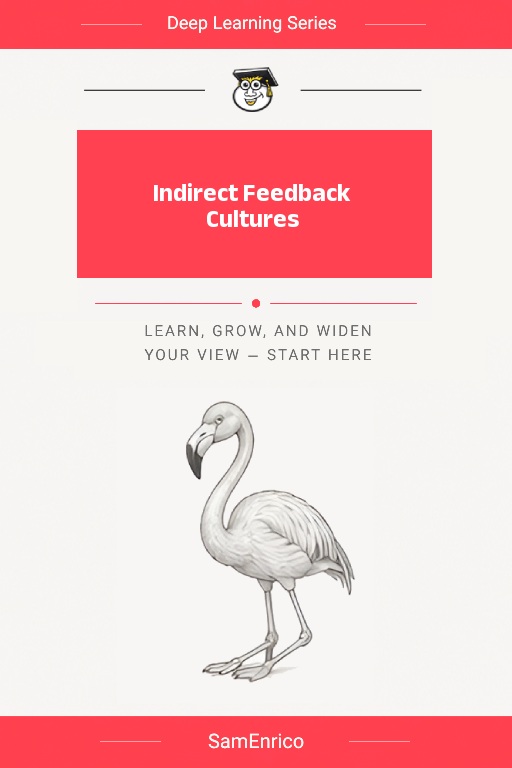
Non-FictionProfessional's Cheat SheetFace Saving
Indirect Feedback Cultures eBook
Give effective mentoring feedback in cultures wher
Give effective mentoring feedback in cultures where direct criticism causes loss of face.
Formats
Free sample
Chapter 1: The Feedback Trap--–- Simon Kim was a model employee. For seven years at a global technology firm, he had met every target, led two successful product launches, and received nothing but glowing performance reviews. His managers praised his technical skill, his diligence, and his quiet professionalism. Then came the morning everything changed.His American director, Sarah, had flown in from Chicago. She asked Simon to stay after the weekly staff meeting.
She closed the door, sat across from him, and said the words that would haunt him for months:"Simon, I need to give you some direct feedback. Your team has been missing deadlines, and your reports lack strategic depth. I'm telling you this because I believe in radical candor. You need to step up."Simon nodded. He said, "Thank you for your honesty.
I understand." He smiled. He walked back to his desk. And then he did absolutely nothing for six weeks.Not because he was lazy. Not because he disagreed. But because in the moment Sarah spoke, something inside him had shut down.
His face—his social standing, his dignity, his sense of professional worth—had been stripped away in front of no one but himself, and that was enough. He felt shame so acute that he could not think clearly. He could not ask for help. He could not even name what had happened. He simply froze.Sarah, meanwhile, believed she had done the right thing.
She had been trained in "Radical Candor," the popular feedback model that urges managers to challenge directly and care personally. She had cared enough to fly across the world. She had been honest. When Simon failed to improve, she concluded he was not "a fit" for the culture. Six months later, Simon resigned.
Sarah hired someone else. The cycle repeated.This is the Mentor's Dilemma. And it is costing organizations billions.The Global Feedback Crisis Let us name the problem plainly: The dominant feedback models of the past decade were designed in low-context, individualistic cultures—predominantly the United States, Germany, the Netherlands, and Scandinavia. These models assume that direct criticism is a gift, that clarity is kindness, and that any professional should be able to "take it on the chin."But most of the world does not operate this way. And increasingly, the workplace does not either.Consider the numbers: By 2030, nearly 70% of global professionals will work in cross-border teams.
Multinational corporations now routinely manage employees across forty, fifty, sixty countries. A single video call might include a manager in London, a designer in Bangalore, a factory lead in Vietnam, and a quality specialist in Brazil. Each person brings a different relationship to feedback, authority, and—most critically—face.The result is a quiet epidemic of miscommunication, disengagement, and preventable failure. Studies suggest that in high-face cultures, direct negative feedback reduces subsequent performance by an average of 34%, compared to a 12% improvement in low-face contexts. Employees who receive public correction are 57% more likely to disengage within three months.
And the cost of replacing a single mid-level manager who "wasn't a fit" now exceeds 150% of their annual salary.Yet most leadership training ignores culture entirely. It treats "Radical Candor," "Crucial Conversations," and "Nonviolent Communication" as universal solutions. They are not. They are culturally specific tools that work beautifully in Amsterdam and fail catastrophically in Jakarta.This book is not an attack on those models. Direct feedback has its place, and we will name exactly when and where it works.
But this book is an argument that the dominant paradigm is incomplete. It ignores the single most important variable in human communication: face.What Is Face? A Working Definition Before we go further, we need a shared language. Throughout this book, "face" refers to the invisible social asset of dignity, standing, and honor that every person carries. It is not vanity.
It is not fragility. It is the psychological equivalent of credit score or professional reputation—except that it exists in every interaction, not just on a report.In high-face cultures (which we will define rigorously in Chapter 2), face is so central that people will sacrifice material gain, career advancement, and even project success to preserve it. This is not irrational. Losing face triggers the same neural threat response as physical danger. The brain does not distinguish between a public correction and a predator.
Both activate the amygdala, flood the system with cortisol, and shut down the prefrontal cortex responsible for learning, planning, and creative problem-solving.When Sarah told Simon that his reports lacked depth, his brain processed it as an attack. Not an opinion. Not helpful feedback. An attack on his professional identity, his standing in the group, his very sense of competence. The fact that Sarah meant well was irrelevant.
The fact that she was correct was irrelevant. His brain had switched from learning mode to survival mode.This is the Feedback Trap: The more directly you criticize someone in a high-face context, the less capable they become of responding productively. Your honesty does not unlock their potential. It locks it away.The Compliment Sandwich Lie Let us examine the most common attempt to solve this problem: the Compliment Sandwich.You have seen it. You have probably used it.
The structure is simple: praise, criticism, praise. "I really appreciate your dedication on this project. However, your analysis missed several key risks. But I know you'll do better next time."On paper, it seems reasonable. Soften the blow.
Surround the negative with positives. Surely that helps?It does not. And the research is devastating.Drawing on meta-analyses from The Feedback Fallacy (Buckingham) and The Power of Feedback (London), we now know that the Compliment Sandwich fails for three reasons:First, the recipient anticipates the pattern. After two or three sandwiches, the brain learns that praise is just the appetizer for criticism. The moment someone says "Great job on..." the threat response begins.
They stop listening to the praise because they are bracing for the attack.Second, the praise feels manipulative. Once the recipient recognizes the pattern, the praise loses all credibility. They think, "You don't actually mean this. You're just trying to make me feel better before you hurt me." The result is that neither the praise nor the criticism lands.Third, the criticism triggers the amygdala hijack anyway. The sandwich does nothing to change the delivery vehicle.
It simply adds padding around the impact. But padding does not stop a car crash. The criticism still arrives as a direct, personal judgment. And in high-face cultures, that is enough to shut down learning.Simon's previous managers had used the sandwich. He had learned to smile through the praise, brace for the middle, and then forget everything.
By the time Sarah arrived with her "radical candor," Simon had already been conditioned to expect pain. He just did not know how to say so.The False Choice Between Honesty and Kindness Here is where most feedback literature goes wrong. It presents a binary: you can be honest (direct, clear, even harsh) or you can be kind (indirect, gentle, unclear). And then it argues that honesty is the higher value, or that "kindness" is just cowardice.This is a false choice. The alternative is not honesty…
This is the end of the free sample. Get the eBook to keep going. Buy now
About this book
Details
- Author
- Sherman Gladys
- Publisher
- SamEnrico
- Language
- English
- Genre
- Non-Fiction, Professional's Cheat Sheet, Face Saving
- Released
- 2026-06-01
- Pages (approx.)
- 146
- Available as
- eBook, Audiobook

Read better in the ZLOADR app
Your eBooks on your phone or tablet. Sign in with your SamEnrico account and start reading.
More by Sherman Gladys
 Email Automation Platform SelectionSherman Gladys$11.99
 Self Hypnosis For Morning Routine ManualSherman Gladys$11.99
 Hybrid Succession PlanningSherman Gladys$11.99
 The Complete Micronutrient Testing GuideSherman Gladys$11.99
 Self Esteem for New RelationshipsSherman Gladys$11.99
 The Silk Road Cartographers: Mapping the Roof of the World (1200s)Sherman Gladys$11.99
 Rustlers and Rainmakers: The Ballad of the Phantom Cattle WarsSherman Gladys$11.99
 Understanding Epp (Erythropoietic Protoporphyria)Sherman Gladys$17.99
 Ultimate Handbook Guide to Semarang : (Indonesia) Travel GuideSherman Gladys$11.99
 Lead Row Field SupportSherman Gladys$11.99
 House Sitting Weekend GuideSherman Gladys$12.99
You may also like
 Hong Kong Handover 1997Dunn Johnnie$11.99
 Zumba For Postnatal Recovery CourseNeal Christian$11.99
 Zumba for BeginnersLadner Nikia$11.99
 YouTube Comment Mining GuideHumes Pandora$12.99
 Worry Box MeditationCarlin Rudy$11.99
 Workplace Stress MeditationNguyen Lynn$11.99
 Workplace Stress and Sleep RepairHawley Ivory$11.99
 Workplace Perfectionism CureDelaney Jeffry$11.99
 Workplace Injustice Anger GuideWallen Isabelle$11.99
 Work Addiction and Burnout LinkGreenwood Ester$11.99
 Women in Yoga and WellnessBeattie Galina$11.99
 Women in Stand Up ComedyChun Evangeline$11.99