
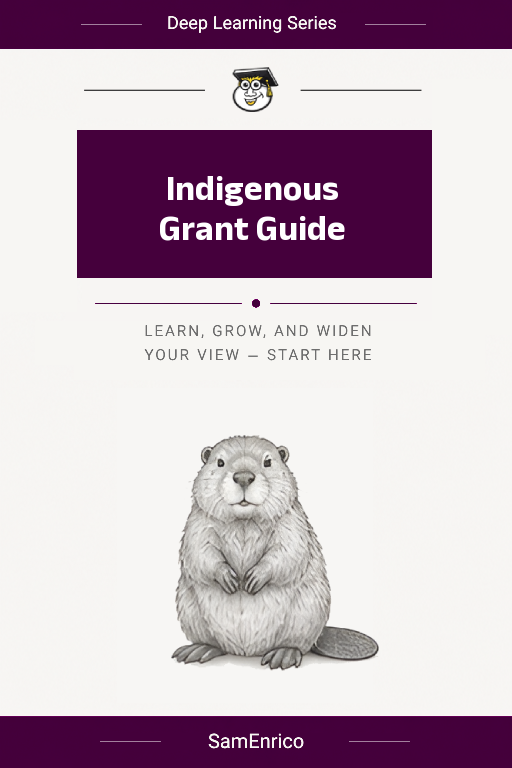
Non-FictionProfessional's Cheat SheetIndigenous Grants
Indigenous Grant Guide eBook
Targeted grant funding for Indigenous-led nonprofi
Targeted grant funding for Indigenous-led nonprofits and community projects in all three countries.
Formats
Free sample
Chapter 1: The Deficit Trap--–- The first time I was told to make my people look worse, I was sitting in a windowless conference room in downtown Denver. A white grant consultant with a $400 hourly rate slid a red pen across my proposal and said, "This needs more suffering. Funders don't write checks to people who are doing fine. They write checks to emergencies." She wanted me to add statistics about addiction rates. She wanted me to describe the mold in our public housing.
She wanted me to use the word "desperate." I was twenty-seven years old, newly hired as the grant writer for a Tribal nonprofit that ran a language immersion school, a community garden, and a youth canoe carve program. We were not desperate. We were overworked and underfunded, yes. But desperate? No.
We had fluent speakers in their eighties who still told jokes in our language. We had teenagers who could name fifteen constellations in our sky. We had a relationship with the land that no colonial accounting could measure. But that consultant was right about one thing: the mainstream grant system rewards trauma. It rewards deficit.
It rewards the performance of brokenness. And if you want to win grants using the conventional playbook – the one written by non-Indigenous experts for non-Indigenous audiences – you will be told, again and again, to lead with what you lack.This chapter dismantles that playbook. It is called "The Deficit Trap" because that is exactly what it is: a cage built from the very language of need. For decades, Indigenous grant seekers have been trained to open their proposals with statements like "Our community suffers from high unemployment" or "Lack of infrastructure has led to poor health outcomes." These statements are often factually true. But they are also a form of colonial violence.
They position Indigenous people as passive recipients of charity rather than active stewards of inherent sovereignty. They ignore the ten thousand years of civilization that preceded the last one hundred years of dysfunction. And, as we will see in this chapter, they are actually less effective than a strengths-based approach. The data is clear: funders rate applications higher when Indigenous applicants lead with stewardship, not suffering. This chapter will teach you how to write the opening paragraph that asserts your inherent right to exist, your role as a land steward, and your vision for the future – not your trauma from the past.
We will cover the trinational legal context (because what works for a US Tribal Nation may not work for a Mexican comunidad), the case study that proved the deficit narrative is a lie, and the practical template you need to rewrite every proposal you have ever submitted. By the end of this chapter, you will never write the words "our community lacks" again – unless you are quoting a federal Needs Statement, and even then, you will know how to bend that requirement to your sovereignty.The Consultant Was Wrong Let me tell you what happened after that meeting in Denver. I went back to my hotel room – paid for by the Tribal council, because they believed in investing in young writers – and I stared at my proposal. The consultant had covered it in red ink. She had crossed out phrases like "We have maintained our language for ten thousand years" and replaced them with "Our language is at risk of extinction." She had deleted "The youth in our canoe carve program learn traditional navigation" and inserted "Youth unemployment exceeds forty percent." She had changed "We seek a partnership to expand our garden" to "We request emergency assistance to address food insecurity." Every line that expressed strength, continuity, or joy had been replaced with a line that expressed crisis, lack, and need.
I was furious. But I was also young, and she was the expert, and the Tribal council had paid her a lot of money. So I rewrote the proposal her way. We submitted it. Three months later, we received a rejection letter that said, verbatim, "While your community's needs are significant, we have chosen to fund other priorities." I have often wondered what would have happened if I had kept my original draft.
I will never know. But that rejection taught me something crucial: the deficit narrative does not guarantee success. It guarantees that you will be evaluated on the scale of your suffering, not the depth of your solutions. And on that scale, someone else will always be suffering more.Over the next decade, as I moved between grant writing roles for Indigenous organizations across the US and Canada, and as I consulted with Mexican comunidades through a network of trusted colleagues, I began to notice a pattern. The proposals that won – the ones that got fully funded, the ones that led to multi-year commitments, the ones that made funders cry (in a good way) – almost never led with deficit.
They led with relationship. They led with land. They led with the ancestors. They said things like "We are the original caretakers of this watershed" and "Our Elders have been waiting for this opportunity" and "This project is the next step in a journey that began before colonization." These proposals still mentioned challenges. They still included data about language loss or health disparities when required.
But that information was buried in the middle of the proposal, after the reader had already been won over by the vision. The opening paragraph was always, always, a declaration of sovereignty. That was the secret. And it was a secret that the mainstream grant guides never revealed because they were written from a colonial worldview that cannot comprehend Indigenous self-determination.The Bestseller Gap Let me be blunt about the books that dominate the grant writing section of your local bookstore. The Only Grant-Writing Book You'll Ever Need by Ellen Karsh and Arlen Sue Fox is a classic.
It has helped countless nonprofits win funding. But it was written for a generic audience – food banks, homeless shelters, after-school programs – operating within a charitable framework that assumes the nonprofit is a temporary solution to a fixable problem. That framework does not work for Indigenous organizations. You are not a temporary solution. You are a permanent nation.
You are not asking for charity. You are asserting a treaty right. You are not a "stakeholder" in someone else's land. You are the original owner. The mainstream guides do not understand this.
They tell you to write a "Needs Statement" that proves you are worthy of help. They tell you to quantify your deficits. They tell you to make the funder feel sorry for you. But pity is a terrible foundation for a partnership. Pity ends when the check clears.
Respect endures.Another bestseller, The Grant Writing Guide by Betty S. Johnson, includes a chapter on "Culturally Competent Writing" that advises readers to "avoid jargon" and "use plain language." It does not mention sovereignty. It does not mention land back. It does not mention the fact that many Indigenous nations do not have a 501(c)(3) because they are sovereign governments that predate the IRS. It is not a bad book.
It is simply a book written from within a system that assumes everyone wants the same thing: to be a…
This is the end of the free sample. Get the eBook to keep going. Buy now
About this book
Details
- Author
- Knudsen Marcelene
- Publisher
- SamEnrico
- Language
- English
- Genre
- Non-Fiction, Professional's Cheat Sheet, Indigenous Grants
- Released
- 2026-05-30
- Pages (approx.)
- 154
- Available as
- eBook, Audiobook

Read better in the ZLOADR app
Your eBooks on your phone or tablet. Sign in with your SamEnrico account and start reading.
More by Knudsen Marcelene
 Nobel Peace Science ConnectionKnudsen Marcelene$11.99
 World News Anxiety Sleep AidKnudsen Marcelene$11.99
 Hotel Bar Conversation GuideKnudsen Marcelene$11.99
 Urban Walking Meditation CourseKnudsen Marcelene$11.99
 Social Support Behavior ChangeKnudsen Marcelene$11.99
 The Last Lantern of the Onryō: A Ghost’s Unfinished VowKnudsen Marcelene$11.99
 The Last Ascent of the Silk Road: A Love That Scaled the HeavensKnudsen Marcelene$11.99
 How to Start a Hobby in Paper CraftsKnudsen Marcelene$11.99
 Understanding GoitreKnudsen Marcelene$17.99
 Pet SitterKnudsen Marcelene$11.99
 One Page PR Outreach WorkbookKnudsen Marcelene$12.99
You may also like
 Hong Kong Handover 1997Dunn Johnnie$11.99
 Zumba For Postnatal Recovery CourseNeal Christian$11.99
 Zumba for BeginnersLadner Nikia$11.99
 YouTube Comment Mining GuideHumes Pandora$12.99
 Worry Box MeditationCarlin Rudy$11.99
 Workplace Stress MeditationNguyen Lynn$11.99
 Workplace Stress and Sleep RepairHawley Ivory$11.99
 Workplace Perfectionism CureDelaney Jeffry$11.99
 Workplace Injustice Anger GuideWallen Isabelle$11.99
 Work Addiction and Burnout LinkGreenwood Ester$11.99
 Women in Yoga and WellnessBeattie Galina$11.99
 Women in Stand Up ComedyChun Evangeline$11.99