
Non-FictionForecast & OutlookIndia
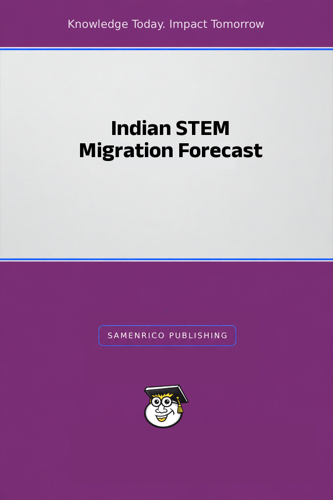
Indian STEM Migration Forecast eBook
Analyzes H1B and student visa trends to US.
Analyzes H1B and student visa trends to US.
Formats
Free sample
Chapter 1: The Broken Ladder...--–- In the spring of 2003, Satya Nadella packed two suitcases, kissed his pregnant wife goodbye, and boarded a flight from Hyderabad to Chicago. He had an H-1B visa, a job offer from Microsoft, and a green card process that his employer promised would take “about five years.” It took three. By 2006, he was a permanent resident. By 2014, he was CEO of the most valuable company on Earth.Twenty-three years later, a twenty-four-year-old named Priya Venkatesan sat in a cramped studio apartment in Sunnyvale, California, refreshing the US Citizenship and Immigration Services (USCIS) website for the third time that hour. She had graduated twelve months earlier from Carnegie Mellon University with a master’s degree in artificial intelligence.
She had paid $142,000 in tuition and living expenses. She had secured a job at a mid-tier tech firm that had agreed to sponsor her H-1B visa. She had entered the lottery—the same lottery that, in 2023, had a 14.6% selection rate for master’s degree holders.It was now early 2026. She had not been selected. Her Optional Practical Training (OPT) work authorization would expire in sixty-seven days.
Her employer had already told her, gently but firmly, that they could not relocate her to their Toronto office because Canadian permits had tightened. They could not send her to London because the UK’s Graduate Route was under review. They could not keep her in the United States because there was no legal pathway that did not involve winning a lottery with odds worse than most state lotteries.Priya was not an anomaly. She was the new normal.The ladder that Nadella climbed—F-1 student visa to OPT to H-1B to green card—had been built over three decades, from 1990 to 2020. It was never easy, but it was predictable.
For hundreds of thousands of Indian STEM graduates, it functioned as a reliable conveyor belt from Indian engineering colleges to American corporate headquarters. That conveyor belt stopped working sometime between the Trump-era executive orders of 2017 and the Biden administration’s quiet retention of those same restrictions. By 2023, the backlog was not a line; it was a geological formation. By 2025, the odds were not a gamble; they were a statistical near-certainty of failure.This book is about that broken ladder. It is not another immigration policy white paper.
It is not a nostalgic tribute to the Nadellas and Pichais who made it. It is a forecast—a data-driven, politically grounded, emotionally honest forecast—of what happens to Indian STEM migration over the next five years. And the first thing you need to understand is this: the problem is not that the ladder is crowded. The problem is that the ladder is being deliberately dismantled, piece by piece, by forces that have nothing to do with your resume, your degree, or your talent.The Three-Decade Pipeline That Worked Before we understand what broke, we must understand what worked.From 1990 to 2020, the typical journey of an Indian STEM professional to the United States followed a near-scripted arc. It began with the F-1 student visa.
Unlike the H-1B, the F-1 had no cap, no lottery, and no employer requirement. Any Indian student admitted to a SEVP-certified US university could obtain one, provided they could prove ties to their home country and sufficient financial support. Between 2000 and 2019, the number of Indian students in the United States grew from roughly 40,000 to over 200,000. By 2019, India was the second-largest source of international students, behind China, and the largest source of STEM graduate students.The second rung was Optional Practical Training (OPT). Created by executive order in 1992 and expanded by the STEM OPT extension in 2016, OPT allowed F-1 graduates to work in their field of study for 12 months—and up to 36 months for STEM degrees.
During this period, the graduate did not need H-1B sponsorship. They simply needed an employer willing to hire them. For Indian STEM graduates, OPT was the golden window: three years to prove themselves, to build relationships, to convince an employer that the legal fees and uncertainty of the H-1B lottery were worth the investment.The third rung was the H-1B visa. Created by the Immigration Act of 1990, the H-1B allowed US employers to hire foreign workers in “specialty occupations” for up to six years. The annual cap was set at 65,000, with an additional 20,000 for master’s degree holders.
For most of the 1990s and 2000s, that cap was not reached every year. In 1995, for example, only 46,000 H-1B petitions were filed. By 2007, that number had exploded to over 160,000. The lottery system—random selection when petitions exceed the cap—was introduced in 2014. For Indian IT professionals, the H-1B became the only game in town.
In 2019, Indians received nearly 70% of all H-1B visas issued, despite making up only 10% of the global applicant pool.The final rung was the employer-sponsored green card, specifically the EB-2 (advanced degree) and EB-3 (professional) categories. Unlike the H-1B, which was temporary, the green card offered permanent residency and a path to citizenship. Unlike the H-1B, which tied the worker to a single employer, the green card offered freedom. But here was the catch: the per-country cap. No more than 7% of green cards in any category could go to nationals of a single country.
For India, which produced far more qualified applicants than any other nation except China, this created a backlog. In 2005, that backlog was about three years. In 2010, it was seven years. In 2015, it was twelve years. In 2020, it exceeded fifty years for EB-3 applicants.
As of early 2026, the backlog for Indian EB-2 and EB-3 applicants exceeds 150 years.Let that number sit with you for a moment. One hundred and fifty years. An Indian engineer who started the green card process in 2024 will, if the backlog holds, receive permanent residency in the year 2174. Their great-great-great-grandchildren might attend the citizenship ceremony.This is not a line. This is a life sentence of temporary status.The Great Unwinding: 2020–2025If the pipeline worked for thirty years, what changed?
The answer is not one thing. It is four things, each reinforcing the others.First, the Trump administration’s executive orders (2017–2020) did not just target Muslim-majority countries. They fundamentally restructured how USCIS adjudicated H-1B petitions. The “Buy American, Hire American” executive order directed agencies to propose new rules to prevent the “fraud and abuse” of the H-1B system. Between 2017 and 2020, the denial rate for H-1B petitions for Indian IT firms like Infosys and TCS rose from 5% to over 30%.
Requests for Evidence (RFEs) became standard. The definition of a “specialty occupation” narrowed. Entry-level programmers were increasingly deemed ineligible.Second, the Biden administration retained most of these restrictions. Despite campaign promises to reverse Trump’s immigration policies, President Biden’s Department of Homeland Security kept the stricter H-1B adjudication standards in place. The administration argued that it was waiting for Congress to pass comprehensive reform.
Congress did not. By 2023, the denial rate for Indian IT firms had fallen slightly but remained at 18%, triple the pre-Trump rate. The message was clear: the executive branch, regardless of party, had lost interest in defending the H-1B pipeline.Third, the rise of the House Freedom Caucus…
This is the end of the free sample. Get the eBook to keep going. Buy now
About this book
Details
- Author
- Gurley Mackenzie
- Publisher
- SamEnrico
- Language
- English
- Genre
- Non-Fiction, Forecast & Outlook, India
- Released
- 2026-06-08
- Pages (approx.)
- 131
- Available as
- eBook, Audiobook

Read better in the ZLOADR app
Your eBooks on your phone or tablet. Sign in with your SamEnrico account and start reading.
More by Gurley Mackenzie
 Calisthenics Cool Down GuideGurley Mackenzie$11.99
 Work Addiction Cognitive Behavioral GuideGurley Mackenzie$11.99
 Gaming Withdrawal SymptomsGurley Mackenzie$11.99
 Physical Sensations Anger ForecasterGurley Mackenzie$11.99
 The Wave Equation: Solving the Pacific's Mathematical MysteryGurley Mackenzie$11.99
 Breaking the Silence: The Unlikely Redemption of Lance ArmstrongGurley Mackenzie$11.99
 Production Control ManagerGurley Mackenzie$11.99
 Understanding Chromosome 6, Monosomy 6qGurley Mackenzie$17.99
 How to Start a Constructional Engineering Business (Beginners Guide)Gurley Mackenzie$11.99
 Healthcare Buyer IdentificationGurley Mackenzie$12.99
 Phone Call Validation MethodGurley Mackenzie$12.99
You may also like
 Hong Kong Handover 1997Dunn Johnnie$11.99
 Zumba For Postnatal Recovery CourseNeal Christian$11.99
 Zumba for BeginnersLadner Nikia$11.99
 YouTube Comment Mining GuideHumes Pandora$12.99
 Worry Box MeditationCarlin Rudy$11.99
 Workplace Stress MeditationNguyen Lynn$11.99
 Workplace Stress and Sleep RepairHawley Ivory$11.99
 Workplace Perfectionism CureDelaney Jeffry$11.99
 Workplace Injustice Anger GuideWallen Isabelle$11.99
 Work Addiction and Burnout LinkGreenwood Ester$11.99
 Women in Yoga and WellnessBeattie Galina$11.99
 Women in Stand Up ComedyChun Evangeline$11.99