
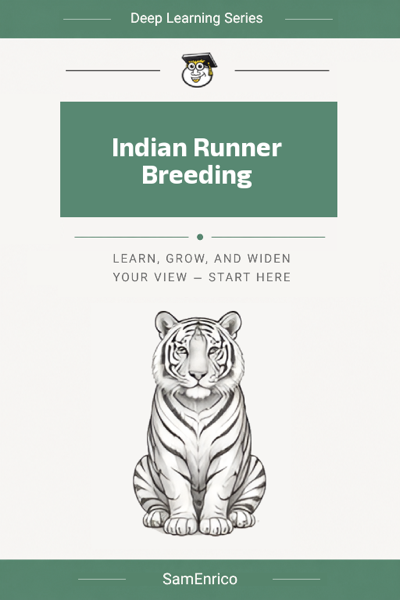
Non-FictionInformativeEducational
Indian Runner Breeding eBook
A Coursebook on Indian Runner Breeding
A Coursebook on Indian Runner Breeding
Formats
Free sample
Chapter 1: The Living Arrow--– The Indian Runner duck is not a mistake of nature, nor is it a recent invention of enthusiastic breeders. It is, in fact, one of the most refined biological machines ever shaped by human hands—a living arrow pointed directly at the soil, designed over centuries to convert insects, slugs, and spilled grain into eggs with an efficiency that commercial poultry breeds have never matched. Yet, for all its remarkable qualities, the Indian Runner remains one of the most misunderstood and mismanaged domesticated waterfowl in the Western world. Most first-time owners acquire them because they look amusing, because they stand like tiny penguins in a flock of normal ducks, or because a viral video showed a herd of Runners waddling with impossible speed toward a puddle. They fall in love with the novelty.
And then, within a year, they give them away or sell them cheaply, convinced that Runners are too nervous, too loud, too fragile, or simply too strange to keep.The tragedy is not that the ducks fail. The tragedy is that the owners fail the ducks.This book exists to correct that failure. Before we discuss housing, breeding, genetics, or biosecurity, we must first understand what the Indian Runner actually is—not as a pet, not as a curiosity, but as a biological asset shaped by thousands of years of selective pressure. Only then can the breeder make intelligent decisions about management, selection, and improvement. This chapter lays that foundation.
It traces the Runner’s journey from the rice paddies of Southeast Asia to the exhibition halls of Europe and America. It dismantles common myths about the breed’s origins and behavior. It analyzes the anatomy that makes the Runner unique—the vertical carriage, the flightless skeleton, the relentless foraging drive. And it introduces the single most important concept that will recur throughout this coursebook: that understanding the Runner’s natural history is the key to unlocking its genetic potential.By the end of this chapter, you will never look at an Indian Runner the same way again. You will see not a funny duck, but a masterpiece of domestication—and you will be ready to treat it as such.The Indonesian Genesis: More Than a Myth The precise origins of the Indian Runner duck are shrouded in the kind of uncertainty that accompanies most pre-colonial domesticated animals.
Unlike the modern Pekin duck, whose development is well-documented in 19th-century agricultural records, the Runner emerged from centuries of folk husbandry on the islands of Southeast Asia. The consensus among historical poultry scholars—based on the work of early 20th-century naturalists like C.A. Finsterbusch and Joseph W. Luckey—places the breed’s epicenter on the Indonesian archipelago, specifically the islands of Lombok and Java.But why Indonesia? The answer lies in the agricultural systems of the region.
Traditional rice farming creates a perfect ecological niche for a duck that can walk long distances, does not fly away, and actively hunts the golden apple snail (Pomacea canaliculata) and other rice pests. Local farmers in Lombok did not set out to create a “penguin duck.” They selected, generation after generation, for ducks that could walk for miles between paddies without tiring, that held their heads high to see over tall grass, that laid prodigiously on minimal feed, and that did not waste energy on flight muscles they would never use in a managed landscape.This is the crucial point that most breed histories get wrong. The Indian Runner was not bred for appearance. It was bred for function. The upright posture, the long slender body, the close-lying feathers, the remarkable running speed—all of these traits emerged as byproducts of selection for foraging efficiency and egg production.
The “penguin” look is not an ornamental quirk. It is a design for walking.European colonists encountered these ducks in the mid-19th century, likely through Dutch traders who controlled the Indonesian spice trade. The ducks arrived in England in significant numbers around the 1840s and 1850s, where they caused something of a sensation. Here were ducks that stood like soldiers, that ran rather than waddled, that laid eggs as well as any chicken. They were initially called “Penguin Ducks” in England, a name that persists in some old poultry books, before settling on the geographical misnomer “Indian Runner.” The name stuck despite the fact that the breed has no proven connection to India—a case of colonial geography overriding biological accuracy.From England, the breed spread to continental Europe and eventually to North America, where it was admitted to the American Poultry Association’s Standard of Perfection in 1898.
What arrived in America, however, was already changed. European breeders had begun selecting for more extreme angles, for cleaner color patterns, for the pure novelty of the upright stance. The functional farm duck of Lombok was becoming an exhibition bird.The Great Confusion: Indian Runner vs. Pomeranian Before we proceed any further, we must address a persistent source of misidentification that plagues novice breeders: the difference between true Indian Runners and the closely related Pomeranian duck. This is not merely a matter of pedantic correctness.
The distinction matters for breeding programs, for show eligibility, and for understanding what behaviors to expect from your flock.The Pomeranian duck originated in northern Germany (the region of Pomerania, now split between Germany and Poland) and shares some visual similarities with the Indian Runner. Both breeds are upright, both are excellent layers, and both have a distinctive “arrow” shape when viewed from the side. However, the differences are substantial and consistent. True Indian Runners have a much more extreme vertical carriage, ideally 75 to 80 degrees from horizontal. Pomeranian ducks are upright but less so—closer to 60 to 70 degrees.
The Runner’s body is described in the Standard as “slim, cylindrical, with a long, fine head and a slender neck.” The Pomeranian is blockier, with a wider head and a thicker, shorter neck. Most tellingly, Pomeranian ducks retain a vestigial crest (a small tuft of feathers on the back of the head) in some color varieties, while Indian Runners are strictly crested only in specific, non-standard lines that are generally disqualified from exhibition.Why does this matter for the breeder? Because cross-breeding between the two is common in backyard flocks, and the resulting offspring often look like “almost Runners”—upright but not quite right, good layers but not outstanding. Many sellers mislabel these crosses as pure Runners, either through ignorance or active deception. A breeder who pays premium prices for “show-quality Runners” based on posture alone may end up with Pomeranian crosses that will never win a competition and may not breed true for the extreme upright angle.The lesson is simple: buy from reputable breeders who can provide lineage records, or learn to assess conformation with the rigor of a judge.
We will cover assessment techniques in Chapter 3, but for now, understand that the Indian Runner’s identity is wrapped up in its extreme posture. A duck that stands like a wine bottle is a Runner. A duck that stands like a soda can is something else.The Anatomy of an Arrow: Understanding the Runner’s Body To manage Indian Runners successfully, you must understand their anatomy—not…
This is the end of the free sample. Get the eBook to keep going. Buy now
About this book
Details
- Author
- Winfield Kiera
- Publisher
- SamEnrico
- Language
- English
- Genre
- Non-Fiction, Informative, Educational
- Released
- 2026-05-04
- Pages (approx.)
- 157
- Available as
- eBook, Audiobook

Read better in the ZLOADR app
Your eBooks on your phone or tablet. Sign in with your SamEnrico account and start reading.
More by Winfield Kiera
 Burnout Recovery Exercise GuideWinfield Kiera$11.99
 The DNA Diet Personalized GuideWinfield Kiera$11.99
 Self Worth Maintenance GuideWinfield Kiera$11.99
 Workplace Esteem for TeachersWinfield Kiera$11.99
 Parental Grief and Career ImpactWinfield Kiera$11.99
 The Jade Serpent's Last FlightWinfield Kiera$11.99
 The Babylonian Star Catalog: Mapping the Cosmos in Clay (7th Century BCE)Winfield Kiera$11.99
 How to Start a Cellulose Nitrate Business (Beginners Guide)Winfield Kiera$11.99
 Descriptive Statistics ExcelWinfield Kiera$12.99
 Katrina Lake Stitch Cash ManualWinfield Kiera$12.99
 Understanding Glaucoma, CongenitalWinfield Kiera$17.99
You may also like
 Hong Kong Handover 1997Dunn Johnnie$11.99
 Zumba For Postnatal Recovery CourseNeal Christian$11.99
 Zumba for BeginnersLadner Nikia$11.99
 YouTube Comment Mining GuideHumes Pandora$12.99
 Worry Box MeditationCarlin Rudy$11.99
 Workplace Stress MeditationNguyen Lynn$11.99
 Workplace Stress and Sleep RepairHawley Ivory$11.99
 Workplace Perfectionism CureDelaney Jeffry$11.99
 Workplace Injustice Anger GuideWallen Isabelle$11.99
 Work Addiction and Burnout LinkGreenwood Ester$11.99
 Women in Yoga and WellnessBeattie Galina$11.99
 Women in Stand Up ComedyChun Evangeline$11.99