
Non-FictionBusiness BriefData Privacy
Indian BPO Data Security Guide eBook
Ensure GDPR and SOC2 compliance when outsourcing c
Protect customer data when outsourcing to India using this privacy compliance handbook.
Formats
Free sample
Chapter 1: The Consent Illusion--–- In the winter of 2022, a mid-sized Dutch health insurance company called Zorg Direct did everything right. They spent six months vetting Indian BPO vendors, paid for a SOC2 Type II audit, signed a thirty-page data processing agreement, and even flew their DPO to Bangalore to inspect the vendor's facilities in person. The BPO, a reputable firm with 5,000 employees and glowing client testimonials, promised full GDPR compliance. Six months after go-live, the Dutch Data Protection Authority imposed a €475,000 fine. The reason: the BPO's customer consent mechanism allowed opt-out by default, not opt-in.
The Dutch regulator ruled that Indian "deemed consent" had illegally overridden GDPR's explicit consent standard. Zorg Direct's CEO later testified before a parliamentary committee, saying, "We thought SOC2 meant safe. We were dangerously wrong."This story is not an anomaly. It is the canary in the coal mine for every Western company outsourcing customer data processing to India today. The global BPO industry, valued at over $260 billion, processes billions of customer records daily—from healthcare claims and credit card numbers to chat transcripts and biometric authentication data.
India commands roughly 55 percent of this market. And yet, the vast majority of outsourcing contracts rely on a dangerous assumption: that a SOC2 report, an ISO 27001 certificate, or a signed set of Standard Contractual Clauses creates a compliant data processing environment. It does not.The three-body problem of modern data protection—GDPR, SOC2, and India's newly enacted Digital Personal Data Protection Act, 2023—has created a compliance minefield that most legal and security teams are only beginning to understand. GDPR demands individual rights and strict consent. SOC2 demands auditable security controls but says nothing about legal processing bases.
DPDP demands local governance structures and allows "deemed consent" in ways that directly conflict with EU law. Caught in the middle is the Western data controller who outsources to an Indian BPO, believing that liability can be transferred along with the data.This chapter dismantles that illusion. It begins by exposing the three fundamental tensions between these regimes, walks through a real-world trilemma scenario using a decision matrix, and ends with a clear framework for determining which law governs which processing activity. By the end of this chapter, you will understand why "certified BPO" is not synonymous with "compliant BPO"—and why the Indian DPDP Act has fundamentally altered the risk equation for every company processing EU or Indian customer data through Indian subcontractors.The Great Consent Mistake Let us start with the most dangerous misconception in the entire outsourcing compliance landscape: the belief that GDPR requires explicit opt-in consent for most BPO processing activities. This error appears in countless vendor questionnaires, data protection impact assessments, and legal opinions.
It is also legally wrong, and relying on it creates unnecessary operational risk.GDPR provides six legal bases for processing personal data: consent, contract necessity, legal obligation, vital interests, public task, and legitimate interests. For the vast majority of BPO services—customer support, claims processing, technical help desks, fraud detection—the appropriate legal basis is almost never consent. It is contract necessity. When a customer calls a support line, buys a product, or files an insurance claim, the processing of their personal data is necessary to perform the contract to which they are a party. No consent checkbox is required.The misunderstanding arises because many privacy professionals default to consent as a "safe" basis without analyzing the actual processing purpose.
Consent requires a positive opt-in, must be granular (separate checkboxes for separate purposes), must be withdrawable as easily as given, and must be documented with proof of each consent event. Contract necessity requires none of that—only that the processing is objectively necessary to fulfill a contractual obligation.Why does this matter for Indian BPOs? Because the DPDP Act introduces a concept called "deemed consent" under Section 7. Deemed consent applies to processing that is necessary for specified legitimate purposes, including fraud prevention, whistleblowing, employment, and—crucially—"any purpose specified by the Central Government by notification." If a Western controller mistakenly relies on consent as their legal basis, they must then ensure the Indian BPO's systems support granular opt-in toggles, withdrawal mechanisms, and proof of consent. If they instead use contract necessity (the correct basis for most BPO services), the DPDP's deemed consent provisions become largely irrelevant to that processing stream.The real conflict emerges not in routine BPO services but in secondary processing: marketing, profiling, data sharing with third parties, and cross-border transfers beyond the original purpose.
In those scenarios, GDPR requires explicit consent for any processing beyond the original contractual purpose. DPDP allows deemed consent under the "legitimate uses" provision, which is broader than GDPR's legitimate interests. A typical Indian BPO's privacy notice might state, "We may use your data for improving our services and analytics." Under GDPR, that requires consent. Under DPDP, it may fall under deemed consent. The BPO, processing data under the controller's instructions, will follow its local interpretation unless explicitly prohibited.The solution is not to avoid India.
The solution is to map each processing activity to its correct legal basis before signing the BPO contract, to prohibit the BPO from relying on deemed consent for any processing of EU data subjects, and to embed that prohibition in the data processing agreement with explicit reference to GDPR Article 28.SOC2: The Security Mirage The second tension is more subtle but equally dangerous. SOC2 is a security and availability framework developed by the American Institute of Certified Public Accountants. A SOC2 Type II report provides reasonable assurance that a service organization's controls are designed appropriately and operating effectively over a period of time—typically six to twelve months. It is an excellent tool for evaluating technical security, logical access, change management, and incident response.What SOC2 does not do: evaluate legal compliance with any specific privacy law, assess the lawfulness of processing, verify the existence or effectiveness of consent mechanisms, or ensure data subject rights are honored. A BPO can have a flawless SOC2 report and still be in complete violation of GDPR or DPDP because they have no process for handling erasure requests, no legal basis for processing sensitive data, or no record of processing activities.The specific friction points between SOC2 and DPDP are particularly instructive.
SOC2's control criteria focus on security, availability, processing integrity, confidentiality, and privacy. The privacy criteria (CCM 4.0) include some elements of notice, choice, and consent, but they are not jurisdiction-specific. A BPO that passes SOC2 privacy controls may still fail DPDP's requirements for a resident Data Protection Officer (DPO) or a grievance officer physically located in India. SOC2 audits do not verify DPO appointments, do not test cross-border transfer restrictions, and do not audit records of processing activities against DPDP Section 10.Consider a concrete example. A US-based fintech outsources customer verification to an Indian BPO.
The BPO holds a current SOC2 Type II report covering security and confidentiality. The fintech's audit team reviews the report, notes no exceptions, and signs the contract. Six months later, an Indian data principal files a complaint with the Data Protection Board under DPDP Section 13, alleging that the BPO never appointed a grievance officer. The Board investigates. The BPO admits they have no Indian-resident…
This is the end of the free sample. Get the eBook to keep going. Buy now
About this book
Details
- Author
- Almond Hannelore
- Publisher
- SamEnrico
- Language
- English
- Genre
- Non-Fiction, Business Brief, Data Privacy
- Released
- 2026-05-29
- Pages (approx.)
- 152
- Available as
- eBook, Audiobook

Read better in the ZLOADR app
Your eBooks on your phone or tablet. Sign in with your SamEnrico account and start reading.
More by Almond Hannelore
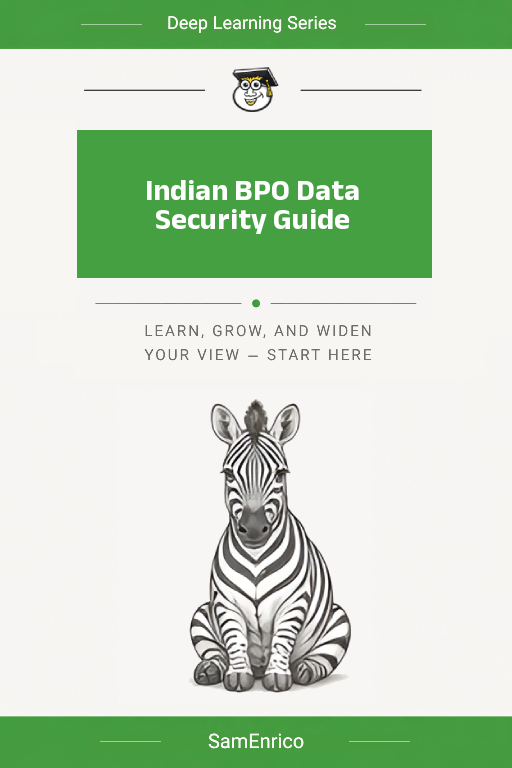 Indian BPO Data Security GuideAlmond Hannelore$12.99
 Opioid Recovery and Anger ManagementAlmond Hannelore$11.99
 Pol Pot KillingAlmond Hannelore$11.99
 Pattern Recognition for DesignersAlmond Hannelore$11.99
 The Dream Journal WorkbookAlmond Hannelore$11.99
 Parallel Parking Frustration GuideAlmond Hannelore$11.99
 Imposter Syndrome for EntrepreneursAlmond Hannelore$11.99
 Sleep Hygiene for MemoryAlmond Hannelore$11.99
 Gridiron Warrior Mindset TrainingAlmond Hannelore$11.99
 Dopamine Agonist AugmentationAlmond Hannelore$11.99
 Whispers of the Jade Serpent: China's Forgotten Dragon CultAlmond Hannelore$11.99
 The Vanishing Hiker of the Appalachian TrailAlmond Hannelore$11.99
You may also like
 Hong Kong Handover 1997Dunn Johnnie$11.99
 Zumba For Postnatal Recovery CourseNeal Christian$11.99
 Zumba for BeginnersLadner Nikia$11.99
 YouTube Comment Mining GuideHumes Pandora$12.99
 Worry Box MeditationCarlin Rudy$11.99
 Workplace Stress MeditationNguyen Lynn$11.99
 Workplace Stress and Sleep RepairHawley Ivory$11.99
 Workplace Perfectionism CureDelaney Jeffry$11.99
 Workplace Injustice Anger GuideWallen Isabelle$11.99
 Work Addiction and Burnout LinkGreenwood Ester$11.99
 Women in Yoga and WellnessBeattie Galina$11.99
 Women in Stand Up ComedyChun Evangeline$11.99