
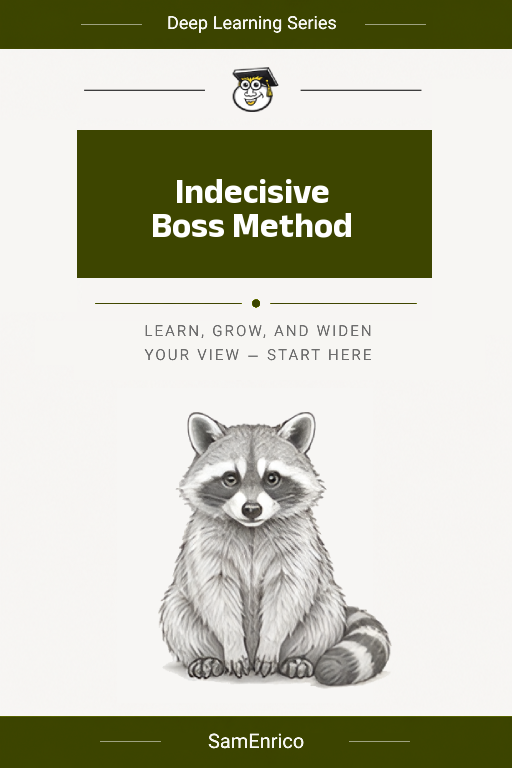
Non-FictionProfessional's Cheat SheetDecision MakingOption Framing
Indecisive Boss Method eBook
Offer two clear options with your recommendation a
by Scales Sabra
Offer two clear options with your recommendation and a deadline for their decision.
Formats
Free sample
Chapter 1: The $2.3 Million Pause--–- The email arrived at 9:14 AM on a Tuesday. A vendor contract, two options clearly laid out by the finance team, a recommendation highlighted in yellow, and a note: “Please decide by Friday so we can lock in pricing.” The CEO read it, nodded to himself, and thought, “I’ll get back to them after I review the Q2 forecast.” He never did. Three weeks later, the vendor pulled the offer. The company paid $2.3 million more for a worse contract. The finance director updated her résumé that same week.
The CEO told the board, “We just missed the window.” But the window hadn’t closed on its own. He had closed it by doing nothing.Welcome to the most expensive leadership habit you have never measured.The Scene That Plays Out Ten Million Times a Day Somewhere in the world, right now, a boss is saying “Let me think about it.” The words feel harmless. Responsible, even. A leader who pauses before deciding seems thoughtful, deliberate, measured. But here is what those four words actually do: they stop time for everyone listening.When a boss says “Let me think about it” to a direct report, that direct report cannot move forward.
Their team cannot move forward. The people waiting on that team cannot move forward. One vague sentence creates a cascade of frozen work that spreads through an organization like a virus. And because the boss said nothing definitive—no timeline, no criteria, no follow-up plan—everyone simply waits. They check email.
They refresh Slack. They hold “touch base” meetings that produce nothing. They lose momentum. They lose morale. And slowly, invisibly, they lose trust.Here is the most dangerous part: the boss who says “Let me think about it” almost never thinks about it.
The question gets buried under the next email, the next meeting, the next “Let me think about it.” The direct report learns not to ask again. The decision becomes a ghost—never made, never officially abandoned, just… forgotten. And the organization learns a terrible lesson: asking the boss for a decision is a waste of time.The $2.3 Million Contract That Never Got Signed Let me take you inside the actual case study that opened this chapter.A midsize fintech company—let’s call them Verge Payments—had spent nine months building a new fraud detection engine. They needed a cloud infrastructure provider to host it. Two vendors had made the final shortlist.
Vendor A was cheaper but required a three-year commitment. Vendor B was more expensive but offered month-to-month flexibility. The engineering team analyzed both options for two weeks. They produced a twelve-page document with clear pros and cons. The CTO wrote a recommendation: Vendor B, because the fraud landscape was changing too quickly to lock into three years.
The finance team added a note: choosing Vendor A would save $1.1 million upfront but increase risk.The CEO received the document on a Tuesday. He replied, “Let me think about it.”On Wednesday, nothing happened.On Thursday, the CTO sent a polite follow-up. “Any initial thoughts?”The CEO replied, “Still thinking. Will circle back.”On Friday—the original deadline—the CEO said nothing. The CTO assumed the decision was still pending.
The vendor’s pricing guarantee expired at midnight. No one had authorization to sign without the CEO. The deal went to another company.Three weeks later, when Verge finally needed to choose a provider, the market had shifted. Vendor B had raised prices by 22%. Vendor A was no longer accepting new multi-year contracts.
The company ended up signing with a third vendor—inferior technology, worse support, higher cost. The total financial impact: $2.3 million in additional expenses over two years. Plus, the fraud detection engine launched six weeks late. Plus, the CTO left the company within four months. Plus, the engineering team stopped bringing the CEO options.
They learned that bringing a decision to the boss meant waiting for weeks, not hours.The CEO didn't set out to lose $2.3 million. He set out to be careful. He confused thoughtfulness with paralysis. And his team paid the price.The Psychology of Decision Fatigue Why do smart, capable leaders fall into this trap? The answer lies in a phenomenon called decision fatigue.
Every decision a leader makes—even small ones like “What’s for lunch?” or “Which color should the report be?”—drains a finite reservoir of cognitive energy. By the time a boss faces their third or fourth significant decision of the day, the brain starts looking for ways to conserve energy. Saying “Let me think about it” feels like conservation. It pushes the decision into the future, creating the illusion of action without the cost of choosing.But decision fatigue explains only part of the problem. The rest comes from a deeply misunderstood virtue: open-mindedness.When Open-Mindedness Becomes a Weapon of Avoidance Most leaders believe that being open-minded means keeping options alive as long as possible.
The longer you wait to decide, the more information you can gather, and the better your final choice will be. This logic sounds reasonable. It is also almost always wrong.Here is what open-mindedness actually looks like in high-performing organizations: rapidly narrowing possibilities to two viable paths, choosing one, and moving forward with speed and accountability. Open-mindedness is not about keeping doors open forever. It is about knowing which doors to close and when to close them.The leaders who hide behind “Let me think about it” are not being open-minded.
They are being risk-avoidant. They are protecting themselves from the possibility of being wrong by never committing to being right. And they are mistaking procrastination for prudence.The Five Hidden Costs of “Let Me Think About It”If you are a leader who uses this phrase regularly, you are paying five invisible taxes. Let me name them clearly.Cost One: Team Morale Erosion Every time you say “Let me think about it” and fail to follow up, your team learns something. They learn that bringing you questions is futile.
They learn that your promises of follow-through are unreliable. They learn that you will not protect them from stalled projects or missed deadlines. Over time, this erodes psychological safety—the belief that one can speak up without fear of punishment or humiliation. Teams without psychological safety stop innovating, stop raising concerns, and stop caring. They do exactly what you ask and nothing more.
Your indecision has trained them to be passive.Cost Two: Decision Velocity Collapse Organizations run on decisions. Every decision that stalls creates a blockage. The blockage spreads. One indecisive boss can slow down five teams, each of which waits on answers before proceeding. This is not a metaphor.
It is a measurable phenomenon. When a team leader delays a decision by one week, the downstream teams attached to that decision often delay by three to four weeks because their work was scheduled sequentially. A single week of indecision creates a month of lost productivity.Cost Three: Trust Deficit Accumulation Trust is built in small moments. When you say “Let me think about it” and then actually follow up with a thoughtful answer within a reasonable timeframe, trust increases slightly. When you say it…
This is the end of the free sample. Get the eBook to keep going. Buy now
About this book
Details
- Author
- Scales Sabra
- Publisher
- SamEnrico
- Language
- English
- Genre
- Non-Fiction, Professional's Cheat Sheet, Decision Making, Option Framing
- Released
- 2026-05-29
- Pages (approx.)
- 127
- Available as
- eBook, Audiobook

Read better in the ZLOADR app
Your eBooks on your phone or tablet. Sign in with your SamEnrico account and start reading.
More by Scales Sabra
 Wholesaling Subject To GuideScales Sabra$11.99
 Wholesaling Banking GuideScales Sabra$11.99
 The Layoff Aftermath WorkbookScales Sabra$11.99
 The Do Not Disturb ScheduleScales Sabra$11.99
 Follow Up Email Networking GuideScales Sabra$11.99
 CrossFit Box Etiquette GuideScales Sabra$11.99
 Breath for Labor ContractionsScales Sabra$11.99
 Mary Barra GMScales Sabra$11.99
 Road Rage and Sleep LinkScales Sabra$11.99
 The Silent Sentinels: How Women Spies Changed the Great WarScales Sabra$11.99
 The Forgotten Goddess: Neith and the Weaving of FateScales Sabra$11.99
 The Midnight Tunnel: The Bold Breakout of Frank Morris and the Anguilla ThreeScales Sabra$11.99
You may also like
 Hong Kong Handover 1997Dunn Johnnie$11.99
 Zumba For Postnatal Recovery CourseNeal Christian$11.99
 Zumba for BeginnersLadner Nikia$11.99
 YouTube Comment Mining GuideHumes Pandora$12.99
 Worry Box MeditationCarlin Rudy$11.99
 Workplace Stress MeditationNguyen Lynn$11.99
 Workplace Stress and Sleep RepairHawley Ivory$11.99
 Workplace Perfectionism CureDelaney Jeffry$11.99
 Workplace Injustice Anger GuideWallen Isabelle$11.99
 Work Addiction and Burnout LinkGreenwood Ester$11.99
 Women in Yoga and WellnessBeattie Galina$11.99
 Women in Stand Up ComedyChun Evangeline$11.99