
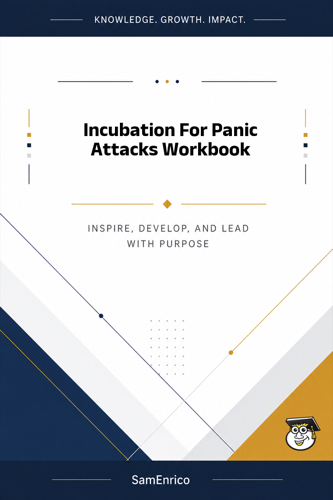
Non-FictionSelf-HelpPanic Disorder
Incubation For Panic Attacks Workbook eBook
Dreams process triggers and build coping imagery.
Dreams process triggers and build coping imagery.
Formats
Free sample
Chapter 1: The 3 AM Alarm--The bedroom is dark. The clock reads 3:14 AM. Your eyes snap open for no reason you can name. There is no sound, no intruder, no earthquake. And yet, within seconds, your heart is hammering against your ribs like a trapped animal.
Your breath comes in short, shallow gasps. Your palms are slick with sweat. The ceiling above you seems to be tilting, or maybe that's just your stomach lurching. You are absolutely, bone-deep certain that something is terribly wrong—that you are dying, losing your mind, or both.You lie there, paralyzed, waiting for the wave to pass. It doesn't.
It builds. Your mind races through the possibilities: heart attack, stroke, aneurysm, suffocation, insanity. You consider waking your partner. You consider calling 911. You consider running to the bathroom to splash water on your face, but you're not sure your legs will hold you.
So you stay frozen, counting your heartbeats, waiting to die.But you don't die. You never do. Twenty minutes later, the wave recedes. Your breathing slows. Your heart rate drops from 140 to 90 to 70.
The ceiling stops tilting. And you are left lying in the dark, exhausted and confused, asking yourself the same question you've asked a hundred times before: What the hell was that?If this scene feels familiar—if you have lived this exact moment more times than you can count—then this book was written for you. And the first thing you need to know is this: You are not broken. Your body is not betraying you. And the answer to "what the hell was that" is not a mystery.
It is a biology lesson you were never taught.The Great Misunderstanding: Why Sleep Feels Like Danger Most people believe that sleep is a sanctuary. After a long, stressful day, you crawl into bed, close your eyes, and escape. Sleep is supposed to be the body's reset button—a nightly retreat from the worries and fears of waking life. For the vast majority of people, this is true. Sleep restores, repairs, and renews.But for you—for the person reading this book at 3 AM or at 3 PM, desperate for answers—sleep is not a sanctuary.
Sleep is a trigger. And that is not a sign that you are broken. It is a sign that your nervous system is doing exactly what it evolved to do: scanning for danger, finding anomalies, and sounding the alarm. The problem is not the alarm. The problem is that no one ever taught you what the anomalies actually are.The central argument of this entire book is simple, radical, and life-changing once you truly believe it: The physical sensations that wake you in a panic are not evidence of illness, danger, or impending death.
They are normal biological events that your brain has learned to misinterpret as threats. This misinterpretation is not your fault. It is a learned pattern—and what has been learned can be unlearned.The Incubation Cycle: How Daytime Stress Becomes Nighttime Terror Before we can fix the problem, we need to understand how it starts. I call this the Incubation Cycle, and it is the engine that drives every nocturnal panic attack you have ever experienced.Here is how it works: During the day, you experience stress. Maybe it's work pressure, relationship conflict, financial worry, health anxiety, or simply the accumulated weight of a hundred small frustrations.
Your brain processes this stress in real time, but it does not always resolve it. Some of that stress gets stored—not as a conscious memory, but as a physiological residue. Your muscles stay slightly tense. Your breathing stays slightly shallow. Your nervous system stays slightly on edge.Then you go to sleep.
And here is where the magic—or the curse—happens. While you sleep, your brain does not simply turn off. It goes to work. During REM (rapid eye movement) sleep, the brain processes the day's emotional experiences, filing some away, discarding others, and trying to make sense of the rest. This processing happens through dreams.
Dreams are not random noise; they are your brain's attempt to integrate new information into existing mental models.But here is the catch: if you go to sleep with a stressed, sensitized nervous system, your brain processes that stress through the lens of threat. The neutral becomes ominous. The ambiguous becomes dangerous. A dream about being late for a meeting becomes a dream about being trapped. A dream about a minor disagreement becomes a dream about being attacked.
A dream about feeling out of breath becomes a dream about drowning.This is the incubation phase. Daytime stress incubates in your subconscious during sleep, emerging as fragmented REM, vivid or disturbing dreams, and a nervous system that is already primed for alarm by the time morning comes—or, more commonly, by the time 3 AM arrives.The 3 AM Trap: Why Your Body Betrays You at the Worst Possible Hour Now we arrive at the specific moment that brings most of my readers to this book: the 3 AM wake-up. Why 3 AM? Why not midnight or 5 AM? The answer lies in the architecture of your sleep cycle.Human sleep moves through roughly 90-minute cycles, alternating between deep (non-REM) sleep and lighter (REM) sleep.
In the first half of the night, deep sleep dominates. In the second half of the night, REM sleep dominates. Around 3 AM—assuming you went to bed around 10 or 11 PM—you are transitioning out of a REM cycle and into a lighter stage of sleep. This transition is neurologically complex. Your brain is shifting from dream mode to waking mode.
Your body is adjusting blood pressure, heart rate, and breathing patterns.Here is what is happening behind the scenes during that transition:Heart rate variability. As you emerge from REM sleep, your heart rate naturally becomes more variable—speeding up and slowing down in ways that feel irregular but are actually normal.Blood pressure drop. Your blood pressure reaches its lowest point of the 24-hour cycle during deep sleep. When you transition toward waking, it begins to rise again. That shift can feel like a lurch or a wave.Breathing changes.
REM sleep is associated with irregular breathing patterns. As you leave REM, your breathing stabilizes—but that stabilization can feel like a sudden awareness of breathlessness.Cognitive confusion. The dreaming mind does not turn off like a light switch. For several seconds or even minutes after waking, you may experience hypnopompic hallucinations—fragments of dreams bleeding into waking awareness. These fragments are often bizarre, threatening, or terrifying.Now here is the trap.
At 3 AM, all of this is happening in the dark, with no external distractions. You cannot look at your phone and see that your heart rate is normal. You cannot ask a friend if you look okay. You cannot remind yourself that you felt this exact same way last week and survived. You are alone in the dark with a body that feels like it is coming apart.And because you are alone in the dark, with no external information to correct your interpretation, your brain does the only thing it knows how to do: it sounds the alarm.
Cortisol surges. Adrenaline dumps. Your heart rate spikes from 60 to 120. Your breathing becomes rapid and shallow. Your palms…
This is the end of the free sample. Get the eBook to keep going. Buy now
About this book
Details
- Author
- Barnette Ellie
- Publisher
- SamEnrico
- Language
- English
- Genre
- Non-Fiction, Self-Help, Panic Disorder
- Released
- 2026-06-10
- Pages (approx.)
- 144
- Available as
- eBook, Audiobook

Read better in the ZLOADR app
Your eBooks on your phone or tablet. Sign in with your SamEnrico account and start reading.
More by Barnette Ellie
 The IBS Partner GuideBarnette Ellie$11.99
 Jealousy Journal WorkbookBarnette Ellie$11.99
 Calm Parenting of Strong-Willed KidsBarnette Ellie$11.99
 The Relapse Prevention for OpioidsBarnette Ellie$11.99
 The Gothic Vision: Cathedrals That Touched the SkyBarnette Ellie$11.99
 Roofing LabourerBarnette Ellie$11.99
 Reddit Validation MethodBarnette Ellie$12.99
 Payment Policy Update AfricaBarnette Ellie$12.99
 Understanding Thumb Absent Short Stature Immune DeficiencyBarnette Ellie$17.99
 How to Become a Dry-cell-assembly-machine TenderBarnette Ellie$11.99
You may also like
 Hong Kong Handover 1997Dunn Johnnie$11.99
 Zumba For Postnatal Recovery CourseNeal Christian$11.99
 Zumba for BeginnersLadner Nikia$11.99
 YouTube Comment Mining GuideHumes Pandora$12.99
 Worry Box MeditationCarlin Rudy$11.99
 Workplace Stress MeditationNguyen Lynn$11.99
 Workplace Stress and Sleep RepairHawley Ivory$11.99
 Workplace Perfectionism CureDelaney Jeffry$11.99
 Workplace Injustice Anger GuideWallen Isabelle$11.99
 Work Addiction and Burnout LinkGreenwood Ester$11.99
 Women in Yoga and WellnessBeattie Galina$11.99
 Women in Stand Up ComedyChun Evangeline$11.99