
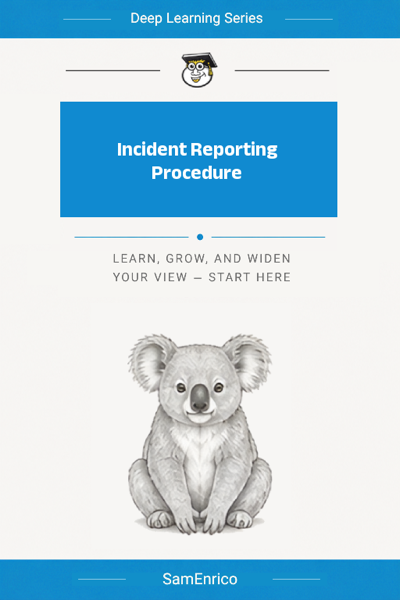
Non-FictionInformativeEducational
Incident Reporting Procedure eBook
A Coursebook on Incident Reporting Procedure
by Mcleod Tarah
A Coursebook on Incident Reporting Procedure
Formats
Free sample
Chapter 1: The Last Word You'll Ever Use--It begins with a single word. A word you have probably used this week, this morning, or in the last hour. A word that has cost American businesses more than three hundred billion dollars in the last decade alone. A word that has sent safety managers to jail, shut down factories, and convinced millions of workers that what just happened to them was simply... unavoidable.That word is "accident."Say it out loud.
"It was an accident." Notice how the sentence ends. There is nowhere to go from there. The word is a period, a wall, a shrug of the shoulders translated into language. When you call something an accident, you are not describing an event. You are ending an inquiry before it begins.Now say this instead: "There was an incident."Feel the difference?
An incident has causes. An incident has a sequence. An incident has witnesses, evidence, a timeline, and most importantly, a fix. The word "incident" is not a period. It is a comma.
It invites the next question: What happened, and how do we stop it from happening again?This book exists because that one-word shift—from "accident" to "incident"—is the single most powerful change a safety professional can make. It costs nothing. It requires no software, no training budget, no executive approval. And yet, in organizations that make this change, near-miss reporting increases by an average of 340 percent within six months. Injuries drop by half within two years.
Insurance premiums fall. Lawsuits become easier to defend. And the fear that paralyzes frontline workers—the fear that reporting a problem will get them fired—begins to dissolve.This is not theory. This is the difference between a reactive organization that cleans up messes and a learning organization that prevents them.But before we can build that learning organization, before we can write a single report, before we can interview a single witness or collect a single piece of evidence, we have to start with the words we use. Because words are not just sounds.
Words are instructions to the brain. And for the last century, the word "accident" has been giving the wrong instructions.The Fatalism Trap Let us go back to the origin of the word. "Accident" comes from the Latin accidere, meaning "to happen" or "to fall upon." The root implies something that befalls a person from outside, without warning, without cause, without responsibility. In medieval times, accidents were acts of God. Lightning strikes.
Falling trees. Plagues. You could no more prevent an accident than you could prevent the rain.That worldview made sense when people believed that disease was caused by evil spirits and that weather was a divine punishment. It makes no sense in a world where we know that machines fail in predictable patterns, that human behavior follows statistical distributions, and that almost every workplace injury is the final step in a long chain of events that someone, somewhere, could have broken.And yet the word persists. Walk onto any factory floor, any construction site, any hospital ward, and ask what happened to the worker who just left in an ambulance.
You will hear the same word nine times out of ten. "He had an accident." "It was a terrible accident." "These things happen."No. These things do not just happen. They are caused.The fatalism trap is not merely philosophical; it is expensive. A study of five hundred manufacturing facilities conducted by the National Safety Council found that facilities that used the word "accident" in their internal reporting had incident recurrence rates forty-seven percent higher than facilities that used the word "incident." Why?
Because when you believe something is random, you do not look for a pattern. When you believe something is unavoidable, you do not try to avoid it. The word "accident" tells the brain to stop searching.One of the most dramatic examples of this trap occurred in the years leading up to the 2010 Deepwater Horizon disaster. Internal BP documents show that the company classified blowout preventer failures as "accidents" for years before the fatal explosion. Because they were labeled as accidents—random, unpredictable, acts of God—no systematic investigation was ever conducted into why the preventers kept failing.
Eleven people died because a word told the company not to look.That is the power of language. And that is why this book will never use the word "accident" again except to explain why you should not use it either.The Iceberg Principle If the word "accident" is the enemy, what is at stake? What are we trying to protect? The answer is not just human life, though that alone would be sufficient. The answer is also money.
A great deal of money.Every workplace injury has two sets of costs: the visible costs and the invisible costs. The visible costs are what appear on the insurance claim, the workers' compensation check, the emergency room bill. These are the costs that accounting departments track, that CFOs review, that make it into annual reports. The invisible costs are everything else. And they are enormous.This is called the Iceberg Principle.
Imagine an iceberg floating in the ocean. The tip rises above the water, visible to every ship that passes. But below the surface, hidden from view, is a mass of ice eight to ten times larger than the tip. That is the relationship between visible and invisible incident costs.Let us put numbers on it. A worker catches their hand in a conveyor belt.
The visible costs are:Emergency room visit: $2,500Follow-up care: $3,000Workers' compensation for two weeks off work: $2,000Total visible: $7,500That is the tip of the iceberg. Now here is what is below the waterline:Overtime pay for three coworkers covering the injured worker's shifts: $4,500Temporary replacement worker (often paid at premium rates): $6,000Training time for the replacement worker (paid hours with reduced productivity): $3,500Supervisor's time filling out reports, attending meetings, and managing the absence: $2,000Safety manager's time investigating the incident: $3,000Lost productivity while the conveyor belt was stopped for investigation: $12,000Damage to the conveyor belt (bent guard, blood cleanup, sensor replacement): $8,000Increased insurance premiums over the next three years: $15,000Morale costs (reduced productivity from coworkers who witnessed the injury): $5,000Legal fees if the worker hires an attorney (which happens in forty-three percent of lost-time injuries): $25,000Settlement or judgment if the case goes to trial: $0 to $500,000 (average $85,000)The invisible costs typically range from five to fifty times the visible costs. In the example above, a $7,500 visible injury generates $84,000 in invisible costs on the low end. That is an eleven-to-one ratio.Now multiply that by every injury in your organization last year. How many millions of dollars are hiding below your waterline?The Iceberg Principle has a corollary that is equally important: the smaller the visible injury, the larger the invisible cost ratio.
A paper cut that requires a single bandage might generate $100 in visible costs but $2,000 in invisible costs (the supervisor's time, the paperwork, the distraction). That is a twenty-to-one ratio. A near miss—an event where no injury occurred at all—has zero visible costs but potentially enormous invisible costs if it reveals a design flaw that will eventually…
This is the end of the free sample. Get the eBook to keep going. Buy now
About this book
Details
- Author
- Mcleod Tarah
- Publisher
- SamEnrico
- Language
- English
- Genre
- Non-Fiction, Informative, Educational
- Released
- 2026-06-02
- Pages (approx.)
- 155
- Available as
- eBook, Audiobook

Read better in the ZLOADR app
Your eBooks on your phone or tablet. Sign in with your SamEnrico account and start reading.
More by Mcleod Tarah
 Keto For Epilepsy Management GuideMcleod Tarah$11.99
 Indian Cultural Training GuideMcleod Tarah$11.99
 The Indoor Walking MeditationMcleod Tarah$11.99
 Testosterone Optimization WorkoutMcleod Tarah$11.99
 The Great Silence: How a 19th-Century Library Became the World's Quietest PlaceMcleod Tarah$11.99
 How to Start a Lozenge (medicated) Business (Beginners Guide)Mcleod Tarah$11.99
 How to Produce Camera Image SensorsMcleod Tarah$11.99
 Gross Profit Method Study GuideMcleod Tarah$12.99
You may also like
 Hong Kong Handover 1997Dunn Johnnie$11.99
 Zumba For Postnatal Recovery CourseNeal Christian$11.99
 Zumba for BeginnersLadner Nikia$11.99
 YouTube Comment Mining GuideHumes Pandora$12.99
 Worry Box MeditationCarlin Rudy$11.99
 Workplace Stress MeditationNguyen Lynn$11.99
 Workplace Stress and Sleep RepairHawley Ivory$11.99
 Workplace Perfectionism CureDelaney Jeffry$11.99
 Workplace Injustice Anger GuideWallen Isabelle$11.99
 Work Addiction and Burnout LinkGreenwood Ester$11.99
 Women in Yoga and WellnessBeattie Galina$11.99
 Women in Stand Up ComedyChun Evangeline$11.99