
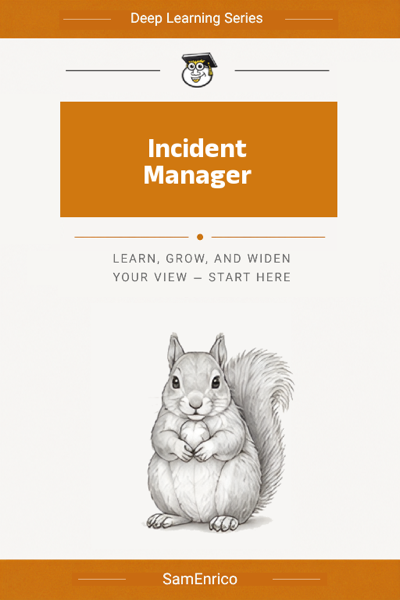
Non-FictionInformativeEducational
Incident Manager eBook
A Coursebook on Incident Manager
by Ahmed Lynell
A Coursebook on Incident Manager
Formats
Free sample
Chapter 1: The Unbroken Thread--–- The pager screamed at 2:17 AM. Maria Chen, a fifteen-year veteran of infrastructure operations, stared at the amber glow of her phone screen. The message was brief but catastrophic: "Payment gateway offline. All retail transactions failing. Estimated loss: $450,000 per hour." Her finger hovered over the "Acknowledge" button.
She knew that the moment she pressed it, her night—and possibly her week—would belong to whatever demon had crawled out of the data center's digital swamp. She pressed it. For the next eleven hours, Maria would do something remarkable. She would not write a single line of code. She would not reboot a single server.
She would not patch a single vulnerability. Instead, she would do the only thing that an Incident Manager truly does: she would hold the unbroken thread of attention, coordination, and decision-making that connected two hundred panicked people across twelve time zones, and she would weave that thread into a resolution.This book is about becoming Maria Chen. Not the technician she used to be, but the commander she became. This chapter establishes the semantic and strategic foundation for everything that follows. It answers three fundamental questions: What exactly is an incident?
How do we distinguish it from everything else that happens in a complex organization? And most importantly, why does the Incident Manager need a unified framework that treats a burning building, a ransomware attack, and a failed database cluster as variations of the same underlying problem?If you skip this chapter, you will spend the rest of this book confused about basic terms. If you read it carefully, you will acquire a mental map that makes every subsequent chapter—from psychology to forensics to crisis negotiation—snap into place like perfectly machined gears.The Problem with Ordinary Language In everyday conversation, we use words like "problem," "issue," "incident," "emergency," and "crisis" interchangeably. The server is slow? That's an incident.
The coffee machine is broken? That's an incident. A hurricane just destroyed the primary data center? Also an incident. This linguistic sloppiness is harmless at a dinner party.
In a war room, it is lethal.Consider the following scenario. A financial services firm receives an alert that its authentication service is returning timeout errors. A junior technician sees the alert and says, "We have an incident." He pulls three people onto a bridge line. They spend forty minutes restarting services. Meanwhile, the real cause—a distributed denial-of-service attack targeting the authentication layer—goes unnoticed because no one bothered to check traffic patterns.
The incident escalates. By the time someone thinks to involve security, the attackers have already found an exposed API and exfiltrated forty thousand customer records.Where did the process fail? It failed at the very first word. The technician used "incident" to mean "something is weird," which triggered a response protocol designed for service interruptions, not active attacks. He needed a different word for a different reality.
He needed precision.This chapter provides that precision. We will build a shared vocabulary that distinguishes between routine events, service incidents, major incidents, emergencies, and crises. We will then examine the three domains in which incidents occur—IT, cybersecurity, and physical safety—and demonstrate why they are not separate disciplines but facets of the same underlying challenge. Finally, we will introduce the All-Hazards Approach, the unifying framework that allows an Incident Manager to walk into any crisis and immediately impose order, regardless of the technical domain.The Unified Severity Ladder Let us begin with the most important diagram in this book. It is not a network topology or a decision tree.
It is a ladder with five rungs. Every organization should have this ladder laminated and taped to the wall of every war room. From lowest to highest severity:Rung One: Event. An event is any observable change in the state of a system. A user logs in.
A server's CPU usage spikes to eighty percent. A firewall logs a dropped packet. Events are neutral. They are neither good nor bad. They are simply data points.
Most events require no response whatsoever. The art of Incident Management begins with knowing which events to ignore.Rung Two: Incident. An incident is an unplanned interruption or reduction in the quality of an IT service. The payment gateway stops processing transactions. The email system becomes slow for all users in Europe.
A critical database returns read-only errors. In traditional frameworks, incidents are strictly about technology services. As we will see, modern Incident Managers must stretch this definition.Rung Three: Major Incident. A major incident is an incident that exceeds the organization's normal response capacity. This is a deliberately subjective threshold.
For a small e-commerce startup, a one-hour database outage might be a major incident because the entire engineering team must drop everything to fix it. For a global cloud provider, a one-hour database outage affecting a single customer might not even register as an incident. The defining characteristic of a major incident is that it requires dedicated command structures, shift rotations, and external communications. You cannot handle it with the person-on-call and a cup of coffee.Rung Four: Emergency. An emergency is an incident with immediate life safety, physical safety, or regulatory consequences.
A fire in a data center is an emergency. A chemical spill in a laboratory is an emergency. A breach of protected health information that triggers a forty-eight-hour reporting deadline under HIPAA is an emergency. The defining characteristic of an emergency is that someone could die, someone could be physically harmed, or someone could go to jail. Emergencies override normal business priorities.
You do not worry about service level agreements when the building is on fire.Rung Five: Crisis. A crisis is an incident that threatens the survival of the organization itself. A ransomware demand for ten million dollars that would bankrupt the company if paid or destroy its reputation if not paid. A product safety scandal that leads to a global recall and class-action lawsuits. A nation-state attack that exfiltrates the company's entire intellectual property portfolio.
Crises are existential. They require board-level involvement, legal counsel embedded in the war room, and often external parties like law enforcement or regulators. The Incident Manager who handles a crisis is no longer managing service levels; she is managing survival.Why does this ladder matter? Because each rung triggers a different response. An event triggers monitoring.
An incident triggers standard troubleshooting. A major incident triggers the full Incident Command System described in Chapter 3. An emergency triggers life safety protocols, evacuation procedures, and immediate regulatory notifications. A crisis triggers the board of directors, legal holds, and possibly external crisis communications firms.The most common mistake made by novice Incident Managers is treating every event as an incident, every incident as a major incident, and every major incident as a crisis. This leads to burnout, wasted resources, and—paradoxically—slower response times because everyone becomes desensitized to alerts.
The second most common mistake is the opposite: failing to recognize when an incident has crossed a threshold. The technician who says "it's not that bad" while a database leaks customer records is not being calm; he is being negligent.Throughout this book, we will refer back to this ladder. Chapter…
This is the end of the free sample. Get the eBook to keep going. Buy now
About this book
Details
- Author
- Ahmed Lynell
- Publisher
- SamEnrico
- Language
- English
- Genre
- Non-Fiction, Informative, Educational
- Released
- 2026-06-02
- Pages (approx.)
- 155
- Available as
- eBook, Audiobook

Read better in the ZLOADR app
Your eBooks on your phone or tablet. Sign in with your SamEnrico account and start reading.
More by Ahmed Lynell
 Red Light Mindfulness PracticeAhmed Lynell$11.99
 Quit Smoking Accountability GuideAhmed Lynell$11.99
 Candida Overgrowth TreatmentAhmed Lynell$11.99
 Daily Review for Project ManagersAhmed Lynell$11.99
 Cleopatra Cultural Diplomacy with RomeAhmed Lynell$11.99
 The Double Life of Anna AndersonAhmed Lynell$11.99
 The Last Telegram: How a Single Message Ended a WarAhmed Lynell$11.99
 10 Ways to Use Chopped Tomatoes (Recipe Book)Ahmed Lynell$11.99
 Payment Provider Selection GuideAhmed Lynell$12.99
 Cohort Caffeine Spending PatternsAhmed Lynell$12.99
 Understanding Bassoe SyndromeAhmed Lynell$17.99
You may also like
 Hong Kong Handover 1997Dunn Johnnie$11.99
 Zumba For Postnatal Recovery CourseNeal Christian$11.99
 Zumba for BeginnersLadner Nikia$11.99
 YouTube Comment Mining GuideHumes Pandora$12.99
 Worry Box MeditationCarlin Rudy$11.99
 Workplace Stress MeditationNguyen Lynn$11.99
 Workplace Stress and Sleep RepairHawley Ivory$11.99
 Workplace Perfectionism CureDelaney Jeffry$11.99
 Workplace Injustice Anger GuideWallen Isabelle$11.99
 Work Addiction and Burnout LinkGreenwood Ester$11.99
 Women in Yoga and WellnessBeattie Galina$11.99
 Women in Stand Up ComedyChun Evangeline$11.99