
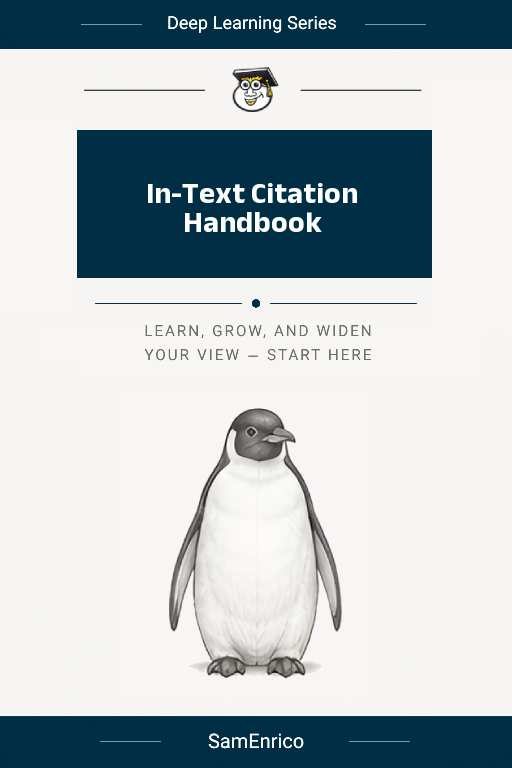
Non-FictionHandbookWriting Guide
In-Text Citation Handbook
Focus only on parenthetical and narrative citation
by Knight Scott
Focus only on parenthetical and narrative citations across styles. Learn when to cite and how to integrate sources smoothly.
Formats
About this book
Free sample
Chapter 1: The Citation Paradox...--–- Every academic writer knows they must cite sources. Most have never been taught why the rules exist or how to apply them without destroying their own voice. This chapter dismantles the most common misconceptions about in-text citations, introduces the foundational distinction between parenthetical and narrative forms, and establishes the single most important principle that governs every citation decision you will ever make.The Anxiety Beneath the Parenthesis Walk into any university writing center during midterm season, and you will witness the same scene repeated in twenty different versions. A student sits hunched over a laptop, three highlighted articles spread across the desk, their cursor blinking somewhere in the middle of a paragraph that has been rewritten seven times. The problem is rarely the thesis.
It is rarely the evidence. The problem is the parentheses. Should the citation go before the period or after? Does the period go inside the quotation marks or outside? When do you use "et al."?
What if you cannot find the original publication date? What if the source has no author at all? And the question that produces the most visible distress: how many citations are too many, and how few are too few?This collection of anxieties has a name, though no official diagnostic manual includes it. Call it citation anxiety. It is the nagging fear that you are either plagiarizing someone else's work or cluttering your own prose with so many parenthetical intrusions that no reader could possibly follow your argument.
Both fears are reasonable. Both have legitimate roots in the high stakes of academic writing, where a missing citation can mean a failed assignment or even an accusation of misconduct. But both fears also grow from the same underlying confusion: a misunderstanding of what in-text citations are actually for.The title of this chapter names a paradox. The Citation Paradox is this: in-text citations are simultaneously the most rule-bound and the most flexible element of academic writing. The rules are strict—you cannot invent your own punctuation, you cannot omit the year in APA, you cannot add a comma…
This is the end of the free sample. Get the eBook to keep going. Buy now
Contents
- Chapter 1
- Chapter 2
- Chapter 3
- Chapter 4
- Chapter 5
- Chapter 6
- Chapter 7
- Chapter 8
- Chapter 9
- Chapter 10
- Chapter 11
- Chapter 12
Details
- Author
- Knight Scott
- Publisher
- SamEnrico
- Language
- English
- Genre
- Non-Fiction, Handbook, Writing Guide
- Released
- 2026-05-30
- Pages (approx.)
- 142
- Available as
- eBook, Audiobook

Read better in the ZLOADR app
Your eBooks on your phone or tablet. Sign in with your SamEnrico account and start reading.
More by Knight Scott
 Imposter Syndrome In MentorshipKnight Scott$11.99
 Shame Based Identity Healing GuideKnight Scott$11.99
 Shoulder Mobility Stretching GuideKnight Scott$11.99
 TikTok Lifestyle Comparison DetoxKnight Scott$11.99
 Assertive Communication for IntrovertsKnight Scott$11.99
 The Last Voyage of the Demeter: A Captain’s Forbidden LogKnight Scott$11.99
 Understanding Myopia, SevereKnight Scott$17.99
 How to Start a Pack Trains (i.e. - Trail Riding) - Recreational BusinessKnight Scott$11.99
 Pinterest SWOT GuideKnight Scott$12.99
 Collecting CurrencyKnight Scott$11.99
You may also like
 Hong Kong Handover 1997Dunn Johnnie$11.99
 Zumba For Postnatal Recovery CourseNeal Christian$11.99
 Zumba for BeginnersLadner Nikia$11.99
 YouTube Comment Mining GuideHumes Pandora$12.99
 Worry Box MeditationCarlin Rudy$11.99
 Workplace Stress MeditationNguyen Lynn$11.99
 Workplace Stress and Sleep RepairHawley Ivory$11.99
 Workplace Perfectionism CureDelaney Jeffry$11.99
 Workplace Injustice Anger GuideWallen Isabelle$11.99
 Work Addiction and Burnout LinkGreenwood Ester$11.99
 Women in Yoga and WellnessBeattie Galina$11.99
 Women in Stand Up ComedyChun Evangeline$11.99