
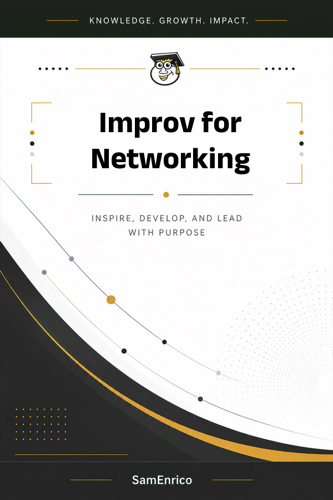
Non-FictionSelf-HelpNetworking
Improv for Networking eBook
Start conversations and keep them flowing naturall
Start conversations and keep them flowing naturally.
Formats
Free sample
Chapter 1: The Rehearsal Trap--–- The first time I watched someone sabotage a conversation in real time, I was standing next to a cheese plate at a crowded industry mixer. A young software engineer named Priya had spent twenty minutes rehearsing in the corner. I know this because I watched her. She mouthed words to herself. She adjusted her collar seven times.
She practiced her smile in the reflection of a wine glass.When she finally approached a senior executive, she delivered her opening line perfectly. It was polished. It was professional. It was dead on arrival.The executive nodded, gave a tight smile, and within ninety seconds excused himself to “find the restroom.” Priya was left holding her wine glass, her perfectly rehearsed follow-up questions still loaded in her mental chamber, unasked.She had done everything right by conventional networking wisdom. She prepared.
She practiced. She stockpiled. And it failed because the very act of preparation had made her incapable of the one thing networking actually requires: presence.This book exists because that moment happens thousands of times every day, in conference rooms and coffee shops, at weddings and work retreats. Smart, capable people walk into social situations armed with scripts, and those scripts become walls. Not because the scripts are bad, but because scripts are the enemy of connection.The secret that improv comedians have known for a century, and that neuroscience is now proving, is that human beings connect not through cleverness but through shared discovery.
You cannot discover anything with someone when you already know what you are going to say next.The Myth of the Prepared Person Let me ask you a question, and I want you to answer honestly. When you walk into a room full of strangers, what do you do?If you are like ninety‑four percent of the professionals I have surveyed, you do some version of the following: you scan the room, you identify a few approachable people, and you silently run through a mental list of conversation starters. “What do you do?” “How long have you been with your company?” “Nice weather we are having.” Maybe, if you are ambitious, you have prepared a thirty‑second “elevator pitch” about yourself, a tidy little package of accomplishments and aspirations designed to make you sound impressive.This is what I call stockpiling. You are stockpiling questions, stockpiling stories, stockpiling witty comebacks and charming anecdotes. You are building an arsenal of conversational ammunition.And it is ruining your networking.The belief that underlies stockpiling is seductive.
It says: if I prepare enough, I will not be caught off guard. If I have a script, I will not freeze. If I memorize the right questions, I will never face that terrifying silence. Preparation is protection.Except it is not. Preparation is a cage.Here is what actually happens when you stockpile.
While the person in front of you is speaking, a significant portion of your brain is not listening to them. It is busy. It is retrieving your next question. It is checking the quality of your last response. It is monitoring your tone, your posture, your word choice.
It is running a quiet, anxious background operation called Am I Doing This Right?This means you are having two conversations at once. One is the conversation you are actually in. The other is the conversation you are having with yourself, the one where you are the director, the critic, and the desperate understudy.And you cannot do both.What the Research Actually Says The cognitive science here is unambiguous. Psychologists have studied what they call “dual‑task interference” for decades. The basic finding is this: the human brain has limited attentional resources.
When you ask it to perform two attention‑demanding tasks simultaneously, performance on both degrades.Listening to another person is an attention‑demanding task. It requires parsing words, reading facial expressions, tracking emotional tone, and forming a mental model of what the other person is saying. This is not passive. It is active, expensive, exhausting work.Mental rehearsal is also an attention‑demanding task. Formulating your next question, monitoring your own performance, retrieving memorized lines—these are not background processes.
They consume real cognitive resources.When you stockpile, you force your brain to split its attention between listening and rehearsing. The result is that you listen poorly, and you rehearse poorly. Your follow‑up questions feel mechanical because they are mechanical. Your responses land half a beat too late because your brain was busy elsewhere.The irony is painful. You prepare to avoid looking stupid, and your preparation makes you look distracted, anxious, and inauthentic.But there is a deeper irony, and this one is the key to everything that follows.
When researchers have studied what makes people likable in conversation, they have found that the single strongest predictor is not eloquence, not wit, not status. It is the degree to which the person makes the other person feel heard and valued.Notice what is missing from that list. Impressiveness is missing. Cleverness is missing. A perfectly delivered elevator pitch is missing.What matters is whether you were actually there.The Memory Game Before we go any further, I want you to experience this for yourself.
Not intellectually. Not as a concept. As a felt, bodily truth.Find a partner. This could be a friend, a colleague, or someone in a workshop setting. If you are reading this alone right now, keep reading but promise yourself you will try this within the next forty‑eight hours.Here is the exercise.
I call it The Memory Game.Step one. Person A will speak for sixty seconds about their weekend. Not a rehearsed monologue. Just whatever comes to mind. What they did, who they saw, what they ate, how they felt.
The only rule for Person A is to keep talking, even if it feels mundane.Step two. While Person A is speaking, Person B has one job. Listen. But there is a twist. Person B is absolutely forbidden from thinking about their own response.
No planning what to say next. No formulating the perfect follow‑up question. No mental commentary about how the conversation is going. Just listening.Step three. After sixty seconds, Person A stops speaking.
Person B must now recall three specific details from what Person A just said. Not general impressions. Specific, concrete details. “You mentioned your brother’s name is Michael.” “You said the restaurant was on Maple Street.” “You ate the fish tacos.”Step four. Switch roles.
Person B speaks for sixty seconds about their weekend. Person A listens without rehearsing. Then Person A recalls three specific details.Here is what almost everyone discovers. When you are not allowed to rehearse, when you give yourself permission to stop preparing your response, you remember vastly more. The details come easily.
They are vivid. You heard them because you were not busy doing something else.But here is the other discovery, the one that surprises people. Person A almost always reports feeling more heard, more valued, more connected during the no‑rehearsal round. Even when the conversation is artificial, even when it is just an exercise about a mundane weekend, the…
This is the end of the free sample. Get the eBook to keep going. Buy now
About this book
Details
- Author
- Velasquez Sammie
- Publisher
- SamEnrico
- Language
- English
- Genre
- Non-Fiction, Self-Help, Networking
- Released
- 2026-06-08
- Pages (approx.)
- 109
- Available as
- eBook, Audiobook

Read better in the ZLOADR app
Your eBooks on your phone or tablet. Sign in with your SamEnrico account and start reading.
More by Velasquez Sammie
 Passive Aggressive To Assertive GuideVelasquez Sammie$11.99
 Non Resident Bank Account SetupVelasquez Sammie$11.99
 Financial Stress for Security GuardsVelasquez Sammie$11.99
 The Cloud Merger and Acquisition OutlookVelasquez Sammie$11.99
 The Mamluk Engineer: How Qalawun's Siege Towers Changed Warfare ForeverVelasquez Sammie$11.99
 House AttendantVelasquez Sammie$11.99
 Baby Gear SpendingVelasquez Sammie$12.99
 IRS Non Resident LLC PenaltiesVelasquez Sammie$12.99
 Understanding Reactive Attachment Disorder (Rad)Velasquez Sammie$17.99
 How to Become a Pocket-machine OperatorVelasquez Sammie$11.99
You may also like
 Hong Kong Handover 1997Dunn Johnnie$11.99
 Zumba For Postnatal Recovery CourseNeal Christian$11.99
 Zumba for BeginnersLadner Nikia$11.99
 YouTube Comment Mining GuideHumes Pandora$12.99
 Worry Box MeditationCarlin Rudy$11.99
 Workplace Stress MeditationNguyen Lynn$11.99
 Workplace Stress and Sleep RepairHawley Ivory$11.99
 Workplace Perfectionism CureDelaney Jeffry$11.99
 Workplace Injustice Anger GuideWallen Isabelle$11.99
 Work Addiction and Burnout LinkGreenwood Ester$11.99
 Women in Yoga and WellnessBeattie Galina$11.99
 Women in Stand Up ComedyChun Evangeline$11.99