
Non-FictionSelf-HelpNegotiation
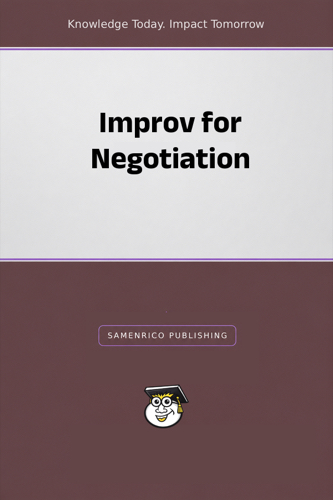
Improv for Negotiation eBook
Adapt to counter offers and unexpected proposals s
Adapt to counter offers and unexpected proposals spontaneously.
Formats
Free sample
Chapter 1: The Seven-Second Panic--–- The conference room was immaculate. Floor-to-ceiling windows overlooked a gray Chicago skyline. Twelve people sat around a polished walnut table, their leather chairs creaking in unison as they leaned forward. The procurement director, a woman named Sarah who had prepared for this meeting for three weeks, opened her binder. She had color-coded tabs.
She had competitive analysis. She had a walk-away price written in red ink on a sticky note attached to page fourteen.Thirty seconds into the presentation, the vendor's lead negotiator interrupted her."Before we go further," he said, pushing his glasses up, "we need to address something. Our costs have shifted. The price we quoted last month is no longer viable. We're looking at an eighteen percent increase across the board."Sarah froze.Not for a moment.
Not for a breath. For seven full seconds, she sat in silence while her brain tried to reconcile the script in her binder with the reality in front of her. Page three of her playbook said "expect initial offer to be five to seven percent below target." Page eleven said "if they push back on price, remind them of volume commitment." Nowhere did it say "they will raise their own price before you even make an offer."Her face flushed. She felt heat climbing her neck. Her mouth opened, then closed.
She looked at her boss, who raised an eyebrow. She looked back at the vendor, who was waiting patiently. In that seven-second window, Sarah's brain did something evolution had designed it to do: it treated the unexpected as a threat. Her amygdala, the brain's ancient alarm system, triggered a fight-or-flight response. Blood rushed away from her prefrontal cortex—the part responsible for complex reasoning and creative problem-solving—and toward her limbs, preparing her to run or fight.But she was in a conference room.
There was nowhere to run. And fighting meant losing the deal.So she did what most people do when their brain is flooded with threat chemicals and their script has just evaporated. She said the first thing that came to mind."That's… that's not what we agreed."It was weak. It was defensive. It sounded like a child who had just been told they couldn't have dessert before dinner.
The vendor smiled politely and said, "We didn't agree to anything. That's why we're negotiating."Sarah lost eighteen percent before she even made her first counteroffer. She spent the next forty-five minutes trying to claw back three percent. Her boss never interrupted, but he didn't need to. The silence in the car on the way back to the office said everything.Sarah is not weak.
She is not stupid. She is not bad at her job. Sarah is every negotiator who has ever been caught off guard, which is to say, every negotiator who has ever lived. The problem wasn't her preparation. The problem was what her preparation assumed: that the other side would follow the script.The Myth of the Scripted Deal Let me tell you something that every improviser knows and most negotiators learn too late: the script is a trap.Not because scripts are bad.
Scripts are comforting. Scripts give us the illusion of control. A script says, "If they say X, I will say Y. If they say A, I will say B." A script turns a chaotic, unpredictable human interaction into something that resembles a math problem. And our brains love math problems because math problems have right answers.But negotiation is not math.
Negotiation is improvisation.Here is the truth that separates successful negotiators from the ones who freeze: you cannot predict what the other side will say. You can prepare for probabilities. You can study their incentives. You can rehearse your opening. But in the moment—the actual, live, unscripted moment when two human beings sit across from each other—they will say something you did not anticipate.
Not because they are tricky. Because they are human. And humans are unpredictable.The average business negotiation involves two to three unexpected turns. That number comes from a study of 147 corporate negotiations conducted by the Harvard Negotiation Project, which found that in 89 percent of cases, at least one party introduced a condition, constraint, or demand that had not appeared in any pre-negotiation communication. In 42 percent of cases, the surprise fundamentally altered the deal structure.In other words, if you prepare a script, you are preparing for a reality that does not exist.This chapter introduces the central problem that the rest of the book solves: the Critical Moment.
A Critical Moment is the three-to-eight-second window after an unexpected offer, counteroffer, question, or demand when your brain's threat response activates. In that window, you will either freeze, fight, flee, or pivot. Three of those four options lose you value. Only one—pivot—keeps the deal alive and moving in your direction.The rest of this book teaches you how to pivot. But before you can pivot, you have to understand what happens inside your own head when the script dies.Your Brain on Surprise: A Brief Tour of the Amygdala Neuroscientists have a name for what happened to Sarah in that Chicago conference room.
They call it an "amygdala hijack."The amygdala is a small, almond-shaped cluster of nuclei located deep within the temporal lobe. Evolutionarily speaking, it is ancient. It predates the neocortex—the wrinkly outer layer of your brain that handles language, reasoning, and self-awareness—by hundreds of millions of years. The amygdala's job is simple: detect threats and respond faster than conscious thought.This was a great feature when the threat was a saber-toothed tiger. The amygdala would flood your system with cortisol and adrenaline, redirect blood to your large muscle groups, and shut down non-essential functions like digestion and complex reasoning.
You did not need to solve a quadratic equation when a tiger was charging. You needed to run.But the amygdala cannot distinguish between a tiger and a procurement negotiation. When the vendor said "eighteen percent increase," Sarah's amygdala heard "tiger." Her blood left her prefrontal cortex. Her reasoning shut down. She could not access the creative, strategic parts of her brain because those parts had been deprioritized.
In their place, she had access to three primitive responses: fight (argue, blame, attack), flight (concede, withdraw, escape), or freeze (say nothing, hope it goes away).She fought weakly. Then she froze. Then she fled into a bad deal.This is not a failure of character. This is biology. Every human being has an amygdala.
Every human being experiences amygdala hijack when surprised. The difference between a novice negotiator and an expert is not the absence of this response. The difference is what they do in the three to eight seconds before their prefrontal cortex comes back online.The expert does not try to suppress the hijack. That is impossible. The expert recognizes it, labels it, and uses a structured pause to wait it out.Let me repeat that, because it is the most important sentence in this chapter: You cannot stop the amygdala from hijacking your brain.
You can only shorten the hijack and protect your response window.The average amygdala hijack lasts between six and eighteen seconds.…
This is the end of the free sample. Get the eBook to keep going. Buy now
About this book
Details
- Author
- Cantrell Elene
- Publisher
- SamEnrico
- Language
- English
- Genre
- Non-Fiction, Self-Help, Negotiation
- Released
- 2026-06-11
- Pages (approx.)
- 145
- Available as
- eBook, Audiobook

Read better in the ZLOADR app
Your eBooks on your phone or tablet. Sign in with your SamEnrico account and start reading.
More by Cantrell Elene
 Wine Moderate Drinking GuideCantrell Elene$11.99
 Global Shipping to Amazon USACantrell Elene$11.99
 Garden Sanctuary Visualization GuideCantrell Elene$11.99
 The Government Cloud Adoption ForecastCantrell Elene$11.99
 The Snowtown Murders: Australia's Darkest Serial Killer CaseCantrell Elene$11.99
 Gift Giving PatternsCantrell Elene$12.99
 Non Resident US Phone NumberCantrell Elene$12.99
 Understanding Reactive ArthritisCantrell Elene$17.99
 Hotel Front Desk AgentCantrell Elene$11.99
 How to Start a Dress and Jacket Knitted Ensemble Business (Beginners Guide)Cantrell Elene$11.99
You may also like
 Hong Kong Handover 1997Dunn Johnnie$11.99
 Zumba For Postnatal Recovery CourseNeal Christian$11.99
 Zumba for BeginnersLadner Nikia$11.99
 YouTube Comment Mining GuideHumes Pandora$12.99
 Worry Box MeditationCarlin Rudy$11.99
 Workplace Stress MeditationNguyen Lynn$11.99
 Workplace Stress and Sleep RepairHawley Ivory$11.99
 Workplace Perfectionism CureDelaney Jeffry$11.99
 Workplace Injustice Anger GuideWallen Isabelle$11.99
 Work Addiction and Burnout LinkGreenwood Ester$11.99
 Women in Yoga and WellnessBeattie Galina$11.99
 Women in Stand Up ComedyChun Evangeline$11.99