
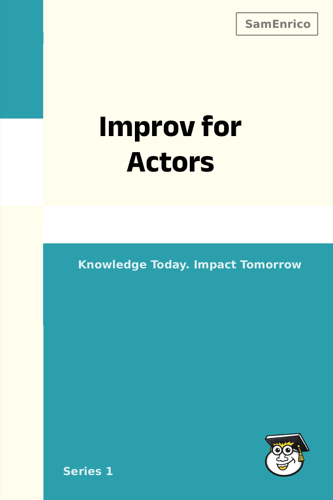
Improv for Actors
Scene building and character spontaneity.
Scene building and character spontaneity.
Formats
About this book
Free sample
Chapter 1: Silencing the Internal Judge...--–- Most actors are trained to be bad improvisers. This is not a provocation; it is an observable fact. Walk into any traditional acting classroom, and you will find intelligent, sensitive, emotionally available performers who freeze the moment you remove the script. Give them a monologue from Shakespeare, and they will find layers of meaning, subtext, and emotional truth. Give them a blank stage, a partner, and the instruction to "just play," and their eyes will dart toward the exit.
Their shoulders will rise toward their ears. Their mouths will go dry. They will apologize before they have even opened them.The reason is not a lack of talent. It is not a lack of courage. It is not even a lack of imagination.
The reason is that most actors have spent years inside an educational system that systematically destroys the very skills improvisation requires. That system—with its emphasis on correct choices, pleasing the director, hitting marks, and delivering the same performance every night—has produced a generation of actors who are terrified of the empty brain. They mistake silence for failure. They mistake uncertainty for incompetence. They mistake the absence of a plan for the absence of ability.None of this is their fault.
It is the inheritance of a theatrical tradition that values control above all else. Konstantin Stanislavski, for all his genius, wanted actors to be able to deliver a performance that was identical on the hundredth night to what it had been on the first. That is a noble goal for the production of Chekhov or Ibsen. But it comes with a hidden cost. The cost is the slow, systematic death of the actor's ability to respond spontaneously in the moment.
The actor becomes what Keith Johnstone, the great theorist of improvisation, called an "approval junkie." Every choice is filtered through a silent internal questionnaire: Will the director like this? Will the audience think I am talented? Am I doing it correctly? Is this the choice the playwright intended?The actor is no longer present in the scene. They are…
This is the end of the free sample. Get the eBook to keep going. Buy now
Contents
- Chapter 1
- Chapter 2
- Chapter 3
- Chapter 4
- Chapter 5
- Chapter 6
- Chapter 7
- Chapter 8
- Chapter 9
- Chapter 10
- Chapter 11
- Chapter 12
Details
- Author
- Howland Aracely
- Publisher
- SamEnrico
- Language
- English
- Genre
- Non-Fiction, Self-Help, Acting
- Released
- 2026-06-06
- Pages (approx.)
- 141
- Available as
- eBook, Audiobook

Read better in the ZLOADR app
Your eBooks on your phone or tablet. Sign in with your SamEnrico account and start reading.
More by Howland Aracely
 Bipolar I Mania Management GuideHowland Aracely$11.99
 Thunberg Autism Pride AdvocacyHowland Aracely$11.99
 Gratitude for BodyHowland Aracely$11.99
 The Metabolic Adaptation GuideHowland Aracely$11.99
 Public Speaking for Military LeadersHowland Aracely$11.99
 Progressive Relaxation ParentHowland Aracely$11.99
 The Mental Health Difficult TalkHowland Aracely$11.99
 Pina Bausch and the Wuppertal Dance Theater: Revolution in MotionHowland Aracely$11.99
 The Iron Lotus: How China's Gymnasts Defied Gravity (1960-1980)Howland Aracely$11.99
 How to Become a Mathematical TechnicianHowland Aracely$11.99
 Nigeria VAT Zero Rated GuideHowland Aracely$12.99
 At-Will Employment False SecurityHowland Aracely$12.99
You may also like
 EQ For Actors Method GuideGriggs Theron$11.99
 Memory Palace For Theater LinesRuff Jena$11.99
 Film Nonverbal GuideDavenport Reda$11.99
 The EQ for Actors GuideFarrow Venus$11.99
 Self Esteem For ActorsKeeton Marita$11.99
 Memory Palace for Actors LinesVarney Jolyn$11.99
 Chunking For ActorsSample Eneida$11.99
 Improv for Actors GuideKent Heriberto$11.99
 The Body Language for ActorsPounds Bebe$11.99
 Status Shifts In ImprovBobo Tresa$11.99
 SRS for Acting LinesDelagarza Bridgette$11.99
 Theatre Nonverbal GuideBray Wyatt$11.99