
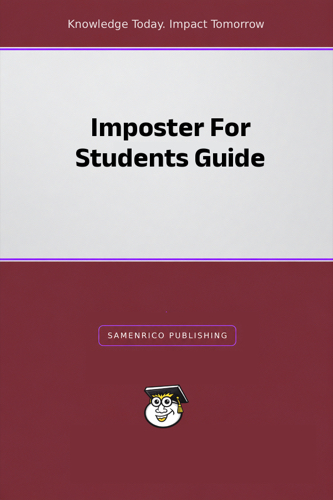
Imposter For Students Guide eBook
Overcome academic self doubt and imposter feelings
Overcome academic self doubt and imposter feelings.
Formats
Free sample
Chapter 1: The Secret Wrecking Ball--–- You are reading this book because somewhere, probably late at night when the library has emptied and you are walking home alone, a voice inside your head told you that you do not belong here. That voice did not shout. It whispered. It said something like: "Everyone else is smarter than you." Or "You only got that grade because the professor felt sorry for you." Or "Wait until they find out you have no idea what you are doing."You have never said these thoughts out loud. You have smiled in study groups, nodded in lectures, and laughed when classmates joked about being tired.
But underneath the smile, you have been quietly terrified that one day—maybe tomorrow, maybe at graduation—someone will tap you on the shoulder and say, "We made a mistake. You do not belong here."Here is the first truth this book needs you to hear, and I need you to read it twice:You are not broken. You are not uniquely fraudulent. And the voice in your head is not evidence of your incompetence—it is evidence that you are a thinking, feeling human being who has been placed inside a system that was designed to make you doubt yourself.This chapter is called The Secret Wrecking Ball because that is what imposter feelings are. They swing silently, invisibly, knocking down your confidence, your willingness to speak up, your ability to ask for help, and your quiet belief that you deserve to be where you are.
Most students never name this wrecking ball. They just feel its destruction and assume the damage is their fault.We are going to name it. Right now. And once you name something, you can start to take it apart.The Confession You Have Never Said Aloud Let me describe a student. Call her Maya.
Maya is a junior studying biology at a competitive university. She has a 3.7 GPA. She has been on the dean's list three times. She tutors first-year students in chemistry. Last semester, a professor asked her to be a teaching assistant.Here is what Maya thinks about herself: "I am a fraud.
I work twice as hard as everyone else, and I still feel like I am barely keeping up. When I tutor, I am terrified that a student will ask a question I cannot answer. When I got the TA offer, my first thought was not excitement—it was panic. I thought, 'Now they will really find me out.' I read the same chapter three times before I understand it. I rewrite my notes until my hand hurts.
I check my grades five times a day because I am sure one of them will be corrected downward."Now let me describe another student. Call him James. James is a first-year graduate student in history. He was the first person in his family to go to college. He does not use words like "hegemony" or "problematize" as easily as his classmates.
He sits in seminars and watches other students debate while he cannot find a way into the conversation. When he finally speaks, he stumbles. He goes home and tells himself, "You don't belong in graduate school. You got in because they needed diversity numbers. You are taking a spot from someone more qualified."Maya and James have never met.
They study different subjects at different kinds of universities. But they share the same secret wrecking ball. And here is what else they share: neither of them has ever told another person the full truth about how they feel.That silence is not a coincidence. It is the most important feature of imposter feelings. You keep them secret because you believe they are uniquely yours.
You believe that if anyone knew how lost you felt, they would confirm what you already suspect—that you do not belong.This chapter exists to break that silence.Where This Idea Came From (And Why It Still Matters)In 1978, two clinical psychologists named Pauline Clance and Suzanne Imes published a study that changed how we think about self-doubt. They had been treating high-achieving women at a university—women with excellent grades, advanced degrees, and professional success—who were convinced that they had fooled everyone. These women believed they were not actually intelligent. They believed they had succeeded through luck, charm, or administrative error. They lived in constant fear of being "found out."Clance and Imes called this the Imposter Phenomenon.
They initially believed it was mostly a female experience, shaped by family dynamics and societal messages about women's competence. Later research changed that view. We now know that imposter feelings cut across gender, race, class, and academic field. Men feel it. Engineering students feel it.
Art history majors feel it. Nobel Prize winners have described feeling it. The current Surgeon General of the United States has written about feeling it in medical school.The most important finding from decades of research is this: Imposter feelings are not correlated with actual incompetence. In fact, they are often correlated with the opposite. The more competent you are, the more likely you are to underestimate your abilities.
This is called the Dunning-Kruger effect's cousin: incompetent people overestimate themselves, and competent people underestimate themselves. The student who worries about being exposed as a fraud is almost always the student who is doing just fine—and often doing better than fine.Let me say that again because it is easy to read past. Your worry that you are not good enough is not evidence that you are not good enough. It is evidence that you care, that you are self-aware, and that you are holding yourself to a standard that no human being could consistently meet.The 3:00 AM Thought That Everyone Has Here is an experiment you can run. The next time you are in a lecture hall or a study group, look around at the other students.
Pick three of them at random. Then imagine what they worry about at 3:00 AM when they cannot sleep.You will imagine something like this: "They probably worry about their grades. Or maybe they worry about a relationship. Or maybe they are stressed about money."Now try this instead. Imagine that each of those three students has a secret thought that they have never spoken out loud.
Imagine that their secret thought is almost identical to yours. Imagine that they are looking around the same lecture hall, picking you at random, and thinking, "That person has it figured out. I am the only one who is lost."This is not a metaphor. This is a documented cognitive bias called pluralistic ignorance. It happens when a majority of people in a group privately reject a norm but incorrectly believe that most others accept it.
In academic settings, the norm is "I understand the material and belong here." Privately, most students are confused, struggling, or uncertain. But because no one admits it, everyone concludes that they are the abnormal one.I have stood in front of hundreds of students and asked, "How many of you have felt like an imposter at some point in your academic career?" In a room of two hundred students…
This is the end of the free sample. Get the eBook to keep going. Buy now
About this book
Details
- Author
- Forman Jesusita
- Publisher
- SamEnrico
- Language
- English
- Genre
- Non-Fiction, Self-Help, Student
- Released
- 2026-06-08
- Pages (approx.)
- 137
- Available as
- eBook, Audiobook

Read better in the ZLOADR app
Your eBooks on your phone or tablet. Sign in with your SamEnrico account and start reading.
More by Forman Jesusita
 Body Position Reconstruction GuideForman Jesusita$11.99
 Parent Time Blocking GuideForman Jesusita$11.99
 Public Sector Talent RetentionForman Jesusita$11.99
 Flexible Time BlockingForman Jesusita$11.99
 The Startup Burn Rate GuideForman Jesusita$11.99
 Deep Work For EducatorsForman Jesusita$11.99
 Car Hypnosis Listening SafetyForman Jesusita$11.99
 The Lost Codex of the Silk Road: A Merchant's Secret LegacyForman Jesusita$11.99
 The Alchemists of Timbuktu: Unveiling Africa's Forgotten Scientific PioneersForman Jesusita$11.99
 How to Produce Pool Sweeps and VacuumsForman Jesusita$11.99
 How to Produce Downhill SkisForman Jesusita$11.99
 Exploring Screen-printing: Silkscreen & Stencil MethodsForman Jesusita$11.99
You may also like
 School Building PalaceAsher Corinne$11.99
 Eisenhower For StudentsBostick Tomi$11.99
 Sleep Meditation for StudentsBragg Lizzie$11.99
 The Student Distraction GuideCady Trish$11.99
 Nap Timing for StudentsTurnbull Tyesha$11.99
 Self Talk for Students GuideFernandes Rona$11.99
 Networking for StudentsSommer Mica$11.99
 Daily Review for StudentsHardesty Karie$11.99
 Student Sleep MeditationCalderon Liane$11.99
 Eisenhower Matrix for StudentsSchrader Moshe$11.99
 DBT for Students GuideKenny Ute$11.99
 Habit Formation for StudentsMullen Fidel$11.99