
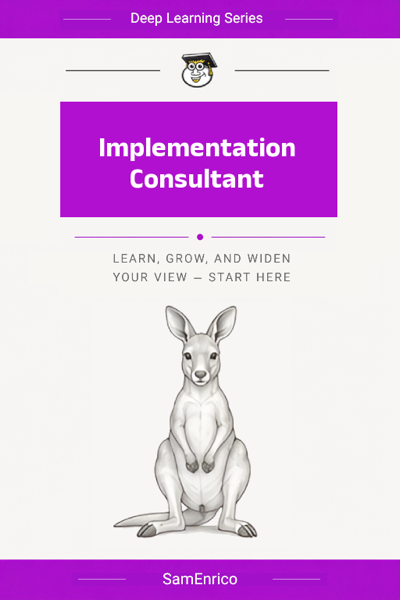
Implementation Consultant eBook
A Coursebook on Implementation Consultant
by Marks Manda
A Coursebook on Implementation Consultant
Formats
Free sample
Chapter 1: Beyond The Button--–- The phone call came at 11:47 PM on a Thursday. I know the exact time because I looked at my watch before answering, hoping the late hour meant it was a wrong number. It was not. It was the CEO of a manufacturing company where my firm had just completed a nine-month ERP implementation. The system had gone live seventy-two hours earlier.
The CEO's voice was taut with a specific kind of anger that only comes from someone who has just realized they made a very expensive mistake and is trying to figure out who to blame."The system is down," he said. "Completely down. No invoices. No purchase orders. No shipping labels.
My factory is idle. My trucks are loaded but cannot leave because the system won't generate bills of lading. My CFO is telling me we might miss payroll if we cannot invoice by Monday. And your project manager is not answering his phone."I remember the silence after he finished speaking. Three seconds that felt like three minutes.
In that silence, I had a choice. I could defend my firm. I could explain that the client had rejected our recommendation for a phased rollout. I could point out that the client had refused to allocate enough super users for testing. I could list all the ways this was not my problem.
Or I could do something else entirely.I said, "I am sorry. I will be on a plane at 6 AM. Can you have your IT director meet me at the office with full system access and a whiteboard?"I hung up and called my project manager. He answered on the first ring. He had been awake, staring at his ceiling, waiting for the call.
We talked for an hour. We did not talk about whose fault it was. We talked about what was broken and how to fix it. By the time I boarded my flight, we had a plan.The problem turned out to be a simple configuration error that had been compounded by three other simple configuration errors. None of them would have broken the system alone.
Together, they created a cascade failure that no one had anticipated. We fixed it by 2 PM on Friday. The client shipped their trucks on Saturday. The CFO made payroll. And the CEO, the same man who had called me at 11:47 PM with anger in his voice, sent me a handwritten note thanking me for flying across the country to stand in front of a whiteboard with his IT director.That note sits in my desk drawer.
I look at it when I need to remember something important: implementation consulting is not about software. It is about what happens when the software stops working. It is about who answers the phone at 11:47 PM. It is about the difference between pointing fingers and solving problems. It is about earning the right to be trusted when everything is on fire.If you are reading this book, you already know that you want to be the person who answers the phone.
You want to be the consultant who flies across the country to stand in front of the whiteboard. You want to earn the handwritten note. But wanting is not enough. Wanting does not teach you how to contract without conflict, how to navigate organizational politics without becoming political, how to say no to a client without losing the relationship, how to deliver bad news without getting fired. Wanting does not teach you the craft.This book teaches the craft.The Lie They Tell You In Certification Classes Every software vendor has a certification program.
Every certification program teaches a methodology. The methodology always has a clever acronym and a colorful diagram with arrows connecting boxes labeled with words like "Discover," "Design," "Build," "Test," "Deploy." The methodology promises that if you follow the steps in the right order, you will deliver successful implementations. The methodology is a lie.Not because it is wrong. Because it is incomplete. The methodology tells you what to do.
It does not tell you what to do when the client refuses to do it. It does not tell you what to do when the timeline has already slipped and the steering committee is demanding answers. It does not tell you what to do when the sales team promised customizations that you know will break the upgrade path. It does not tell you what to do when the super user you were counting on has been pulled onto another project by their manager who never supported this implementation in the first place.The methodology assumes a rational world where everyone behaves logically and everything goes according to plan. You do not work in that world.
You work in a world where the CFO is measured on cost reduction and therefore fights every change order, even the ones that would save money in the long run. You work in a world where the IT director is actively looking for a new job and has checked out mentally. You work in a world where the warehouse supervisor who has been with the company for twenty-two years has no intention of learning a new system and will sabotage it quietly, in ways that are almost impossible to prove.These are not edge cases. These are the job. The methodology does not prepare you for the job.
It prepares you for a sanitized simulation of the job. The real job is messier, harder, and more rewarding than any methodology can capture.My goal in this book is to give you what the certification classes will not. The patterns. The scripts. The frameworks.
The warning signs. The recovery maneuvers. The things I learned the hard way, by making mistakes on expensive projects with real clients who had real businesses to run and real payrolls to meet.The Four Questions That Reveal Everything Before we go any further, I want you to answer four questions about your most recent implementation project. Do not skip this exercise. The answers will tell you more about your strengths and weaknesses than any self-assessment.First, what did the client ask for?
Write down their original request in their own words, as specifically as you can remember.Second, what did the client actually need? Not what they asked for. What would have solved the underlying business problem?Third, what did you build? The system you actually delivered, not the one you planned to deliver.Fourth, what did the client use? The features and processes they actually adopted, not the ones you thought they would.For most consultants, these four answers are different.
Sometimes slightly different. Sometimes radically different. The gap between what the client asked for and what they needed is the gap of discovery. The gap between what you built and what they used is the gap of adoption. Your job is to close both gaps.
Most consultants only close the first one, and they do that poorly.Let me give you an example from my own career. A client asked for a custom expense reporting system. Their expense process took three weeks from submission to reimbursement, and their employees were angry. They needed…
This is the end of the free sample. Get the eBook to keep going. Buy now
About this book
Details
- Author
- Marks Manda
- Publisher
- SamEnrico
- Language
- English
- Genre
- Non-Fiction, Informative, Educational
- Released
- 2026-05-11
- Pages (approx.)
- 135
- Available as
- eBook, Audiobook

Read better in the ZLOADR app
Your eBooks on your phone or tablet. Sign in with your SamEnrico account and start reading.
More by Marks Manda
 Trance for BeginnersMarks Manda$11.99
 Saying No Assertively CourseMarks Manda$11.99
 HTS Code Classification GuideMarks Manda$11.99
 Desert Oasis Visualization GuideMarks Manda$11.99
 The Metta for Rejection SensitivityMarks Manda$11.99
 The Great Unraveling: How a 19th-Century Weavers' Strike Changed the WorldMarks Manda$11.99
 Understanding Rectosigmoid NeoplasmMarks Manda$17.99
 How to Become a Podiatric AssistantMarks Manda$11.99
 Non Resident LLC for ConsultingMarks Manda$12.99