
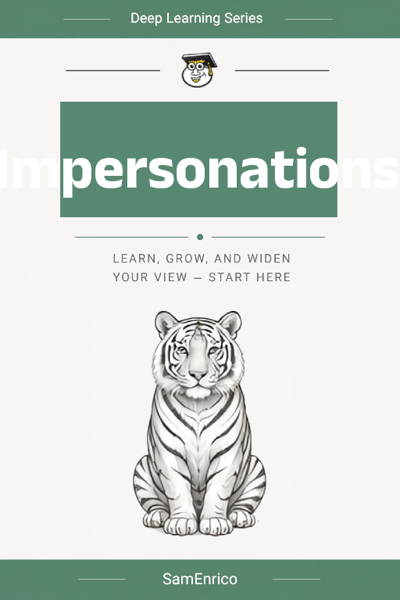
Non-FictionInformativeEducational
Impersonations eBook
A Coursebook on Impersonations
A Coursebook on Impersonations
Formats
Free sample
Chapter 1: We Are All Impersonating Someone--–- I have been impersonating a competent adult for twenty years. So have you.Let that land for a moment. The version of you that answers the phone when your boss calls—the steady, reliable, capable version—is not the same version that lies on the couch at 11 p.m. eating cereal directly from the box and scrolling through photos of vacations you cannot afford. Neither of those versions is the "real" you, because there is no single real you.
There are only the masks you wear, the roles you play, and the audience you happen to be standing in front of at any given moment.This is not a confession of fraud. It is a statement of fact about the human condition.We begin job interviews with a carefully calibrated performance: confident but not arrogant, experienced but not overqualified, enthusiastic but not desperate. We navigate first dates as though we are actors who have studied our lines for weeks, presenting the best possible version of ourselves while hiding the parts we have been taught are unlovable. We attend parent-teacher conferences, family dinners, and work meetings as different characters entirely. And we do all of this so automatically, so habitually, that we have forgotten we are performing at all.This chapter will argue a disturbing thesis: the line between "normal" social impersonation and "criminal" impersonation is thinner than you think.
The same psychological machinery that allows you to put on a brave face for a presentation allows a con artist to convince a widow that he is a military officer in love with her. The difference is not the act of impersonation itself—it is consent, intent, and harm. And once you understand that you are already an impersonator, you will never look at yourself—or anyone else—the same way again.The Mask That Reveals Most people think of a mask as something that hides. The masked figure at a ball, the robber with a stocking over his face, the anonymous internet troll hiding behind a username—these are the cultural images of impersonation. The mask conceals the true self.
The mask allows deception.This book will ask you to unlearn that assumption.In the tradition of theatre—which is where the Western understanding of impersonation begins—the mask does not hide the actor. It reveals the character. The ancient Greek actors wore masks not to disguise their identities but to amplify them, to project a single exaggerated emotion to the back rows of an amphitheater seating fifteen thousand people. The mask of comedy and the mask of tragedy were not lies. They were truth, compressed and intensified.The same is true of the masks you wear every day.Consider the "work you." When you step into your office or log onto your morning Zoom call, you adopt a specific persona.
Your voice changes—slightly higher in pitch if you are seeking to appear agreeable, slightly lower if you are seeking authority. Your posture changes. Your vocabulary changes. You do not curse. You do not complain about your hemorrhoids.
You do not admit that you spent the entire weekend watching reality television and questioning every life choice that led you to this moment.Is this "work you" a lie? No. It is a selection. You are choosing which parts of yourself to amplify and which to mute, based on the context and the audience. That is not deception.
That is social intelligence.Now consider the "date you." The person who laughs at jokes that are not funny, who pretends to be interested in hobbies they find boring, who withholds the fact that their last relationship ended in a spectacular flame of betrayal and therapy. Is that deception? Yes, partially. But it is also the mechanism by which humans build connections—by showing the best parts of ourselves first, then gradually revealing the more complicated, less flattering parts as trust develops.The problem arises when the selection becomes a fabrication. When the "work you" claims a degree you never earned.
When the "date you" claims a marital status that is not true. When the amplification becomes an invention. That is where the spectrum of impersonation bends from the social into the criminal.The Impersonation Spectrum Let us build a taxonomy.Imagine a line. At the far left end, place theatrical impersonation. The actor on a stage, the drag performer, the tribute artist.
The audience knows they are watching a performance. The impersonator is not trying to fool anyone about their legal identity. The contract is explicit: "I will pretend to be someone else, and you will pretend to believe me, and together we will create meaning." This is not deception. It is collaboration.Move slightly to the right, and you find social mimicry. The code-switching of a bilingual person who speaks differently to their grandmother than to their professor.
The professional persona of a surgeon who projects calm certainty even when their patient is dying on the table. The customer service voice that says "I am happy to help you today" when the employee is, in fact, miserable. These are not lies. They are adaptive performances required for functioning in a complex society.Move further right, and you encounter aspirational impersonation. The job applicant who inflates their resume slightly—turning a six-month internship into a year, changing a job title from "assistant" to "coordinator." The online dater who subtracts five years from their age and adds two inches to their height.
The social media influencer who posts photos of a glamorous life while eating instant noodles in a studio apartment. These are lies, yes, but they are lies told in service of a desired future self. They are impersonations of the person you hope to become.At the far right end of the spectrum lies criminal impersonation. Identity theft. Fraud.
Deepfake pornography. The con artist who creates an entire fictional life to extract money, sex, or status from victims. Here, the impersonation is not collaborative or adaptive or aspirational. It is predatory. The audience does not consent.
The impersonator intends harm. And the consequences can be catastrophic.Here is what makes the spectrum useful: there is no bright line between these categories. They bleed into one another. The job applicant who inflates their resume slightly can become the fraudster who fabricates an entire diploma. The online dater who subtracts five years can become the predator who creates a completely fictional identity to manipulate multiple partners.
The social media influencer who curates a glamorous life can become the deepfake pornographer who steals faces and destroys reputations.The question is not whether you impersonate. You do. Constantly. The question is where on the spectrum your impersonation falls—and whether you are willing to be honest with yourself about the answer.The Duke University "Rothschild": A Case Study in Trust Let me tell you about Christopher Rocancourt.In 1987, a young man appeared on the campus of Duke University. He was handsome, well-dressed, and spoke with a European accent that suggested old money and older pedigree.
He told students he was Christopher Rocancourt, heir to the Rothschild banking fortune. He hosted lavish parties, flew on private jets (chartered…
This is the end of the free sample. Get the eBook to keep going. Buy now
About this book
Details
- Author
- Morrissey Elin
- Publisher
- SamEnrico
- Language
- English
- Genre
- Non-Fiction, Informative, Educational
- Released
- 2026-06-02
- Pages (approx.)
- 131
- Available as
- eBook, Audiobook

Read better in the ZLOADR app
Your eBooks on your phone or tablet. Sign in with your SamEnrico account and start reading.
More by Morrissey Elin
 Mnemonics for Law ExamsMorrissey Elin$11.99
 Lobotomy Forgotten HorrorMorrissey Elin$11.99
 Price Performance Positioning GuideMorrissey Elin$11.99
 Digital Planner Listing Optimization GuideMorrissey Elin$11.99
 Glymphatic System GuideMorrissey Elin$11.99
 Iron Ore & Iron Will: The Rise of Vale and the Brazilian Mining EmpireMorrissey Elin$11.99
 The Last Dispensary: How a Single Clinic Fueled a Nation’s AddictionMorrissey Elin$11.99
 Understanding Chinese Restaurant SyndromeMorrissey Elin$17.99
 Mental Health Advisor RecruitmentMorrissey Elin$12.99
 Internal Podcast For Remote TeamsMorrissey Elin$12.99
 How to Become a Bus AttendantMorrissey Elin$11.99
You may also like
 Hong Kong Handover 1997Dunn Johnnie$11.99
 Zumba For Postnatal Recovery CourseNeal Christian$11.99
 Zumba for BeginnersLadner Nikia$11.99
 YouTube Comment Mining GuideHumes Pandora$12.99
 Worry Box MeditationCarlin Rudy$11.99
 Workplace Stress MeditationNguyen Lynn$11.99
 Workplace Stress and Sleep RepairHawley Ivory$11.99
 Workplace Perfectionism CureDelaney Jeffry$11.99
 Workplace Injustice Anger GuideWallen Isabelle$11.99
 Work Addiction and Burnout LinkGreenwood Ester$11.99
 Women in Yoga and WellnessBeattie Galina$11.99
 Women in Stand Up ComedyChun Evangeline$11.99