
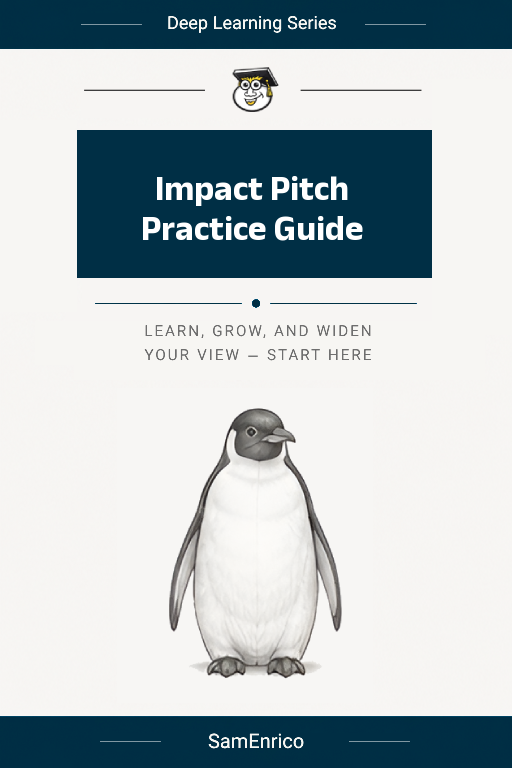
Non-FictionStartup GuideSocial Enterprise
Impact Pitch Practice Guide eBook
Practice impact investor pitches effectively. Mock
Practice impact investor pitches effectively. Mock panels and feedback loops.
Formats
Free sample
Chapter 1: The Kindness Graveyard--–- Most founders never see it coming. They prepare for weeks. They rehearse in front of mirrors. They practice their slides until the transitions feel like second nature. They walk into the investor meeting with confidence, believing they are ready.
And then, within the first five minutes, they are dismantled by questions they have never heard before. Not because their idea is bad. Not because their market is too small. Not because their team lacks talent. But because every single person who gave them feedback before that moment had been too kind.This is the central tragedy of entrepreneurial preparation.
The people closest to you—your friends, your family, your mentors, your fellow founders—have every incentive to encourage you and almost no incentive to tell you the truth. They do not want to hurt your feelings. They do not want to discourage you. They do not want to be remembered as the person who said something negative right before you went out to change the world. And so they smile.
They nod. They say “great job” and “keep going” and “I really believe in you.” They mean every word of it. But their kindness is the most dangerous gift they can give you.This chapter is called The Kindness Graveyard because that is precisely where well-intentioned encouragement buries otherwise promising ventures. The graveyard is invisible. You cannot see it from the road.
But it is filled with founders who received only praise, only affirmation, only gentle suggestions until the day they sat across from a real investor who had no reason to be gentle. That investor did not care about their feelings. That investor had a fiduciary duty to ask hard questions. That investor had seen a hundred similar pitches and knew exactly where the bodies were buried. And the founder, having never been challenged before, crumbled.The purpose of this book is to dig you out of that graveyard before you ever step foot in a real investor meeting.
The purpose is to replace the broken feedback loop that kills most impact ventures with a systematic, deliberate practice engine that turns your pitch into a weapon—sharp, tested, and ready for combat. But before we can build that engine, we have to understand exactly why the default feedback loop fails so catastrophically, and why impact investors in particular are uniquely unforgiving of the gaps that kindness conceals.The Three Fatal Errors of the Default Feedback Loop The way most founders practice for investor meetings is fundamentally flawed. They rely on three methods: practicing alone in front of a mirror, recording themselves on their phones, or pitching to friends and family. Each of these methods produces what we will call the Three Fatal Errors: kindness bias, slow feedback, and low stakes. Understanding these errors is the first step toward escaping them.Kindness Bias The first and most pervasive error is kindness bias.
Human beings are social animals. We are wired to avoid conflict, to preserve relationships, and to prioritize harmony over honesty in personal interactions. When you ask a friend to listen to your pitch, that friend is not evaluating you as an investor would. They are evaluating you as a friend. They are thinking about your feelings.
They are remembering the time you helped them move apartments or listened to their breakup story or covered their shift at work. They want you to succeed, and they do not want to be the person who said something that made you doubt yourself.This bias manifests in predictable ways. Friends will nod along even when your logic is flawed. They will offer vague praise like “that sounds really interesting” without explaining what specifically interested them. They will ask gentle, softball questions like “have you thought about maybe adding a slide on marketing?” rather than the brutal, incisive questions an investor would actually ask, like “your customer acquisition cost is three times your lifetime value—how do you justify that?” They will tell you your pitch is “solid” when it is actually leaking water from a dozen holes.The tragedy is that most founders know this on some level.
They know their friends are being nice. But they do not know how to escape the bias because they do not have access to real investors for practice. So they accept the kind feedback, convince themselves it is good enough, and walk into real meetings with a false sense of readiness. The result is not failure—it is ambush. They are ambushed by the first real question they cannot answer, and the meeting is over before it ever really began.Slow Feedback The second fatal error is slow feedback.
Even when you receive honest feedback from friends or mentors, it almost never arrives in real time. You pitch. They listen. They go home. They think about it.
They send you an email the next day or, more likely, a few days later. By the time the feedback arrives, you have already moved on mentally. You have already convinced yourself the pitch was fine. The feedback feels disconnected from the performance. It lacks the visceral immediacy of someone saying “I don’t believe you” while you are standing in front of them.Slow feedback kills learning because learning requires compression.
The most effective practice environments in the world—athletic training, musical rehearsal, military simulation—all share one characteristic: feedback is immediate. A tennis player knows within seconds whether their serve landed in the box. A pianist hears the wrong note the moment their finger strikes the key. A pilot in a flight simulator knows immediately when they have made an error because the simulated plane crashes. But founders who practice alone or with friends receive feedback on a delay of hours or days.
By the time it arrives, the emotional intensity of the pitch has faded, and the lesson is diluted.This is not a minor inefficiency. It is a structural flaw. The human brain learns best when feedback follows action within seconds. Dopamine and other learning neurotransmitters are released in response to immediate consequences. When you delay feedback, you weaken the neural signal.
You are essentially trying to learn to play the piano by hearing a recording of your mistakes a week later. It is possible, but it is brutally inefficient. And in the high-stakes world of impact fundraising, inefficiency is a luxury you cannot afford.Low Stakes The third fatal error is low stakes. When you practice in front of a mirror, nothing is at risk. When you practice for friends, the worst that can happen is mild embarrassment.
There is no money on the line. There is no reputation on the line. There is no term sheet that disappears if you stumble over your words. The stakes are effectively zero, and your brain knows it.This matters because human performance changes dramatically under pressure. Every athlete knows this.
Every musician knows this. Every surgeon knows this. The way you perform in practice is not the way you perform in the game. The difference is not just psychological—it is physiological. Under pressure, your heart rate increases, your cortisol spikes, your prefrontal cortex (responsible for complex reasoning) partially…
This is the end of the free sample. Get the eBook to keep going. Buy now
About this book
Details
- Author
- Mccall Kindra
- Publisher
- SamEnrico
- Language
- English
- Genre
- Non-Fiction, Startup Guide, Social Enterprise
- Released
- 2026-06-01
- Pages (approx.)
- 145
- Available as
- eBook, Audiobook

Read better in the ZLOADR app
Your eBooks on your phone or tablet. Sign in with your SamEnrico account and start reading.
More by Mccall Kindra
 Influencer Reality CheckMccall Kindra$11.99
 Stress Appetite ChangesMccall Kindra$11.99
 Fish Consumption Longevity GuideMccall Kindra$11.99
 The Performance Review EngagementMccall Kindra$11.99
 Kegel Exercise Technique GuideMccall Kindra$11.99
 Glitch Protocol: The Last Broadcast of Radio Free 1999Mccall Kindra$11.99
 The Breeder's Guide to Beltsville Small White TurkeysMccall Kindra$11.99
 Facebook Ad Frequency GuideMccall Kindra$12.99
 How to Start a Beakers Made of Paper Business (Beginners Guide)Mccall Kindra$11.99
 Chaplain ResidentMccall Kindra$11.99
You may also like
 Hong Kong Handover 1997Dunn Johnnie$11.99
 Zumba For Postnatal Recovery CourseNeal Christian$11.99
 Zumba for BeginnersLadner Nikia$11.99
 YouTube Comment Mining GuideHumes Pandora$12.99
 Worry Box MeditationCarlin Rudy$11.99
 Workplace Stress MeditationNguyen Lynn$11.99
 Workplace Stress and Sleep RepairHawley Ivory$11.99
 Workplace Perfectionism CureDelaney Jeffry$11.99
 Workplace Injustice Anger GuideWallen Isabelle$11.99
 Work Addiction and Burnout LinkGreenwood Ester$11.99
 Women in Yoga and WellnessBeattie Galina$11.99
 Women in Stand Up ComedyChun Evangeline$11.99