

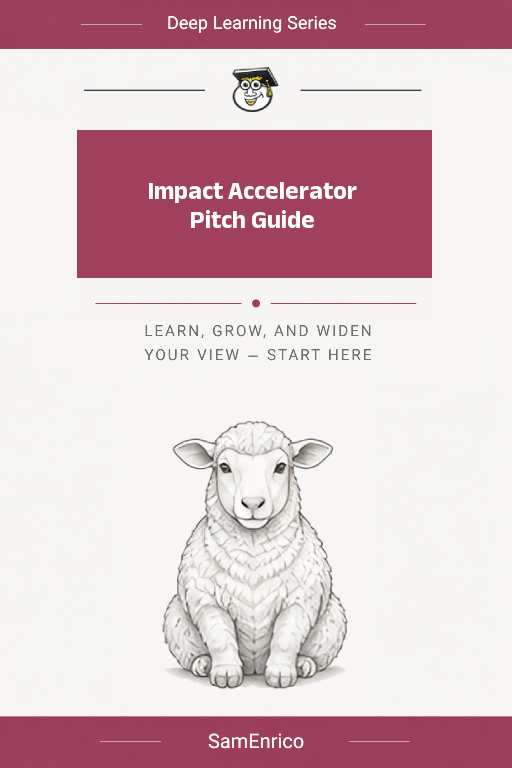
Non-FictionStartup GuideSocial Enterprise
Impact Accelerator Pitch Guide eBook
Pitch to impact-focused accelerators. Selection cr
Pitch to impact-focused accelerators. Selection criteria and cohort benefits.
Formats
Free sample
Chapter 1: The Evidence Revolution--–- In 2011, a young economist named Michael Kremer stood in front of a room full of skeptical philanthropists and delivered a one-sentence pitch that would eventually help him win a Nobel Prize. He did not show a single photo of a suffering child. He did not cry. He did not tell a heartwarming story about a village that changed overnight. Instead, he said: "Our randomized controlled trial of deworming treatment in Kenya found that two dollars spent on deworming increased school attendance by one full year per child, and those children will earn twenty percent more per year for the rest of their lives."The room went silent.
Then someone asked: "Show me the data." Kremer pulled out a single page. On it was a regression table, a p-value, and a cost-effectiveness calculation. The philanthropists read it, looked at each other, and wrote a check for five million dollars.That moment changed everything. It marked the beginning of what we now call the Evidence Revolution in impact funding. Before Kremer, most social funding was based on passion, storytelling, and trust.
After Kremer, a new generation of funders demanded proof. They stopped asking "Is your mission noble?" and started asking "What is your cost per outcome?" They stopped funding beautiful stories and started funding rigorous data.This book exists because most impact founders have not yet internalized the Evidence Revolution. They still pitch like it is 2005. They lead with suffering. They show photos.
They talk about their passion. And they lose to founders like Kremer who walk in with a regression table and a number.Chapter 1 is your induction into the Evidence Revolution. By the time you finish these pages, you will understand why the old way of pitching is not just ineffective but actively harmful to your cause. You will learn the single metric that separates funded founders from rejected ones. And you will make a decision: either you join the revolution, or you get left behind.The Billion-Dollar Blind Spot Let me tell you about a study that should terrify every impact founder.In 2019, researchers at the University of Pennsylvania analyzed three thousand applications to a major social impact accelerator.
They wanted to know what predicted acceptance. They coded every application for dozens of variables: founder education, team size, years of operation, problem severity, number of beneficiaries, media mentions, awards won, and dozens more. Then they ran the numbers.The results were stunning. None of the traditional variables predicted acceptance. Not founder pedigree.
Not the number of beneficiaries. Not the quality of the story. Not even the urgency of the problem. The only variable that predicted acceptance was whether the applicant cited third-party evidence of their intervention's effectiveness.Let me say that again. The only thing that mattered was evidence.Founders who included a single citation to a peer-reviewed study, a randomized controlled trial, or a quasi-experimental evaluation were accepted at five times the rate of founders who did not.
Everything else — the beautiful website, the TEDx talk, the endorsement from a celebrity — accounted for almost nothing.This is the billion-dollar blind spot. Most impact founders spend ninety percent of their time perfecting their story, their deck, and their delivery. They spend almost no time gathering evidence. They are optimizing the wrong thing entirely.Here is a brutal truth: Your story does not matter if your evidence is weak. Your passion does not matter if your cost-per-outcome is high.
Your suffering photos do not matter if you cannot prove that your intervention caused the change. Accelerators have seen thousands of beautiful stories. They have funded very few of them. What they fund are solutions with proof.I have watched founders spend six months crafting the perfect thirty-slide deck. They hire a designer.
They practice their delivery for fifty hours. They memorize every number. Then they walk into a pitch, deliver flawlessly, and get rejected. They leave confused, angry, and broke. They blame the accelerator for being heartless.
They blame the system for being rigged. They blame everyone except themselves.But the accelerator was not heartless. The system was not rigged. The founder simply failed to bring evidence. They brought a story to a data fight.
And they lost.The Two-Dollar Revolution The deworming story that launched the Evidence Revolution is worth examining in detail, because it contains the DNA of every successful impact pitch you will ever make.Here is what Michael Kremer actually did. He did not invent a new technology. He did not build a flashy app. He did not raise venture capital. He took an existing intervention — deworming pills for children — and asked a simple question: Does it work?To answer that question, he designed a randomized controlled trial.
He divided seventy-five Kenyan schools into two groups by lottery. One group received deworming treatment. The other group did not. Then he measured outcomes for both groups over several years.The results were extraordinary. Children who received deworming treatment attended school more often.
They learned more. They grew taller and healthier. They missed fewer days due to illness. And when Kremer tracked them into adulthood, he found that they earned significantly more money than the control group.Then Kremer did something most founders never do. He calculated the cost-effectiveness.
He divided the total cost of the program by the total benefits. The answer: two dollars per additional year of schooling completed. Every two dollars spent generated twenty percent higher lifetime earnings. That is a ten-to-one return on investment.When Kremer walked into that room of philanthropists, he did not ask them to believe in him. He asked them to believe in the data.
He did not promise to save the world. He showed them a spreadsheet that proved he already had. And he did it in ninety seconds.The philanthropists did not fund Kremer because they liked him. They funded him because they could not argue with the numbers. The evidence was so clear, so overwhelming, that saying no would have been irrational.That is your goal.
Not to be liked. To be undeniable.The Six-Stage Funnel of Death Every top impact accelerator uses some version of the Evidence Action six-stage funnel. Understanding this funnel is the single most important strategic insight you will gain from this book. It tells you exactly where you stand, what you need to improve, and whether you should apply now or wait.Here are the six stages, with the official numbering we will use throughout this book.Stage 1: Problem Scoping The accelerator asks: Is this problem real? Is it large enough to matter?
Is it solvable? They want to see that you have done your homework. You can cite the number of people affected, the economic cost of the problem, and the existing interventions that have failed to solve it. If you cannot make a quantitative case that this problem is worth solving, you will not pass Stage 1.Stage 2: Rapid Review This is where ninety percent of applicants die. The accelerator asks: Do you have third-party evidence that your intervention works?
They are not asking for your own data. They are asking for peer-reviewed studies, randomized controlled trials, or quasi-experimental evaluations conducted by someone other than you.…
This is the end of the free sample. Get the eBook to keep going. Buy now
About this book
Details
- Author
- Gresham Layla
- Publisher
- SamEnrico
- Language
- English
- Genre
- Non-Fiction, Startup Guide, Social Enterprise
- Released
- 2026-05-30
- Pages (approx.)
- 139
- Available as
- eBook, Audiobook

Read better in the ZLOADR app
Your eBooks on your phone or tablet. Sign in with your SamEnrico account and start reading.
More by Gresham Layla
 Stress Allergy Flare GuideGresham Layla$11.99
 Education Break GapGresham Layla$11.99
 Catherine Voltaire FriendshipGresham Layla$11.99
 Down Shift Stress For LongevityGresham Layla$11.99
 The Depression Screening GuideGresham Layla$11.99
 Burke and Wills: The Epic Quest to Cross AustraliaGresham Layla$11.99
 The Breeder's Guide to Aylesbury DucksGresham Layla$11.99
 How to Start a Bean Grinding Business (Beginners Guide)Gresham Layla$11.99
 Ecommerce Facebook Ad SetupGresham Layla$12.99
 Btor AdministratorGresham Layla$11.99
You may also like
 Hong Kong Handover 1997Dunn Johnnie$11.99
 Zumba For Postnatal Recovery CourseNeal Christian$11.99
 Zumba for BeginnersLadner Nikia$11.99
 YouTube Comment Mining GuideHumes Pandora$12.99
 Worry Box MeditationCarlin Rudy$11.99
 Workplace Stress MeditationNguyen Lynn$11.99
 Workplace Stress and Sleep RepairHawley Ivory$11.99
 Workplace Perfectionism CureDelaney Jeffry$11.99
 Workplace Injustice Anger GuideWallen Isabelle$11.99
 Work Addiction and Burnout LinkGreenwood Ester$11.99
 Women in Yoga and WellnessBeattie Galina$11.99
 Women in Stand Up ComedyChun Evangeline$11.99