
Non-FictionHealth & WellnessImmunology
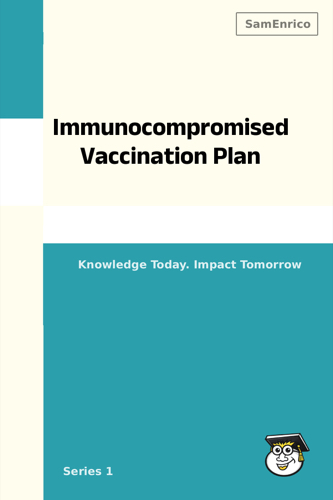
Immunocompromised Vaccination Plan eBook
Modified schedules for transplant and cancer patie
Modified schedules for transplant and cancer patients.
Formats
Free sample
Chapter 1: The Fragile Shield--The first time Maria K. held her new kidney, she was not holding an organ. She was holding a clock.The transplant had been a success—textbook, the surgeons said. Her creatinine levels dropped. Her energy returned.
She posted a triumphant photo on social media: a thumbs-up from her hospital bed, a bouquet of balloons in the background. But six weeks later, Maria was back in the intensive care unit, intubated and sedated, as a team of infectious disease physicians crowded around her chart. The culprit was not organ rejection. It was not surgical complications. It was measles—a disease so rare in her country that most younger doctors had never seen a case.
Maria had contracted measles from a child in her apartment building's elevator. She had been vaccinated against measles as a child, thirty years earlier. But the immunosuppressive drugs that protected her new kidney had also erased her immune memory. Her body no longer remembered the measles vaccine. Her fragile shield had shattered.Maria survived.
But she spent eleven days on a ventilator, lost 20 percent of her kidney function, and accumulated over $400,000 in medical bills that her insurance partially denied because, as the denial letter stated, "measles is a vaccine-preventable disease."The cruelest irony of modern medicine is this: the same treatments that save lives—chemotherapy, organ transplants, biologic therapies for autoimmune disease—simultaneously demolish the immune system's ability to protect itself. Patients are rendered more vulnerable to infections at the exact moment they become least able to respond to vaccines. And the standard vaccination schedules, designed for healthy infants and adults, do not merely fail in these patients. They can kill.This book is not a general guide to vaccines. You can find those anywhere.
This book is a strategic manual for navigating a landscape where the usual rules no longer apply. It is written for the twenty million Americans living with immunocompromising conditions—cancer patients undergoing chemotherapy, transplant recipients on anti-rejection drugs, individuals with hematologic malignancies like CLL and multiple myeloma, and patients on biologic therapies for rheumatoid arthritis, lupus, or inflammatory bowel disease. It is also written for their families, their caregivers, and the primary care doctors who often do not realize that their routine vaccine recommendations could cause active harm.If you or someone you love falls into these categories, you have likely already discovered that standard medical advice is inconsistent. One doctor says to get all vaccines. Another says to get none.
A pharmacist refuses to administer a shot because your white blood cell count is too low. Your oncologist says to wait until after chemotherapy. Your infectious disease specialist says to vaccinate now. In the middle of this conflicting advice sits a patient who just wants to survive.This chapter introduces the foundational paradox of immunocompromised vaccination, defines the four major populations this book serves, and establishes the "Three Phases of Risk" framework that will organize every clinical decision in the chapters ahead. By the end of this chapter, you will understand why your immune system is different, why standard vaccine schedules fail people like you, and why the concept of herd immunity offers you no protection at all.The Paradox That Defines This Book Let us state the problem as clearly as possible.Vaccines work by exposing the immune system to a harmless version of a pathogen—killed virus, weakened live virus, protein subunit, or genetic instruction (m RNA).
The immune system learns to recognize that pathogen and manufactures antibodies and memory cells that lie in wait for years or decades. When the real pathogen appears, the immune system mounts a rapid response and destroys it before it causes serious illness. This is the miracle of vaccination.Immunosuppressive treatments work by deliberately disabling parts of the immune system. Chemotherapy kills rapidly dividing cells, which includes both cancer cells and the lymphocytes that produce antibodies. Anti-rejection drugs like tacrolimus and mycophenolate suppress T-cell activation, preventing the body from attacking a transplanted organ.
Biologic therapies like rituximab specifically target and destroy B-cells, the very cells responsible for antibody production.The paradox is now clear: the treatments that save lives are the same treatments that make vaccines ineffective or dangerous. A patient cannot simply stop immunosuppression to get vaccinated—that would risk organ rejection or cancer progression. But continuing immunosuppression means that most vaccines will produce little to no protection. Meanwhile, live vaccines (MMR, varicella, live zoster, nasal flu) can cause active, disseminated disease in a suppressed patient, leading to pneumonia, encephalitis, or death.This is not a theoretical risk. The Vaccine Adverse Event Reporting System (VAERS) contains hundreds of reports of vaccine-strain infections in immunocompromised patients: disseminated varicella from the chickenpox vaccine, measles pneumonia from the MMR vaccine, and disseminated BCGitis from the tuberculosis vaccine.
In almost every case, the administering provider did not know the patient was immunocompromised, or did not understand the contraindication.The core argument of this book is that vaccination in the immunocompromised patient requires a complete paradigm shift away from routine schedules. You cannot simply follow the CDC's child and adult immunization schedule. You need a Risk-Responsive Framework that answers three questions in sequence:What is your current level of immune function? (Are you pre-treatment, on-treatment, or post-treatment?)What type of immunosuppression do you have? (B-cell depletion, T-cell suppression, hypogammaglobulinemia, or mixed?)What is your timeline?
(How many weeks or months before your next treatment cycle?)The chapters that follow will answer each of these questions in detail. But first, we must identify which population you belong to, because the answer determines everything.The Four Populations of the Immunocompromised Immunocompromise is not a single condition. It is an umbrella term covering dozens of distinct pathophysiologic states. A patient with multiple myeloma has a fundamentally different immune defect than a patient who received a kidney transplant, who in turn has a different defect than a patient undergoing chemotherapy for breast cancer. Treating them the same way leads to the same result: vaccine failure.This book serves four primary populations.
Identify which one describes you or your loved one.Population 1: Solid Organ Transplant (SOT) Recipients Solid organ transplant recipients include individuals who have received a kidney, liver, heart, lung, pancreas, or combined organ transplant. These patients require lifelong immunosuppression to prevent rejection of the donor organ. The typical regimen includes a calcineurin inhibitor (tacrolimus or cyclosporine), an antimetabolite (mycophenolate or azathioprine), and often corticosteroids (prednisone). This combination suppresses both T-cell and B-cell function, though the degree varies by drug.The key feature of SOT patients is that they retain some pre-existing immune memory from vaccines received before transplant. A tetanus shot given twenty years ago may still provide partial protection.
However, their ability to respond to new vaccines (such as a COVID-19 booster or a pneumococcal vaccine) is significantly impaired. The immune system can recall old memories but struggles to form new ones.SOT patients are typically stable on their immunosuppressive regimen after the first six to twelve months. This stability creates windows of opportunity for vaccination, though the windows are narrower than in healthy individuals. Live vaccines are generally contraindicated, with rare exceptions discussed in Chapter 11.Examples: A 55-year-old who received a kidney transplant for polycystic…
This is the end of the free sample. Get the eBook to keep going. Buy now
About this book
Details
- Author
- Rodriguez Jacqueline
- Publisher
- SamEnrico
- Language
- English
- Genre
- Non-Fiction, Health & Wellness, Immunology
- Released
- 2026-06-09
- Pages (approx.)
- 153
- Available as
- eBook, Audiobook

Read better in the ZLOADR app
Your eBooks on your phone or tablet. Sign in with your SamEnrico account and start reading.
More by Rodriguez Jacqueline
 War Photographer StressRodriguez Jacqueline$11.99
 Self Hypnosis for Fear of Being TrappedRodriguez Jacqueline$11.99
 The DBT for Grief GuideRodriguez Jacqueline$11.99
 DNA Evidence BreakthroughRodriguez Jacqueline$11.99
 Hypnosis App Creation GuideRodriguez Jacqueline$11.99
 Workplace Emotional EatingRodriguez Jacqueline$11.99
 Alcohol Recovery for DevelopersRodriguez Jacqueline$11.99
 The Vanishing Heiress: The 1975 Kidnapping That Shocked the British AristocracyRodriguez Jacqueline$11.99
 The Phantom Killer of Cairo: A Hoax That Shocked a NationRodriguez Jacqueline$11.99
 How to Produce FlutophonesRodriguez Jacqueline$11.99
 How to Produce a SeismometerRodriguez Jacqueline$11.99
 A Collector's Handbook to the Bentley Continental S1Rodriguez Jacqueline$11.99
You may also like
 Hong Kong Handover 1997Dunn Johnnie$11.99
 Zumba For Postnatal Recovery CourseNeal Christian$11.99
 Zumba for BeginnersLadner Nikia$11.99
 YouTube Comment Mining GuideHumes Pandora$12.99
 Worry Box MeditationCarlin Rudy$11.99
 Workplace Stress MeditationNguyen Lynn$11.99
 Workplace Stress and Sleep RepairHawley Ivory$11.99
 Workplace Perfectionism CureDelaney Jeffry$11.99
 Workplace Injustice Anger GuideWallen Isabelle$11.99
 Work Addiction and Burnout LinkGreenwood Ester$11.99
 Women in Yoga and WellnessBeattie Galina$11.99
 Women in Stand Up ComedyChun Evangeline$11.99