
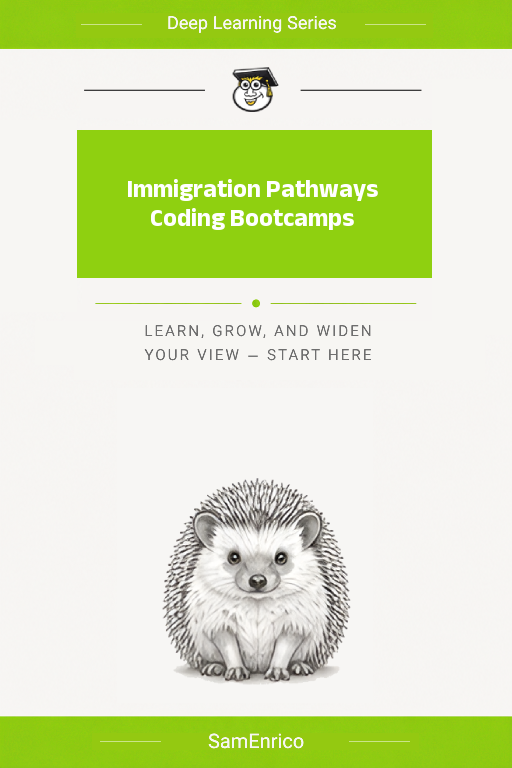
Non-FictionStudent's ShortcutImmigration
Immigration Pathways Coding Bootcamps eBook
Understand which countries recognize bootcamp cert
Understand which countries recognize bootcamp certificates for work visas and which require accredited degrees.
Formats
Free sample
Chapter 1: The Degree Trap--–- Every year, tens of thousands of talented programmers graduate from coding bootcamps around the world. They have mastered React, Python, and cloud architecture. They have built portfolios that would impress senior engineers at Google. They are ready to contribute to the global tech economy. Then they try to move to another country for work, and they hit an invisible wall.The wall is not made of technical incompetence or lack of ambition.
It is made of paper—specifically, the piece of paper that says “Bachelor’s Degree” on it. Immigration systems, designed decades before the first coding bootcamp ever opened its doors, remain stubbornly fixated on traditional academic credentials. They recognize universities. They recognize colleges. They have no category for a twelve-week intensive programming course that transformed a career-changer into a competent software engineer.This chapter exposes the fundamental mismatch between how immigration officers evaluate candidates and how modern tech talent actually acquires skills.
You will learn why the system is broken, how visa officers think, and—most importantly—why you do not need to give up on your international career dreams. The solution exists, but it requires understanding the rules before you can bend them.The Three-Tier Hierarchy That Controls Your Fate Every immigration officer, from Berlin to Brisbane to Boston, works with an unwritten mental framework when evaluating applicants. Call it the Three-Tier Hierarchy of Credentials. Understanding this hierarchy is the single most important factor in determining whether your visa application succeeds or fails.Tier One: The Accredited Degree At the top of the hierarchy sits the accredited degree. This includes bachelor’s degrees, master’s degrees, and doctorates from institutions recognized by government bodies.
In the United States, that means regionally accredited universities. In the United Kingdom, that means Ofqual-recognized institutions. In Germany, that means staatlich anerkannte Hochschulen.Why do immigration officers love degrees so much? Because degrees come with built-in trust. A visa officer in Singapore may know nothing about coding bootcamps, but they have a checklist of approved universities.
If your university is on that list, the officer checks a box and moves on. The degree has already been vetted by the issuing country’s education system. The immigration officer does not need to evaluate your actual skills—only the credential.Tier Two: Professional Work Experience The middle tier belongs to work experience. Specifically, verifiable, documented, full-time employment in a relevant field. Unlike a degree, which signals theoretical knowledge, work experience signals practical competence.
You have done the job. You have solved real problems. You have survived performance reviews and deadlines.However, work experience comes with a critical limitation: most immigration systems require a minimum number of years before experience can substitute for a degree. The number varies dramatically by country. The European Union’s Blue Card program requires three years.
Australia’s skilled migration system effectively requires five years. Canada’s points system gives partial credit for experience but still requires a degree for maximum points.Tier Three: Certificates and Alternative Credentials At the bottom of the hierarchy sits everything else: coding bootcamp certificates, online course completions, professional certifications, and micro-credentials. Immigration officers treat these documents as supplementary evidence at best, and as worthless paper at worst.This does not mean your bootcamp certificate has no value. It means the certificate cannot stand alone as a primary qualification. In the visa officer’s mind, a certificate answers the question “Where did you learn this skill?” but does not answer the question “Are you qualified to work in this country?”The critical insight is that certificates in Tier Three can become powerful supporting evidence when combined with Tier Two experience.
A bootcamp certificate alone is weak. A bootcamp certificate plus three years of professional experience is a completely different proposition.Why Traditional Immigration Books Fail Bootcamp Graduates Before writing this book, the author analyzed the ten best-selling immigration guides currently on the market. The results were alarming. Not one of these books adequately addresses the situation of a bootcamp graduate without a degree. Here is what they get wrong.The Credential Evaluation Fallacy Most immigration books dedicate entire chapters to “credential evaluation services” such as WES (World Education Services) or ECE (Educational Credential Evaluation).
These services compare foreign degrees to their domestic equivalents. A bachelor’s degree from India gets evaluated as equivalent to a bachelor’s degree from Canada. Useful information for degree holders. Completely irrelevant for bootcamp graduates.Credential evaluation services do not evaluate bootcamp certificates. They will take your money and produce a document, but that document will say something like “This certificate does not represent an academic degree” or “No equivalency can be determined.” You have paid several hundred dollars for a piece of paper that actively harms your application by highlighting what you lack.The Points System Obsession Many immigration books focus obsessively on points-based systems.
How many points for age? How many for language ability? How many for a job offer? This approach works well for degree holders who can maximize points across multiple categories.For bootcamp graduates, the points system becomes a trap. You will never earn enough points without a degree in most points-based systems.
Canada’s Express Entry, for example, awards between 120 and 150 points for a bachelor’s degree. Bootcamp certificates receive zero points in the education category. No amount of language ability or work experience will overcome a 150-point deficit.The Good News That Books Miss Here is what the best-selling immigration books do not tell you. Several countries have realized that the degree requirement is outdated. The European Union has built a legal mechanism specifically for skilled workers without degrees—the Blue Card experience equivalency clause.
Germany has created the Chancenkarte (Opportunity Card) that awards points for alternative qualifications. Canada’s Provincial Nominee Programs increasingly accept bootcamp graduates with job offers.The problem is not that immigration pathways do not exist. The problem is that the pathways are hidden, poorly documented, and require strategic planning. This book exists to illuminate those pathways.The Bootcamp Graduate’s Strategic Advantage Let me tell you about two hypothetical applicants. The first holds a bachelor’s degree in computer science from a mid-tier university.
They graduated two years ago. They have worked as a junior developer for eighteen months. They have a bootcamp certificate in cloud computing that they completed last year.The second applicant holds no degree. They attended a twelve-week coding bootcamp three years ago. They have worked continuously as a software developer for three years.
They have built production applications used by thousands of users.Which applicant is more attractive to most tech employers? The second one. Three years of real-world experience beats an outdated degree almost every time.Which applicant is more attractive to most immigration systems? The first one, despite having less relevant experience, because they have a degree.This contradiction is the central problem this book solves. You need to translate your real-world value into a language that immigration officers understand.
That language is not “bootcamp certificate.” That language is “professional experience” combined with “demonstrated competence.”The Experience Equivalency Principle Throughout this book, you will encounter a concept called the Experience Equivalency Principle. It works like this: in…
This is the end of the free sample. Get the eBook to keep going. Buy now
About this book
Details
- Author
- Isaacs Angelique
- Publisher
- SamEnrico
- Language
- English
- Genre
- Non-Fiction, Student's Shortcut, Immigration
- Released
- 2026-06-01
- Pages (approx.)
- 142
- Available as
- eBook, Audiobook

Read better in the ZLOADR app
Your eBooks on your phone or tablet. Sign in with your SamEnrico account and start reading.
More by Isaacs Angelique
 Anger in Neurodiverse LoveIsaacs Angelique$11.99
 Handling Conflict At WorkIsaacs Angelique$11.99
 Body Image For AcneIsaacs Angelique$11.99
 IBS Probiotic Strain GuideIsaacs Angelique$11.99
 Geo Arbitrage for AgenciesIsaacs Angelique$11.99
 Benzo Recovery Sensory Sensitivities CourseIsaacs Angelique$11.99
 Postpartum Anxiety Exposure TherapyIsaacs Angelique$11.99
 Pelvic Floor TipsIsaacs Angelique$11.99
 The Illegitimate Child PrimerIsaacs Angelique$11.99
 The Last Dance of the Soviet Cosmonauts: How the Fall of the USSR Stranded Men in SpaceIsaacs Angelique$11.99
 The Massacre of Saint Bartholomew: Blood in the Streets of ParisIsaacs Angelique$11.99
 The Hollow Men of the Sidhe: Ireland's Forgotten Fairy KingsIsaacs Angelique$11.99
You may also like
 Hong Kong Handover 1997Dunn Johnnie$11.99
 Zumba For Postnatal Recovery CourseNeal Christian$11.99
 Zumba for BeginnersLadner Nikia$11.99
 YouTube Comment Mining GuideHumes Pandora$12.99
 Worry Box MeditationCarlin Rudy$11.99
 Workplace Stress MeditationNguyen Lynn$11.99
 Workplace Stress and Sleep RepairHawley Ivory$11.99
 Workplace Perfectionism CureDelaney Jeffry$11.99
 Workplace Injustice Anger GuideWallen Isabelle$11.99
 Work Addiction and Burnout LinkGreenwood Ester$11.99
 Women in Yoga and WellnessBeattie Galina$11.99
 Women in Stand Up ComedyChun Evangeline$11.99