
Non-FictionBiographyImmigration Law
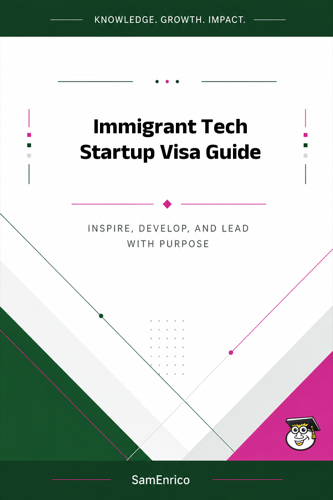
Immigrant Tech Startup Visa Guide eBook
Navigate O1, EB1, and H1B paths while scaling a di
by Michel Karyn
Navigate O1, EB1, and H1B paths while scaling a disruptive company.
Formats
Free sample
Chapter 1: The Velocity Gap...--–- The first time I realized the immigration system was designed to break startups, I was sitting in a freezing USCIS waiting room in San Francisco, watching a founder cry into his coffee. He had raised $4 million. He had fourteen employees. He had a product that was growing 40% month over month. And he was about to be deported because his lawyer had filed the wrong visa nine months earlier.
His startup would not survive his departure. Within six weeks, it didn't.That founder was not an anomaly. He was a statistic.Immigrant founders have built more than half of America's billion-dollar startups. Elon Musk. Sergey Brin.
Satya Nadella. Pierre Omidyar. The list is so long that it has ceased to be remarkable. What is remarkable—what no one talks about—is how many more immigrant founders fail not because of product-market fit, not because of team dynamics, not because of capital, but because their visa expired before their term sheet arrived.This book is for those founders. Not the ones who need a lawyer—you already have one.
Not the ones who need emotional support—you have co-founders for that. This book is for the founder who has read Tahmina Watson's The Startup Visa, who has subscribed to Sophie Alcorn's Ask Sophie, who has cried through Soundarya Balasubramani's Unshackled, and who is now screaming into the void: "I know the laws. I know the pain. But HOW do I close this Series A while my I-94 expires in ninety days?"The answer lies in what I call the Velocity Gap.What Is the Velocity Gap?The Velocity Gap is the dangerous space between how fast a startup moves and how slowly the US immigration system processes change. It is the abyss into which high-growth founders fall when their company pivots faster than USCIS can approve an amendment.
It is the reason venture capitalists have started asking for immigration audits before term sheets. And it is the single most underestimated risk factor for immigrant founders.Let me quantify this gap.A typical high-growth startup, from pre-seed to Series A, will change its business model an average of 2.7 times. It will add new executive roles. It will shift from B2C to B2B, or from Saa S to marketplace. It will hire key personnel who report directly to the founder.
These are all material changes to the founder's employment.USCIS processing times, as of this writing, average 4.5 months for an O-1 petition (regular processing) and 15 days for premium processing—but that fifteen days only starts after you have gathered all your evidence, which typically takes 2-3 months. An H-1B amendment takes 2-4 months. An EB-1 green card can take 8-14 months.Do the math. Your startup can pivot three times in the time it takes USCIS to approve one visa petition.This is the Velocity Gap. And if you do not understand it, it will kill your company.The Burn-the-Boats Paradox Here is the strange truth that no immigration lawyer will tell you: the same psychology that makes immigrant founders successful also makes them vulnerable to the Velocity Gap.Immigrant founders, on average, outperform native-born founders.
A 2018 study by the National Foundation for American Policy found that immigrants founded 55 of 87 (63%) of US billion-dollar startups. The Kauffman Foundation has repeatedly shown that immigrants are nearly twice as likely to start a business as native-born citizens.Why?The answer is what I call the Burn-the-Boats Paradox. When you leave your home country with a suitcase and a student visa, you have no safety net. You cannot go back and work for your parents' company. You cannot lean on family connections.
You have, in the ancient military metaphor, burned your boats on the shore. There is no retreat. There is only forward.This produces an intensity, a focus, and a willingness to take calculated risks that native-born founders often lack. You will work seventy-hour weeks because you have nothing else. You will take below-market salary because you have no other options.
You will pivot aggressively because failure is not an option.But here is the paradox: the same urgency that makes you successful also leads you to break immigration rules without realizing it. You take that customer meeting in Miami even though your visa was issued for California. You accept those stock options as compensation even though your F-1 visa prohibits work without authorization. You let your job title change from "CTO" to "Head of Product" without filing an amendment because you cannot afford the downtime.Each of these is a violation. Each of these will be discovered during your Series A due diligence or, worse, at the airport when CBP pulls you into secondary inspection.
And each of these is a direct consequence of the Velocity Gap.The Five Hidden Risks of High-Growth Founders Through my research and interviews with over two hundred immigrant founders, I have identified five specific legal risks that emerge from the Velocity Gap. These risks are not covered in standard immigration guides because those guides assume stable employment. Startups are not stable. They are chaos engines.Risk 1: Cap Table Contamination Your cap table—the document that lists who owns what percentage of your company—is sacred to investors. But if you have issued shares to non-US persons (including yourself before you had work authorization), you may have violated securities laws and immigration rules simultaneously.I worked with a founder who had granted himself 40% of his company's shares while on an F-1 visa.
He had not been paid a salary. He had worked "for equity only." This is a classic bootstrapping move. It is also, under USCIS rules, unauthorized work. When he applied for his green card, USCIS issued a Notice of Intent to Deny citing his "unlawful presence" during the period he was working without authorization. He spent $45,000 on lawyers to overcome this.
Many founders do not.Risk 2: Unauthorized Equity Exercises Even if you have work authorization, the act of exercising stock options can create problems. Under most visa statuses (F-1, J-1, even some H-1B scenarios), receiving equity as compensation for work performed in the present is considered income from unauthorized work if the underlying work was not authorized.The solution, which we will cover in depth in Chapter 10, is to structure your equity grant as a future promise—a restricted stock unit that vests only after you have obtained the correct work authorization. This keeps you compliant while still aligning incentives.Risk 3: Remote Work Violations Remote work has exploded since 2020, but USCIS has not updated its rules accordingly. Your visa is typically issued for a specific employer at a specific worksite. If you work from a different state—say, you live in New Jersey but your company is incorporated in Delaware and your visa says "New York City office"—you may technically be violating your status.This becomes a nightmare during due diligence.
VCs will ask for your I-94 travel history and payroll records. If they see you were working from Florida for three months when your visa was issued for California, they will flag it. Some VCs will walk away. Others will demand indemnification clauses. All will discount your…
This is the end of the free sample. Get the eBook to keep going. Buy now
About this book
Details
- Author
- Michel Karyn
- Publisher
- SamEnrico
- Language
- English
- Genre
- Non-Fiction, Biography, Immigration Law
- Released
- 2026-06-07
- Pages (approx.)
- 140
- Available as
- eBook, Audiobook

Read better in the ZLOADR app
Your eBooks on your phone or tablet. Sign in with your SamEnrico account and start reading.
More by Michel Karyn
 Stress And Dizziness ScienceMichel Karyn$11.99
 Working Memory Training HandbookMichel Karyn$11.99
 Like Kind Property Definition GuideMichel Karyn$11.99
 Road Rage Exit Strategy GuideMichel Karyn$11.99
 Male Reproductive HealthMichel Karyn$11.99
 The 4 AM Victory HourMichel Karyn$11.99
 Desert Storm POWMichel Karyn$11.99
 Nelson Mandela LongMichel Karyn$11.99
 The Last Voyage of the Mary Celeste: The Ghost Ship That VanishedMichel Karyn$11.99
 The Silk Road Heist: How a 13th-Century Merchant Outwitted the MongolsMichel Karyn$11.99
 The Golden Hands of the Kingdom: How a 19th-Century Industrialist Built a Legacy of Wealth and WisdomMichel Karyn$11.99
 Understanding Ahumada-del Castillo SyndromeMichel Karyn$17.99
You may also like
 Hong Kong Handover 1997Dunn Johnnie$11.99
 Zumba For Postnatal Recovery CourseNeal Christian$11.99
 Zumba for BeginnersLadner Nikia$11.99
 YouTube Comment Mining GuideHumes Pandora$12.99
 Worry Box MeditationCarlin Rudy$11.99
 Workplace Stress MeditationNguyen Lynn$11.99
 Workplace Stress and Sleep RepairHawley Ivory$11.99
 Workplace Perfectionism CureDelaney Jeffry$11.99
 Workplace Injustice Anger GuideWallen Isabelle$11.99
 Work Addiction and Burnout LinkGreenwood Ester$11.99
 Women in Yoga and WellnessBeattie Galina$11.99
 Women in Stand Up ComedyChun Evangeline$11.99