
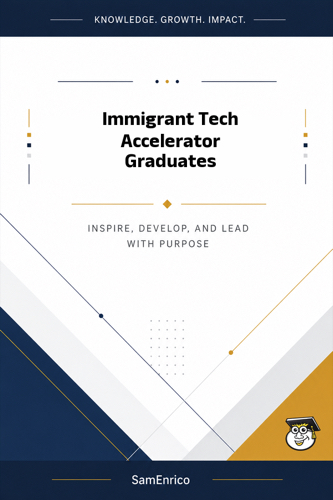
Non-FictionBiographyTech Startup
Immigrant Tech Accelerator Graduates eBook
Profiles immigrant founders who moved from Y Combi
by Wynn Isaiah
Profiles immigrant founders who moved from Y Combinator and Techstars to billion-dollar exits.
Formats
Free sample
Chapter 1: The Visa Clock--The founder refreshes the page. Then again. Then again.It is 2:47 AM in a Y Combinator hacker house in Mountain View, and Harshita Arora is watching two clocks. On her laptop screen, a USCIS case status page loads slowly, spinning its wheel of bureaucratic indifference. On her phone, a term sheet sits unopened in her inbox.
One clock offers permission to stay. The other offers permission to become rich. She is not sure which one terrifies her more.Ninety days. That is how long she has if the startup fails. Ninety days to pack a life, sell a dream, and explain to her mother in India that the American experiment is over.
Not because the code was bad. Not because the product failed. But because a piece of paper did not arrive on time.This is not how the movies tell the story of Silicon Valley. In the movies, the founder has a garage, a vision, and a patient parent who believes in them. In the movies, failure means moving back into the childhood bedroom and trying again next year.
In the movies, the only clock that matters is the one counting down to the product launch.Harshita has no childhood bedroom to return to. Her family in India sold the extra room years ago. Her mother works twelve-hour shifts as a nurse. Her younger cousin sleeps on a mattress in the living room and dreams of engineering school. If Harshita fails, she does not go home to comfort.
She goes home to become a cautionary tale.This is the invisible engine of Silicon Valley. Not the ping-pong tables or the free kombucha or the motivational posters about moonshots. It is the visa clock. And it produces a kind of focus that no amount of equity or mentorship can replicate.The Physics of Scarcity Let us be precise about what we mean by the visa clock. Different visas have different grace periods.
The H-1B, that workhorse of the tech industry, gives you sixty days to find a new job or leave the country. The F-1 OPT, used by international students, allows ninety days of unemployment before your authorization evaporates. The O-1, the so-called "Einstein visa" for people with extraordinary ability, offers no grace period at all. The day your employment ends, your legal presence ends with it.Throughout this book, when we say "ninety days," we are using a symbolic average. The exact number matters less than the psychology.
What matters is this: immigrant founders operate under a deadline that native founders cannot see and cannot understand. It is not a fundraising deadline. It is not a product launch deadline. It is a deadline for continued existence in the only country where their industry functions.Consider the difference in cognitive load. A native founder who wakes up at 3 AM worried about the company has one problem: the company.
An immigrant founder who wakes up at 3 AM has two problems: the company and the calendar. Every investor meeting carries a subtext that goes unspoken. Every pivot carries a risk that cannot be diversified. Every delay is measured not in lost revenue but in days remaining on a document that a stranger in a government office may or may not renew.This is not a disadvantage. It is a different operating system entirely.The Teenager Who Would Not Deport Harshita Arora was nineteen years old when she dropped out of college.
This is not unusual in Silicon Valley. What was unusual was the visa she needed to do it.Most teenage dropouts are American citizens. They have Social Security numbers and birth certificates and parents who can cosign leases. Harshita had an O-1 visa, which required her to prove that she possessed "extraordinary ability" in her field. She was a teenager.
She had been coding since she was twelve. She had built a cryptocurrency trading bot that actually made money. But "extraordinary" is a high bar for a nineteen-year-old.She applied anyway. The application ran to hundreds of pages. She documented every line of code, every competition she had won, every article that had mentioned her work.
She paid an immigration lawyer five thousand dollars that she did not have. She borrowed from her mother, who borrowed from her uncle, who borrowed from a neighbor. The money crossed borders in a chain of trust that would have made a microfinance economist weep with recognition.The visa was approved. She cried. Then she got on a plane.Her first Y Combinator interview was a disaster.
Not because her product was bad. Her product was a cryptocurrency trading bot that worked. The disaster was the room itself. Twelve investors, all older, all male, all native English speakers, staring at her like she had wandered in from another dimension. She pitched.
Her accent thickened with nerves. Someone asked a question about regulatory compliance. She misunderstood the verb tense and answered the wrong question entirely. The room went quiet.She did not get in that time.She applied again. This time she rehearsed for two hundred hours.
She recorded herself and played it back, wincing at her own vowels. She hired a speech coach who specialized in "accent reduction" – a phrase that still makes her angry. She learned to slow down, to emphasize key words, to pause before answering questions. She learned to make her voice sound less like Delhi and more like Palo Alto.The second interview was different. She was still nervous.
Her accent was still there. But she had learned something crucial: the investors were not evaluating her English. They were evaluating her confidence. And confidence, she discovered, could be faked until it became real.She got in.The Uber Shifts Here is something the brochures do not tell you about being an immigrant founder in Y Combinator: you still have to pay rent.YC provides a stipend. It is generous by startup standards.
It is not generous by Bay Area standards. Harshita calculated her burn rate on a spreadsheet and realized she would run out of money in four months. Her visa required her to maintain a certain income level. Her family could not send more. She needed a second job.She drove for Uber.The shifts were brutal.
She would code from 9 AM to 6 PM, eat a protein bar, then drive from 7 PM to midnight. She kept a notebook in the passenger seat and dictated bug fixes into her phone between fares. Passengers asked what she did. "Startup founder," she would say, and they would laugh, because startup founders were not supposed to be driving Uber. She laughed too.
It was better than crying.One passenger recognized her from a tech blog. "Aren't you in YC?" he asked. She said yes. He asked why she was driving. She explained the visa situation.
He was quiet for a long time. Then he said: "That is insane."She agreed. She kept driving.The Uber shifts taught her something that no business school could. They taught her that shame is a luxury that immigrants cannot afford. Native founders talk about "hustle culture" like it is a choice.
For Harshita, it was not a choice. It was the difference between staying and leaving.The Data Behind the Desperation The…
This is the end of the free sample. Get the eBook to keep going. Buy now
About this book
Details
- Author
- Wynn Isaiah
- Publisher
- SamEnrico
- Language
- English
- Genre
- Non-Fiction, Biography, Tech Startup
- Released
- 2026-06-08
- Pages (approx.)
- 104
- Available as
- eBook, Audiobook

Read better in the ZLOADR app
Your eBooks on your phone or tablet. Sign in with your SamEnrico account and start reading.
More by Wynn Isaiah
 ABCDE for Event Planners GuideWynn Isaiah$11.99
 Suicide Attempt After Steroid Withdrawal StoryWynn Isaiah$11.99
 The Pulsatile HGH PatternWynn Isaiah$11.99
 AI Recommendation Letter WriterWynn Isaiah$11.99
 The Sand Serpent's Curse: A Pharaoh's Forgotten OathWynn Isaiah$11.99
 A Beginners Guide to Cornish hurling (Volume 1)Wynn Isaiah$11.99
 Program ManagerWynn Isaiah$11.99
 USA Raise Quick ReferenceWynn Isaiah$12.99
 Data Literacy Workforce GuideWynn Isaiah$12.99
 Understanding MedulloblastomaWynn Isaiah$17.99
You may also like
 Hong Kong Handover 1997Dunn Johnnie$11.99
 Zumba For Postnatal Recovery CourseNeal Christian$11.99
 Zumba for BeginnersLadner Nikia$11.99
 YouTube Comment Mining GuideHumes Pandora$12.99
 Worry Box MeditationCarlin Rudy$11.99
 Workplace Stress MeditationNguyen Lynn$11.99
 Workplace Stress and Sleep RepairHawley Ivory$11.99
 Workplace Perfectionism CureDelaney Jeffry$11.99
 Workplace Injustice Anger GuideWallen Isabelle$11.99
 Work Addiction and Burnout LinkGreenwood Ester$11.99
 Women in Yoga and WellnessBeattie Galina$11.99
 Women in Stand Up ComedyChun Evangeline$11.99