
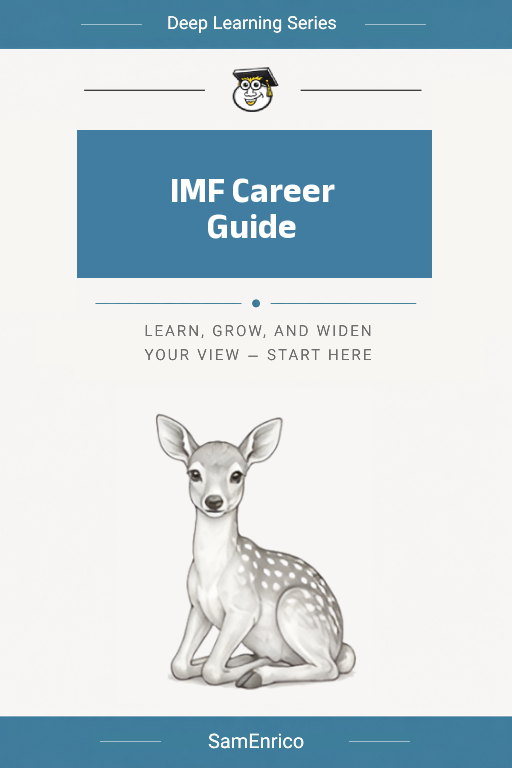
Non-FictionNon-Obvious CareerIMF Careers
IMF Career Guide eBook
Work for International Monetary Fund including eco
Work for International Monetary Fund including economist program, administrative roles, and secondments.
Formats
Free sample
Chapter 1: The Three Doors--You have been reading the wrong job postings.That is the first and most important thing to understand about building a career at the International Monetary Fund. If you have spent hours scrolling through the IMF’s career website, clicking on titles like “Economist” or “Administrative Assistant” or “Program Coordinator,” and feeling increasingly confused about which one fits your background, you are not alone. And you are not the problem. The problem is that the IMF presents itself as a single organization with a single front door, when in reality it operates three completely separate portals of entry. Each portal has its own application process, its own candidate profile, its own career trajectory, and its own hidden rules.
Most candidates spend months—sometimes years—applying to the wrong portal because no one ever told them the difference.This chapter will fix that.By the time you finish reading these pages, you will know exactly which of the three doors belongs to you. You will understand why your investment banking resume is hurting your chances at the Economist Program. You will learn why the D.C. residency requirement is quietly filtering out thousands of administrative applicants. And you will never again waste a single application on a role that was never designed for someone like you.Let us begin with a story.The Candidate Who Applied to the Wrong Door for Three Years Priya was a Ph D economist from a top-ten university.
Her dissertation examined the relationship between fiscal policy and exchange rate volatility. She had published two papers in respected journals. She had presented her research at the Federal Reserve and the European Central Bank. On paper, she was exactly the kind of candidate the IMF claimed to want.She applied to the Economist Program. She was rejected.She applied again the following year.
Rejected again.The year after that, she applied a third time. Same result.Priya was smart, qualified, and persistent. But she was also misinformed. She assumed that the Economist Program was the only door for someone with her credentials. What she did not know was that her background—heavy on fiscal policy, with experience advising a ministry of finance in an emerging market—made her a much stronger candidate for the Specialist track.
Specialists enter at a higher grade than EP economists. They face less competition because the applicant pool is smaller. And they are hired directly into the departments where their expertise is most needed.Priya had been applying to Door Number One for three years. She should have been knocking on Door Number Three.She finally learned the difference from a former IMF economist she met at a conference. Within six months of redirecting her applications, she had an offer.
Today she works in the Fiscal Affairs Department at the A14 level—two grades higher than where she would have entered through the EP.Priya’s story is not unusual. It is the rule.The Three Doors: A Framework The IMF organizes its workforce into three distinct career streams. The organization does not advertise this fact. The job postings do not explain it. But once you understand the framework, every job title, every requirement, and every application becomes instantly clearer.Door One: The Academic Track This door is for Ph D economists and experienced policy professionals.
It includes the flagship Economist Program for recent graduates, as well as the Mid-Career Economist pipeline for central bankers and ministry officials with five or more years of experience. Candidates who enter through this door spend their careers conducting macroeconomic analysis, designing lending programs, and advising member countries on fiscal and monetary policy. They are the public face of the IMF. They write the reports that governments read. They sit across the table from finance ministers and central bank governors.Door Two: The Operational Track This door is for administrative and coordination professionals.
It includes roles from entry-level travel processors (A03) to senior mission coordinators (A06). Candidates who enter through this door do not need advanced degrees in economics. They need organizational talent, systems proficiency, and the ability to manage complex workflows under tight deadlines. They are the people who actually make the IMF run. Without them, economists could not travel.
Reports would not be published. Budgets would not be tracked. Their work is invisible to the outside world but absolutely essential to every mission.Door Three: The Lateral Track This door is for senior professionals who enter the IMF on fixed-term contracts. It includes secondments from central banks and ministries of finance, HQX (Headquarters Expert) contracts for specialists with deep technical knowledge, LTX (Long Term Expert) contracts for field-based roles in member countries, and the Fund Internship Program for graduate students seeking short-term exposure. Candidates who enter through this door already have established careers elsewhere.
They are not looking for a permanent home at the IMF. They are looking for a tour of duty—a few years of high-impact work before returning to their home institutions or moving on to something new.These three doors are not interchangeable. The skills that open Door One will not open Door Two. The application strategy that works for Door Three will fail at Door One. And yet, the vast majority of candidates apply to all three indiscriminately, hoping that something will stick.They are wasting their time.Door One: The Academic Track in Depth The Academic Track is the most visible and the most competitive.
It is also the most misunderstood.The Economist Program (EP)The EP is the flagship entry route for recent Ph D economists. It is a three-year program that accepts between twenty and thirty candidates each year from a global pool of hundreds, sometimes thousands, of applicants. The program is structured as two eighteen-month assignments: one in an Area Department (focused on a specific country or region, such as the African Department or the Western Hemisphere Department) and one in a Functional Department (focused on a specific policy area, such as Fiscal Affairs, Monetary and Capital Markets, or the Research Department).The EP is designed to produce well-rounded macroeconomists who can move seamlessly between country work and policy analysis. It is not a training program for academics who want to publish in top journals, though many EP economists do publish. It is a pipeline to operational roles: country desk officer, mission team member, and eventually, for the most successful, Resident Representative or Division Chief.The hard requirements for the EP are unforgiving.
Applicants must hold a Ph D in economics or a closely related field by the time they start the program. They must have a strong background in macroeconomics, international finance, or monetary policy. And they must be under the age of thirty-four at the start of the program.That age requirement eliminates many otherwise qualified candidates. It exists for bureaucratic reasons that date back decades: the EP was originally designed to align with central bank secondment programs, which typically send staff to the IMF between the ages of thirty and thirty-four. The rule has never been changed.
There are no exceptions. If you turn thirty-four before your start date, you cannot enter through the EP.What the EP Does Not Want…
This is the end of the free sample. Get the eBook to keep going. Buy now
About this book
Details
- Author
- Lemus Waltraud
- Publisher
- SamEnrico
- Language
- English
- Genre
- Non-Fiction, Non-Obvious Career, IMF Careers
- Released
- 2026-05-30
- Pages (approx.)
- 136
- Available as
- eBook, Audiobook

Read better in the ZLOADR app
Your eBooks on your phone or tablet. Sign in with your SamEnrico account and start reading.
More by Lemus Waltraud
 TM Cost and AidLemus Waltraud$11.99
 Medicare OUD Treatment GuideLemus Waltraud$11.99
 Disappointment Proof MindsetLemus Waltraud$11.99
 Night Stalker Survivors SpeakLemus Waltraud$11.99
 Imposter Syndrome in First Generation ProfessionalsLemus Waltraud$11.99
 The Shadow Cabinet: How a Teenage Girl Manipulated a Nation from Behind the ScenesLemus Waltraud$11.99
 The Phantom of the Frozen South: The Enigma of the 1820s Antarctic ExpeditionsLemus Waltraud$11.99
 How to Become a Spinning-machine TenderLemus Waltraud$11.99
 Lease Option To Purchase GuideLemus Waltraud$12.99
 Understanding Craniosynostosis Alopecia Brain DefectLemus Waltraud$17.99
 Journeyman Sheet Metal WorkerLemus Waltraud$11.99
You may also like
 Hong Kong Handover 1997Dunn Johnnie$11.99
 Zumba For Postnatal Recovery CourseNeal Christian$11.99
 Zumba for BeginnersLadner Nikia$11.99
 YouTube Comment Mining GuideHumes Pandora$12.99
 Worry Box MeditationCarlin Rudy$11.99
 Workplace Stress MeditationNguyen Lynn$11.99
 Workplace Stress and Sleep RepairHawley Ivory$11.99
 Workplace Perfectionism CureDelaney Jeffry$11.99
 Workplace Injustice Anger GuideWallen Isabelle$11.99
 Work Addiction and Burnout LinkGreenwood Ester$11.99
 Women in Yoga and WellnessBeattie Galina$11.99
 Women in Stand Up ComedyChun Evangeline$11.99