
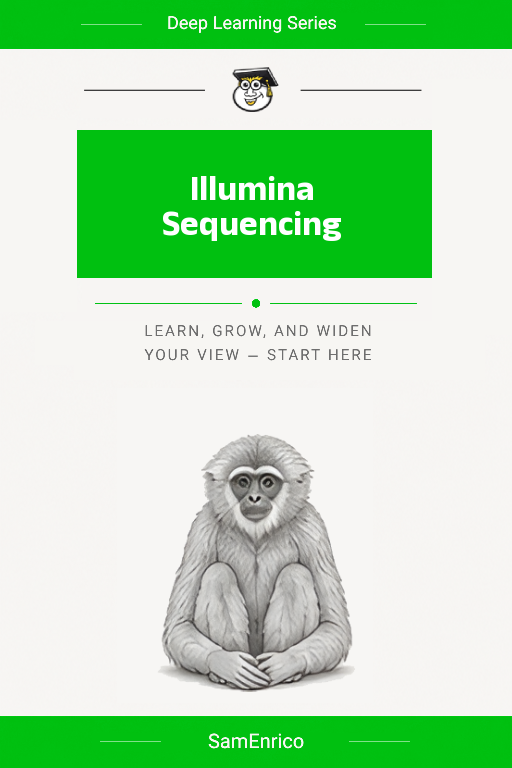
Non-FictionStrategic AtlasGenomics Patents
Illumina Sequencing eBook
Analyze DNA sequencing by synthesis (SBS), NovaSeq
Analyze DNA sequencing by synthesis (SBS), NovaSeq X, and bioinformatics patent portfolio from genomics leader.
Formats
Free sample
Chapter 1: The Billion-Dollar Pause...--The most valuable chemical reaction in the history of biotechnology does not produce a drug, a fuel, or a material. It produces a pause. A momentary, microscopic, meticulously engineered halt in the relentless march of DNA polymerase—an enzyme that evolved over three billion years to never, ever stop. Illumina’s entire fortune, its fifty-billion-dollar market capitalization, its dominion over the genome-reading industry, rests on the ability to slam the brakes on the most efficient molecular machine in the natural world. Then release it.
Then slam it again. Three hundred times in a row. Without breaking anything.This chapter is about that pause. It is about the chemical trick that makes modern genomics possible: the reversible terminator. Understanding the reversible terminator is not optional for readers of this book.
It is the foundation upon which every subsequent chapter—the machines, the patents, the lawsuits, the competitors, the future of medicine—is built. Miss this, and the rest of the story becomes a confusing tangle of legal jargon and blinking lights. Master it, and you will see the genome-reading industry with the clarity of a scientist and the suspicion of a lawyer.We begin not in a boardroom or a courtroom, but in a darkened laboratory at Columbia University in the late 1990s. A young chemist named Jingyue Ju was staring at a problem that had frustrated molecular biologists for two decades. The problem was speed, or rather, the lack of it.
The dominant sequencing technology of the era, invented by Frederick Sanger in 1977, was brilliant but glacial. It worked by creating a random assortment of DNA fragments, each ending in a fluorescently labeled terminator base, then sorting those fragments by size like a molecular filing system. Reading a single human genome that way took years and cost billions. Ju wanted to read genomes in days, not years. He wanted to watch the DNA being built in real time, one base at a time, without ever stopping to sort fragments.The obstacle was DNA polymerase itself.
This enzyme is a masterpiece of natural engineering. It zips along a single strand of DNA at a rate of hundreds of bases per second, selecting the correct complementary nucleotide, checking for errors, and attaching it to the growing chain with breathtaking precision. It does not pause. It does not wait for cameras. It does not care that a human being would like to take a picture of each base before the next one arrives.
The polymerase's job, perfected over eons of evolution, is to never stop.Ju's insight was radical. What if you could chemically force the polymerase to stop? What if you could modify the nucleotides themselves so that after the polymerase added one, it physically could not add another? And what if you could then remove that modification—restoring the nucleotide to its natural state—so the polymerase could take one more step before you stopped it again? Pause, image, release.
Pause, image, release. A molecular stutter step. A billion-dollar pause.The Chemistry of the Stop Sign To understand the reversible terminator, you must first understand how DNA grows. A DNA strand is a chain of nucleotides, each nucleotide consisting of a sugar molecule (deoxyribose), a phosphate group, and a nitrogenous base (A, C, G, or T). The chain grows by adding new nucleotides to the 3' end—specifically, to a chemical group called the 3' hydroxyl, or 3'-OH.
This hydroxyl group acts like an outstretched hand, ready to grab the next nucleotide and form a bond. As long as the 3'-OH is free, the polymerase can keep adding bases indefinitely.The terminator is a chemical block attached to that 3'-OH group. It is a molecular parking boot, a handcuff, a deadbolt. With the block in place, the 3'-OH cannot grab the next nucleotide. The polymerase adds exactly one base and then grinds to a halt.
The chain stops growing. The camera has time to take its picture.But here is the crucial distinction that makes the reversible terminator revolutionary: the block can be removed. In traditional Sanger sequencing, the terminators were permanent. Once added, the chain stopped forever—which was fine for generating fragments of different lengths but useless for reading a single molecule in real time. Ju needed a terminator that could be switched on and off like a light.
Add the nucleotide with the block. Take the picture. Then wash in a chemical that snips the block off, restoring the free 3'-OH. The polymerase wakes up, adds the next nucleotide (also terminated), and stops again. Cycle after cycle, reading the genome one base at a time.This required three chemical innovations working in perfect harmony.
First, each nucleotide had to carry a fluorescent tag—a small, light-emitting molecule that would identify which base had been added. A had to look different from C, which had to look different from G and T. Second, the fluorescent tag had to be attached in a way that could be removed after imaging, because otherwise the growing DNA strand would accumulate a trail of bulky dyes that would eventually disrupt the polymerase. Third, the blocking group on the 3'-OH had to be removable under conditions so mild that they did not damage the DNA, denature the polymerase, or destroy the fluorescent tags waiting to be imaged in future cycles.This was the trilemma that defeated Ju's early attempts. His first reversible terminators worked—on paper, in a test tube, with short synthetic DNA strands.
But the fluorescent tags were dim. The deblocking chemistry was harsh. The polymerase would fall off after twenty or thirty cycles. The signal-to-noise ratio degraded into nonsense. Ju could read perhaps fifty bases before the whole system collapsed.
That was not a sequencer. That was a parlor trick.The Solexa Solution Three thousand miles east, across the Atlantic Ocean, two Cambridge chemists named Shankar Balasubramanian and David Klenerman were working on a different piece of the puzzle. They were not trying to build a sequencer. They were trying to understand how DNA polymerase works at the single-molecule level. To do that, they needed to watch individual polymerase molecules in real time.
That meant attaching DNA to a surface and imaging it with a microscope.The problem was signal strength. A single fluorescent molecule is incredibly dim. Imaging it requires expensive cameras, perfect optics, and a vibration-free room. Even then, the signal fades after a few seconds as the dye molecule photobleaches, destroyed by the very light used to see it. Balasubramanian and Klenerman realized that single-molecule imaging was impractical for sequencing.
But what if, instead of imaging a single molecule, they could amplify that molecule into a cluster of identical copies? Then the cluster would be bright enough to image easily, and the amplification would happen on the surface, eliminating the need for the slow, separate fragment-separation step that plagued Sanger sequencing.This was the birth of bridge amplification. It works like this. You start with a glass slide—a flow cell—whose surface has been coated with two different short DNA sequences, called adapters. Think of them as molecular Velcro.
Then you take your sample DNA, the genome you want to sequence, and you cut it into small fragments, roughly…
This is the end of the free sample. Get the eBook to keep going. Buy now
About this book
Details
- Author
- Wilks Deandra
- Publisher
- SamEnrico
- Language
- English
- Genre
- Non-Fiction, Strategic Atlas, Genomics Patents
- Released
- 2026-05-29
- Pages (approx.)
- 114
- Available as
- eBook, Audiobook

Read better in the ZLOADR app
Your eBooks on your phone or tablet. Sign in with your SamEnrico account and start reading.
More by Wilks Deandra
 The Empathy in Customer Service GuideWilks Deandra$11.99
 Creativity TriggerWilks Deandra$11.99
 PCOS Inflammatory Type GuideWilks Deandra$11.99
 HRT For Skin Hair Aging HandbookWilks Deandra$11.99
 Semiconductor Investment StrategyWilks Deandra$11.99
 The Painter Who Captured the Soul of Africa: William John Burchell’s Unseen LandscapesWilks Deandra$11.99
 Understanding Pentalogy of CantrellWilks Deandra$17.99
 Stripe vs Paystack Comparison GuideWilks Deandra$12.99
 Quantum Computing ProgrammingWilks Deandra$11.99
 How to Become a Tumor RegistrarWilks Deandra$11.99
You may also like
 Hong Kong Handover 1997Dunn Johnnie$11.99
 Zumba For Postnatal Recovery CourseNeal Christian$11.99
 Zumba for BeginnersLadner Nikia$11.99
 YouTube Comment Mining GuideHumes Pandora$12.99
 Worry Box MeditationCarlin Rudy$11.99
 Workplace Stress MeditationNguyen Lynn$11.99
 Workplace Stress and Sleep RepairHawley Ivory$11.99
 Workplace Perfectionism CureDelaney Jeffry$11.99
 Workplace Injustice Anger GuideWallen Isabelle$11.99
 Work Addiction and Burnout LinkGreenwood Ester$11.99
 Women in Yoga and WellnessBeattie Galina$11.99
 Women in Stand Up ComedyChun Evangeline$11.99