
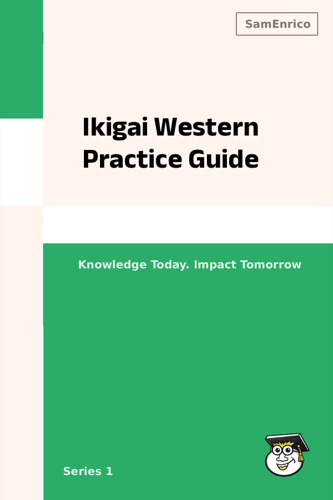
Ikigai Western Practice Guide
Adapts Japanese purpose concept to daily life.
by Gage Myesha
Adapts Japanese purpose concept to daily life.
Formats
About this book
Free sample
Chapter 1: The Five Living Pillars--–- Every morning, before your feet touch the floor, a quiet calculation happens in your brain. It takes less than a second. Your mind scans the day ahead and asks a single question: Is today worth showing up for? Most people never notice this calculation. They roll out of bed, brush their teeth, and begin the slow trudge toward evening without ever realizing that their answer to that question—their ikigai temperature—is already setting the trajectory of their entire day.If you picked up this book, chances are that your answer lately has been a lukewarm “I guess so.” Not a resounding no.
Not a suicidal despair. Just a dull, persistent meh that has become the background noise of your adult life. You get things done. You meet deadlines. You show up for people who need you.
But somewhere along the way, the why behind your getting up has become fuzzy, like a photograph left too long in the sun.You are not broken. You are not lazy. And you are certainly not alone.The Japanese word ikigai is often translated as “reason for being,” but that translation has done enormous damage in the West. It makes purpose sound like a destination—a treasure chest you locate once, open triumphantly, and then possess forever. That is not how ikigai works in Okinawa, where centenarians tend vegetable gardens not because gardening is their “passion” but because it is their Wednesday morning.
In Japan, ikigai is not a noun you find. It is a verb you perform. Repeatedly. Often imperfectly. Almost always in small ways that would never make it onto a vision board.This chapter introduces the five living pillars of ikigai—not as abstract philosophy to admire, but as five levers you can pull today to shift that morning calculation from “I guess so” to “All right, let’s see what happens.” These pillars are adapted from the work of neuroscientist Ken Mogi, but stripped of mysticism and translated into the language of behavioral psychology.
Think of them less as spiritual ideals and more as diagnostic tools. When your sense of purpose feels stuck, one…
This is the end of the free sample. Get the eBook to keep going. Buy now
Contents
- Chapter 1
- Chapter 2
- Chapter 3
- Chapter 4
- Chapter 5
- Chapter 6
- Chapter 7
- Chapter 8
- Chapter 9
- Chapter 10
- Chapter 11
- Chapter 12
Details
- Author
- Gage Myesha
- Publisher
- SamEnrico
- Language
- English
- Genre
- Non-Fiction, Self-Help, Ikigai
- Released
- 2026-06-06
- Pages (approx.)
- 124
- Available as
- eBook, Audiobook

Read better in the ZLOADR app
Your eBooks on your phone or tablet. Sign in with your SamEnrico account and start reading.
More by Gage Myesha
 Gambling Addiction and Esports BettingGage Myesha$11.99
 The Working Memory Boost GuideGage Myesha$11.99
 HIIT for ADHD FocusGage Myesha$11.99
 Government Contract NegotiationGage Myesha$11.99
 Recovering From Public MistakesGage Myesha$11.99
 Child Loss and Foster CareGage Myesha$11.99
 Divorce and FaithGage Myesha$11.99
 The Battle of the Dardanelles: Byzantine Fire vs. Viking Fury (941 AD)Gage Myesha$11.99
 Nefertiti's Vision: The Urban Mastermind of AmarnaGage Myesha$11.99
 How to Produce Motor Vehicle Loading RampsGage Myesha$11.99
 A Collector's Handbook to the Renault VivasixGage Myesha$11.99
 Generative AI Marketing GuideGage Myesha$12.99
You may also like
 Hong Kong Handover 1997Dunn Johnnie$11.99
 Zumba For Postnatal Recovery CourseNeal Christian$11.99
 Zumba for BeginnersLadner Nikia$11.99
 YouTube Comment Mining GuideHumes Pandora$12.99
 Worry Box MeditationCarlin Rudy$11.99
 Workplace Stress MeditationNguyen Lynn$11.99
 Workplace Stress and Sleep RepairHawley Ivory$11.99
 Workplace Perfectionism CureDelaney Jeffry$11.99
 Workplace Injustice Anger GuideWallen Isabelle$11.99
 Work Addiction and Burnout LinkGreenwood Ester$11.99
 Women in Yoga and WellnessBeattie Galina$11.99
 Women in Stand Up ComedyChun Evangeline$11.99